
Agility Advantage: Why Mid-Market Companies Adopt AI Faster Than Enterprise

In this episode of CFO Weekly, Amy Wang, Chief Financial Officer at Procurify, joins Megan Weis to explore what AI in finance actually looks like inside growing organizations, why mid-market companies adopt AI faster than enterprise, where automation genuinely adds value, and where human judgment still matters most. Amy brings a career that spans PwC, Solium, Morgan Stanley, Userful, and now Procurify, an AI-enhanced spend management platform built for mid-market organizations.
With firsthand experience across audit, high-growth SaaS, fintech, and capital markets, Amy has seen finance from the auditor’s chair, the scale-up, the enterprise, and now the CFO seat, where she oversees finance, people operations, legal, IT, and procurement. She shares why mid-market teams are moving faster on AI than their enterprise counterparts, how to separate real solutions from flashy demos, and why the CFO of the next two to three years will look less like a record keeper and more like a value architect.
Show/Hide Transcript
[00:00:46] Megan Weis: Welcome back to CFO Weekly. Today I’m joined by Amy Wang, Chief Financial Officer at Procurify, an AI enhanced spend management platform helping mid market organizations gain greater visibility and control over their financial operations. Amy’s experience spans high growth SaaS, fintech and capital markets, including leadership roles at Morgan Stanley, Solium, Userful and now Procurify, where she oversees not only finance, but also people operations, legal, IT and procurement. Amy is deeply focused on helping organizations build finance functions that are disciplined without becoming bureaucratic and modern without chasing hype. In this episode we’ll explore what AI and finance actually looks like inside mid market companies where automation genuinely adds value, where human judgment still matters most, and how finance leaders can make smart technology decisions in a landscape that changes almost every six months. Welcome to this episode Amy, and thank you so much for taking the time to be here with me.
[00:01:54] Amy Wang: Thanks Megan. I’m really glad to be here.
[00:01:56] Megan Weis: So to start, can you walk us through your career journey and how it shaped the way you think about technology, operations and modern finance leadership?
[00:02:06] Amy Wang: So in terms of my own career journey, it has definitely been a bit of a tour from a lot of different angles in terms of finance and accounting. I had started out my career at PwC. What I’d like to see, say as I did my time in audit insurance. But joking aside, I did really enjoy my time there. Not only did I learn a lot, but what I got to see was a lot of range. So auditing and working with a lot of different businesses from the likes of oil and gas, mom and pop shops, a lot of tech businesses as well as a lot of financial services. So you kind of started to see like the same pain points over and over, that same manual work, reconciliations, all the stuff that our teams have been consistently absorbing over time. So not long after PwC I decided to move into an industry role to a company called Solium. They’re a fintech had really a good product in terms of stock based compensation management and that’s kind of where I put on my operator gloves, really learning the business from the ground up. And it’s really where I fell in love with product first companies. And so for me it’s when the product leads and their buyers are that finance team, you really get to have a lot of different impact and input into the business itself. So at Solium, I grew into leadership roles, worked through global compliance, money movement, treasury reporting, the like. But I would say the highlight of that role was really helping the company get to its billion dollar exit over Morgan Stanley. And that’s where I had stayed on at Morgan Stanley after the acquisition, which was its own education and experience. I think that’s where I really saw behind the scenes on what enterprise really looks like. A lot of red tape and bureaucracy, but from a technology standpoint, really outdated technology. You would be surprised in terms of what they’re working with, but really like very smart people that had to work around that every day. And from there I took my first CFO role, Userful, where I was able to help own the full function in a growing tech company and help really advise and build on what the next stage of investment and technology look like. And that’s where it ultimately brought me to Procurify today where again my passion is helping improve the pain points for finance team. And so seeing what Procurify had to offer in terms of being a product for first company and what was ultimately doing for the office CFO, I wanted to be on that side in terms of building for that fix. And that’s where Procurify really sits at that intersection. Right. In terms of spend management, we’re very much built for the mid market and really these teams feel the pain points most and have the least capital and ability or resources to absorb those pain points. So I think to wrap it up, I’ve really seen finance from all angles. From that auditor chair to scale up and really inside that enterprise and now from a CFO lens. And that’s helped me really think about technology differently, about what tool stack I recommend or bring into an organization, and then thinking about how I really measure my decisions and investments.
[00:05:44] Megan Weis: Long term, amazing career so far. Congratulations on that. AI is of course all the rage right now and it’s hard to have a conversation that doesn’t revolve around that topic. But from your perspective, what does AI adoption actually look like inside a mid market company versus the enterprise narratives that we often hear about?
[00:06:05] Amy Wang: I think it is very jarring in terms of what it’s like for enterprise versus mid market. It does very much feel like two different worlds. When I was at Morgan Stanley, I really saw how long it took to change things at scale. If we wanted a new tool, if we wanted to change a process, those were years long planning. And so for some folks, they started the project and they weren’t even there to see it being executed or going live. So I think bringing it back to what AI adoption looks like for the enterprise right now, I think a lot of it really is stuck in that pilot phase, that decision phase. Some of the recent studies that we’ve seen is that Deloitte found one in five companies has a mature governance model for autonomous agents. CFO Connect also found that 68% of CFOs say they don’t know where to start. So those are jarring stats in terms of where adoption or ultimately AI fluency is at. But when we look at the mid market, I think not as much hype and noise around it. However, there’s a lot of things happening and I do think there’s actually more movement, more teams going live with AI tooling. And I think part of that is really structural in nature. There’s less analytics headcount to displace. So AI isn’t replacing an analyst or a headcount that already exists. It’s really kind of the first one a team would ever have. There’s also less change management baggage. I don’t say this lightly in terms of what mid market and enterprise comparisons look like, but change management is a big thing. There isn’t a committee that has to approve or defend how the old way of things has to be done. And so you’re working with a much simpler system set or ecosystem from a tech stack perspective. So when you think about most mid markets, you know they’re on your standard ERPs such as NetSuite, Sage Dynamics, QuickBooks, they’re not burdened by the customization, the multiple custom systems that need to be put in place. So while in practice it does look small, well defined workflows going live in weeks rather than months. We had one customer, for example, a school out in Texas that was able to centralize six and a half million in terms of spend and took approvals from a purchasing standpoint from over a week down to a day. And so I think to be fair with the enterprise, they’re not behind so much as starting from a much harder place. Definitely a different starting position. So you’re seeing different speeds in terms of adoption overall.
[00:09:01] Megan Weis: That’s really interesting because I guess I would have thought enterprises would have it, they have more money to spend it would be easier, but in a lot of ways it’s a lot harder for them to change direction in a gigantic shift.
[00:09:14] Amy Wang: Exactly.
[00:09:15] Megan Weis: So why do you think that many finance teams still struggle to separate genuinely useful AI applications from the hype? Or do they struggle at this point?
[00:09:28] Amy Wang: I think it’s a very real problem. I think it is also part of just who we are as finance folks. When you think about the typical finance or accounting individual, very much type A, very risk averse. So when finance has traditionally always been on the hook for accuracy, audibility by nature, we’re just careful and we should be. So I think we’re just fundamentally wired that way. But there’s a few reasons I think the hype is hard to see through. First off, vendors I’m sure you’re being sold to on a daily basis, they sell the model, they don’t really sell the workflow. So while you may sit on a great demo, it isn’t really a solution necessarily. But for me, I think before I really trust anything, I really want to see how the workflows are set up. What is the governance structure, what is the audit trail and then what happens when the technology or the AI itself gets something wrong? I think that’s the really telling part. The second is that I think we’re measuring the wrong thing. A lot of it is flashy. Does it feel modern? I think if that’s your mark on is this the right tool, should I trust it? You’ll definitely get burnt in that sense. I do think we have to be more prescriptive with what tests we’re using and it should be very prescriptive in the sense and very measurable. Like did it change the cycle time? Was there a specific compliance outcome or was there a decision that I can actually tie back to the tool itself? And then last but not least is really trust. Our company did a study in terms of AI readiness in finance and we saw that about 37% of organizations had said AI gave them more spend visibility, but only 30% trusted the outputs. So when you look at that stat, you see that trust is always lagging adoption. And I think that’s the gap. That gap is real and it’s the state of things right now. But as we get deeper into the products, as there’s more usage and testing, I think that gap starts to slowly close.
[00:11:46] Megan Weis: And as AI becomes more and more advanced, where do you believe that human judgment will still absolutely need to remain in the loop? For sure?
[00:11:57] Amy Wang: I think at the end of the day, AI should augment your decision making, but doesn’t replace the accountability that still needs to exist. I think you can get things done a lot faster and at higher volumes. So when I think about it, it’s really in tiers. So when you think about high stakes work, you are definitely still a human in the loop. When you think about routine work inside things where you can build clear parameters, you want a human that’s on the loop so they’re watching rather than doing. And all of that should be able to be traced back and auditable at the end of the day. I think where I wouldn’t ever really take the human out is when you think about things like onboarding a new vendor or what off policy spend looks like. When you’re revising what a baseline for budget is, when you’re reviewing exceptions that are above a certain threshold, anything that is critical judgment or judgment calls that are required, those are things I would always have in the loop. I think where AI does really earn its place in terms of being effective is when you think about automation. So when you look at routine, repetitive, really well structured work, any approvals that are kind of within your set policy things like invoice coding or three way matching, flagging exceptions, I think that’s when it does its best work and it’s able to narrow what your team needs to look at on a day to day basis, but it’s not necessarily making the decision or core judgments for them. You’ll still be in that loop. So I think for me AI should augment decision making but not replace that accountability. And so when something goes wrong, someone still has to be accountable and address the issue.
[00:13:55] Megan Weis: And I’ve read a lot about how AI is sort of replacing entry level jobs and work. So do you think we’re at risk at all of automating away the roles that actually teach people about the business and how it operates?
[00:14:12] Amy Wang: To be honest, I do think there is a risk here in the sense of I think it’s a risk, but it’s also I think an opportunity for many teams in terms of just understanding what their org structure should ultimately look like. I think a lot of the things, or I guess what I called it, grunt work or the things that taught me how to have that level of judgment I did at my entry level roles, right. Or in the junior level roles. Those are what is fundamentally being displaced by AI and tooling. Just if you have the right infrastructure or data layer in place, AI can be really effective in terms of getting those analyses to you quickly and with a lot more variations as well. So I don’t think it’s necessarily a problem that’s been solved for at this juncture, but definitely I do think it does put at risk some of those entry level roles where we’ve traditionally set those tasks too. But that being said, I think it gives you the opportunity to really evaluate your current work structure. Right in terms of where you have certain roles, I think leaner teams can now do much more versus before you would have had to allocate that capital to additional headcount. I think it’s just a different way of doing work and learning. So we’re working through that I think as an industry.
[00:15:41] Megan Weis: And you just mentioned data needing to be in place, but what else needs to be in place before an investment in AI can create meaningful value?
[00:15:52] Amy Wang: I think it is about doing an audit or review of your current tech stack. One is from an infrastructure layer. What is the ecosystem you play in, what are the pain points you’re actually trying to solve for and what are the outcomes you’re driving for? That needs to sit as number one and fundamental in terms of your evaluation, but also secondly, thinking about the people, the communication side. So putting on my operator hat, thinking about what change management needs to happen in terms of hey, your responsibilities and scope are going to look very different. Your day to day used to be a lot of manual work or administrative work. Now it’s on really high value or high stakes work in terms of judgment required. And so I think setting your team up for success in terms of having those conversations in advance and helping them be a part of that tool evaluation and helping them understand how a new workflow might fundamentally change the way they work. I think that is, is something that we don’t really maybe talk about enough or have thought about enough, but also is, I think a big blocker for a lot of finance teams in terms of hesitations to adopt technology.
[00:17:16] Megan Weis: And the tooling landscape changes incredibly fast these days. So how do you avoid constantly chasing the next platform or trend while still managing to stay innovative?
[00:17:28] Amy Wang: For me, I think I try to keep it really simple. I use three criteria when I’m looking at AI tooling. Does it really actually solve a problem or is it just adding another layer of complexity and another bill that you’re paying for? For me, I ask, “Does it change a cycle time or a decision that I can ultimately measure, does it work inside the system of record that I already have?” So thinking about things like your CRM, thinking about other tools that you have in your tech stack, does it make me adopt a new one and can it show its work? So if it’s a yes on those three, I think it’s real and I do deeper evaluation. If it’s no, I think ultimately I might be buying hype and complexity and
[00:18:19] Megan Weis: looking at the organization as a whole. How has AI changed or not changed the relationship between finance, operations, procurement and the broader business?
[00:18:30] Amy Wang: I think it’s definitely changed the relationship between finance and the business more than the org chart itself. So I think it used to be that finance had to have the data and then all the other teams or everybody had to come and ask for it. Generally that can take days or weeks and finance was often kind of as seen as the bottleneck or gatekeepers of this. But now I think people can see that data in real time and I think it’s finance’s job to really help shape the decisions being made with the data. So it’s more about insight rather than gatekeeping. And I think when we think about procurement, procurement is near and dear to me. In terms of a clearest example, it used to be the department of note. So now with budget guardrails right at the point of request, having conversations that happen before anyone actually commits, it’s not a conversation that happens weeks later when the bill lands and when we’re making the payment and a reconciliation is happening. So I think the speed is changing the tone in which we’re, hey, if approvals used to take 50 hours, now it’s taking 7 hours. Finance really stops being that bottleneck or the workaround people see it’s a relationship change and not necessarily a process change.
[00:19:58] Megan Weis: And you might have just answered this question, but you mentioned it being the office of no. I’ve heard it referred to the role of a cf no. So how can finance leaders use AI and automation to improve discipline without slowing down their teams?
[00:20:15] Amy Wang: For the business, there always needs to be checkpoints. Sometimes I describe myself to my team as kind of that speed bump in a road in terms of before we move too fast on a decision, let’s do this speed bump check. But what I would put is like bureaucracy is when you design a checkpoint for that worst 5% of cases and then you apply it to every case. What we want to drive for is discipline. So when your system is able to enforce policy automatically and then only the exceptions then come to you. So in practice that means putting budget guardrails at that point of request, soft stops and hard stops built into that intake process, and approvals being automatically routed by Department threshold and vendor risk and that’s what we have been able to build in terms of our guided intake product. So I think at the end of the day accountability doesn’t necessarily go away, but it does move the team and people from manually having to check things to policy. And then you’re seeing like that same level of accountability but definitely a lot less friction.
[00:21:30] Megan Weis: And last question, but as you look ahead, how do you see the role of CFO evolving over the next two to three years? Because there’s no way we can see out past that point.
[00:21:42] Amy Wang: Five to 10 years is a long time, the next two to three. I know, yeah, for sure. Yeah. I think it is going to be a lot of learning. I think where we’ve traditionally been that record keeper, right. In terms of reporting on things that have occurred, we kind of rebrand and move towards more of a value architect where we help kind of design and determine how value gets created in the organization. So practically speaking, I would say that means the CFO role is in the room earlier, right. When a product is being launched, when a go to market plan is being built and not really after the fact, when decisions and dollars have already been committed or moved. I think also when you think about capital allocation or cash management, it gets to become a lot more continuous, the traditional way of annual budget and won’t necessarily disappear because boards at the end of the day would still want an anchor but it stops being really like the only time we would make those decisions. So you’re continuously rebalancing, reallocating as you go, provided that you have those clear guardrails. And then I think really the CFO does become a systems designer, building out that finance ops that’s able to continuously run, run instead of just being kind of burdened by the one offs or the month end cycles. And we become that storyteller as much as a steward because numbers on their own don’t really move or motivate people or the business. And I think the pipeline changes. So I think in terms of when we talked about what the next generation looks like, the next generation of CFOs will look less like our traditional set of control and probably more like operators who are able to manage the numbers but also leverage the broader skill set.
[00:23:54] Megan Weis: Amy, thank you so much for taking the time to be here with us today and share your experience and knowledge.
[00:24:01] Amy Wang: Thank you so much. I really appreciate you having me.
[00:24:04] Megan Weis: And to all of our listeners, please tune in next week and until then, take care.
What You’ll Learn:
- Why mid-market companies are adopting AI faster than the enterprise
- How to separate genuinely useful AI applications from vendor hype
- Where humans must stay in the loop, and where AI earns its place
- How AI is changing entry-level finance roles and how learning must adapt
- A simple three-question test for evaluating any new AI tool
- How AI is shifting finance from gatekeeper to strategic partner
- What the CFO role will look like over the next two to three years
Key Takeaways:
Why Mid-Market Teams Are Moving Faster on AI
Amy describes enterprise and mid-market AI adoption as two different worlds. At Morgan Stanley, changing a tool or process meant years of planning. Today, many enterprises are still stuck in the pilot phase. Deloitte found that only one in five companies has a mature governance model for autonomous agents, and CFO Connect found that 68% of CFOs say they don’t know where to start. Mid-market teams, on the other hand, have less change management baggage and simpler tech stacks built on ERPs like NetSuite, Sage, Dynamics, and QuickBooks. One Procurify customer, a school in Texas, centralized $6.5M in spend and cut purchasing approvals from over a week to a day.
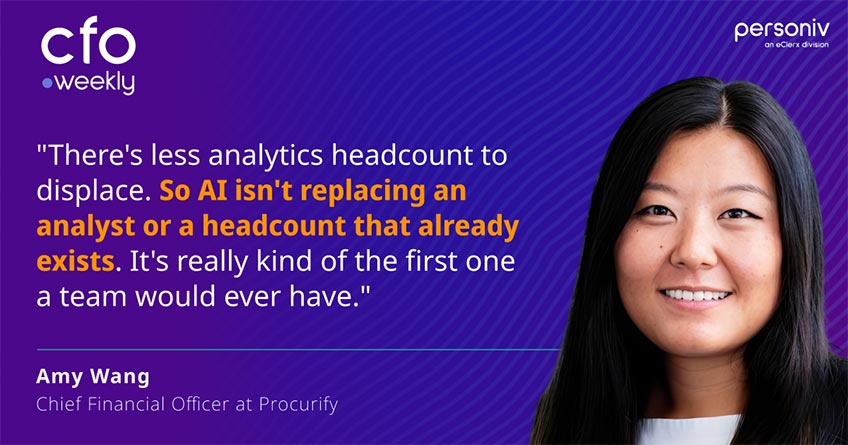
“There’s less analytics headcount to displace. So AI isn’t replacing an analyst or a headcount that already exists. It’s really kind of the first one a team would ever have.” Wang mentioned. – 00:05:44 – 00:09:01
Separating Real Solutions from the Hype
Finance professionals are wired to be careful, which makes the hype hard to see through. Amy points to three reasons: vendors sell the model rather than the workflow, teams measure the wrong things (does it feel modern?) instead of measurable outcomes like cycle time or compliance results, and trust remains the missing piece. A Procurify study on AI readiness found that 37% of organizations said AI gave them more spend visibility, but only 30% trusted the outputs. Before trusting any tool, Amy wants to see the workflow, the governance structure, the audit trail, and what happens when the AI gets something wrong.

As Wang said, “You see that trust is always lagging adoption. And I think that’s the gap.” – 00:09:15 – 00:11:46
Where Humans Stay in the Loop
Amy thinks about human oversight in tiers. High-stakes work always keeps a human in the loop. Routine work with clear parameters needs a human on the loop, watching rather than doing. Everything should remain traceable and auditable. She would never remove humans from onboarding a new vendor, reviewing off-policy spend, revising budget baselines, or approving exceptions above a threshold. AI earns its place on routine, well-structured work such as policy-based approvals, invoice coding, three-way matching, and flagging exceptions.

Wang explained during the conversation, “AI should augment your decision making, but doesn’t replace the accountability that still needs to exist.” – 00:11:46 – 00:13:55
Entry-Level Roles and What Needs to Be in Place First
Amy acknowledges that the “grunt work” that taught her judgment early in her career is the work AI is now displacing, and the industry hasn’t solved that problem yet. She also sees an opportunity for leaner teams to do more and to rethink their org structure. Before investing in AI, she recommends auditing the current tech stack to understand the ecosystem, pain points, and desired outcomes, and then preparing people through early communication, change management, and involving the team in tool evaluation. That people side, she says, is a big blocker that doesn’t get discussed enough.

“It gives you the opportunity to really evaluate your current work structure.” Wang noted. – 00:13:55 – 00:17:16
Three Criteria, Fewer Bottlenecks, and Discipline Without Bureaucracy
To avoid chasing every new platform, Amy asks three questions: Does it solve a real problem, or just add complexity and another bill? Does it change a cycle time or decision she can measure? Does it work inside the system of record she already has, and can it show its work? AI has also changed the relationship between finance and the business: data is visible in real time, so finance shifts from gatekeeper to insight partner. With budget guardrails at the point of request, approvals that once took 50 hours now take 7. Discipline means enforcing policy automatically and surfacing only the exceptions, rather than applying worst-case controls to every case.

“Bureaucracy is when you design a checkpoint for that worst 5% of cases and then you apply it to every case.” Wang remarked. – 00:17:16 – 00:21:30
The CFO as Value Architect
Looking ahead two to three years, Amy sees the CFO moving from record keeper to value architect: in the room earlier when products launch and go-to-market plans are built, managing capital allocation and cash continuously rather than only through annual budgets, and designing finance operations that run continuously instead of through month-end cycles. The CFO also becomes a storyteller as much as a steward, and the next generation will look more like operators than traditional controllers.

“We become that storyteller as much as a steward because numbers on their own don’t really move or motivate people or the business.” Wang shared. – 00:21:30 – 00:23:54
Want more insights? Explore our full library of podcast blogs here.
To listen to the full conversations, check us out on Apple Podcasts, Spotify, and our RSS or your favorite podcast player!
Instructions on how to follow, rate, and review CFO-Weekly are here.
Moving quickly is the reason why mid-market companies adopt AI faster than enterprise, but speed only works if your core operations are solid. We handle the heavy lifting of routine accounting and day-to-day finance tasks so your team has the bandwidth to move fast and adopt new tech cleanly. Reach out to learn more about how we can support your growth.


