


In this episode of CFO Weekly, Devin Weil, Chief Financial Officer at ShipMonk, joins Megan Weis to explore the most effective operational finance leadership style for CFO success. They discuss how leaders are revolutionizing operations by becoming true partners to warehouse and logistics teams. Devin brings extensive experience as a finance leader across organizations like XPO and Carrier, where he built his career inside some of the most operationally complex environments in the supply chain and logistics space.
With his deep background spanning corporate finance, performance improvement, and network operations, Devin shares how finance teams can leverage data to diagnose performance issues, drive meaningful KPIs, and build field finance organizations that sit alongside operators. Currently serving as CFO of ShipMonk, Devin oversees finance for one of the fastest-growing tech-enabled fulfillment platforms in the world, managing 12 warehouses and 1,600 employees across the globe.
Show/Hide Transcript
Megan - 0:50: Welcome back to CFO Weekly. Today, I'm chatting with Devin Weil, the chief financial officer at ShipMonk, one of the fastest growing technology driven fulfillment solution platforms in the world. With a deep background in finance leadership across organizations like XPO and Carrier, Devin has built his career inside some of the most operationally complex environments in the supply chain and logistics space. His experience spans corporate finance, performance improvement, network operations, and leading teams through transformational change. Today, we'll dive into Devin's journey, explore how CFOs can become catalysts for operational excellence, and unpack the role finance plays in driving performance, efficiency, and strategic clarity in businesses where execution is everything. Devin, thank you very much for joining me on this episode of CFO Weekly.
Devin - 1:40: Thank you very much, Megan. It's a pleasure to be here, and I appreciate the opportunity to speak with you guys today.
Megan - 1:45: Yeah. I'm looking forward to this conversation. Today's CFOs are no longer measured solely by clean closes or accurate forecasts. In operationally intense businesses like logistics and fulfillment, finance leaders are increasingly expected to sit at the center of execution, translating data into action, surfacing constraints before they become failures, and helping operators scale without losing discipline. And, Devin, you've built a career at the intersection of finance and operations, leading in complex, high volume environments where performance is won or lost on the warehouse floor as much as in the forecast. So to start us off, I'd love to go back to the moment when that path first became clear for you. Looking back to the early days of your finance career, was there maybe, like, a first experience or the moment that made you realize that you really wanted to build your path around operational performance and not just traditional accounting or FP&A?
Devin - 2:45: Absolutely. I think for me, it goes back to my very first day of grad school. I started at Honeywell, and I came into their leadership program as an operator, actually. So I was doing lean and six sigma activities on the factory floor in a fire alarm factory in Connecticut, and I was really enjoying that. It was a lot of fun. I was learning a ton about how a manufacturing operation works. I was also responsible for helping to build the budget every year for the factory, and that put me in close contact with the folks in the FP&A team and the CFO of that business just was absolutely enamored with the ability that those folks had to see the entire business. Since the chair that they sat in in finance. You saw everything happening. You saw the numbers on the page, but then you could actually see how those translated into performance out in the field, what the drivers were for that performance. I thought that was really well, for lack of a better term, I migrated very quickly for my next role at Honeywell. I migrated into FP&A really because of that experience that I had, helping to take the operational experience that I had gained on the floor and translate that into financial performance to thinking about ultimately budgeting and forecasting, which then was the backbone of kind of my career over the last twenty years or so plus in finance.
Megan - 3:55: Was it like a rotational program that you did at Honeywell?
Devin - 3:58: It was, and it was unique because most programs didn't allow you to move around between functions. Most companies didn't that wasn't something they brought you in as a finance guy and you were going to be a finance guy. And Honeywell's program allowed you to come into one function and move to another, which was really very fortunate for me.
Megan - 4:12: I love those types of programs. So that leads naturally to how you design finance teams today. How do you approach building a finance function that not only reports performance, but actively identifies operational bottlenecks and opportunities for improvement across a complex fulfillment network?
Devin - 4:30: I think that's been something that I have just developed over the years and seeing what works and what doesn't. For me, the fundamental tenet or focus that we need to have in a financial organization is being able to be operational partners. And for me, what that means practically speaking is helping the business to see around corners, understanding a story, what's happening in the business, and then helping that business to see around corners. And to me, that means you need to get finance resources as close to operators as you can. One of my recent experiences at XPO, we built out a field finance organization where one didn't exist before for that very reason. General managers were a little bit isolated from the planning process, from their own budgets, and then from a reporting standpoint, didn't have a lot of support when they got their P&Ls to be able to have someone to help explain what had happened and tell the story. So we built a field finance organization in that business from the ground up, started from scratch, added some FP&A resources to the field where the general managers now had actual finance partners working with them, and the feedback from them was tremendous. Within a few months, there was no pushback. This is fantastic. We've been waiting for this for a long time, and their performance got better. The trust that was built between the center of the organization, the central FP&A and finance organizations and the field proved pretty dramatically, rapidly, and became a true trusted business partner in that organization. And so I brought that same mentality to ShipMonk as well. And so my finance team has regular interactions with the operations folks. We spend time out in the field. I just spent most of the last ten days actually in Texas along with my team, the head of FP&A, our VP of accounting, sitting there alongside of our warehouse operators, not shaking hands, but actually packing boxes, pulling inventory off the shelf, and getting our customers their shipments. And the advantage to doing that, obviously, there's some team building aspect of that and it's good for morale, but it also allows us to really think through what's important for the operators and allows us to be able to better translate the numbers that we're seeing into reality. So it's been something that I've brought forward with me from my previous life, and I think it's made a big difference here at ShipMonk. We're pretty integrated that way.
Megan - 6:39: And before we go on, just tell us a little bit about ShipMonk, how they're differentiated, and what it is you guys do.
Devin - 6:46: Sure. ShipMonk is a tech enabled third party logistics operator providing fulfillment services primarily to direct to consumer customers. And we operate 12 locations across the globe, 12 warehouses that range anywhere from 250 to 400,000 square feet, 1,600 employees, and most of those are hourly. Whole goal in life is to make our customers' lives easier by managing their warehouse operations, their inventory, as well as their transportation needs. Running a smaller direct to consumer business, small to mid size direct to consumer business, can take a lot of that stress out of our customers and allow them to operate more efficient.
Megan - 7:24: And drawing on your experience across large scale logistics and industrial environments, what are the most effective levers a CFO can pull to drive meaningful operational efficiency?
Devin - 7:36: The number one thing for us from that standpoint is understanding what's happening in the individual business and helping to translate the numbers that the team is seeing into things that they can actually do something about. For example, driving KPIs is a big deal for us. I always like to use the example of losing weight. You want to lose weight, you look just at a number on the scale and you say, I want to lose weight. You set a goal for yourselves, and you can't get there to that goal by just looking at the scale every day. There has to be a plan underneath that. I'm going to do X amount of exercise each week, but my calories are eating certain types of foods. You have to be doing all those types of things in order to then drive the ultimate number, which is a weight number that you're trying to reach. It's the same way in business. When we set a target, the target is great, a lot of times aspirational, but you have to have a list of KPIs underneath that you're driving every single day and monitoring to make sure that you're actually doing the things that you need to to get to that ultimate target that you're trying to reach, and that's what we do here. Whether it's looking at orders per hour in our warehouses, looking at our labor statistics, looking at our revenue per order and cost per order on a very granular basis, that's what we do to make sure that we're hitting our goal weight, so to speak.
Megan - 8:50: And ShipMonk is expanding. It's adding new facilities, geographies, and capabilities. Each of those come with real execution risks. So how does finance partner with operations to ensure that expansion decisions are both strategically sound and operationally executable?
Devin - 9:08: I think at ShipMonk, one of the biggest things that I do, probably my main job on a daily basis, is capital allocation, deciding where we're going to invest our money, and that could be actual capex that we're investing in capacity. It could be how we choose to use our development resources that we have. It's a big portion of what we do. We're a tech enabled company, so software and the development of our software is a big piece of that, and capacity definitely falls into that category as well. So when we think about growing, which we're definitely in a growth mode at the moment, when we think about that, we look at what capacity we're going to need to be able to support the customers that we have in the pipeline and the types of customers that we want to service and whether those fit with our core. And for us, the core is everything, and understanding and having a good relationship with the operators allows us to make decisions around that from a strategic standpoint, which customers we bring on board, for example. Do they fit with the core? Are they in a vertical that we feel like we've got a really good handle on that we could serve well, make the customer happy, and it's still going to be something that the operators can manage and not just throw a bunch of volume at them and say, go figure it out. We try and be very strategic and selective about which customers we bring on and which ones fit and make sure that they're in that core of things that we do well.
Megan - 10:25: And in a high volume 3PL model, small variances can compound quickly. So what role should the CFO play in creating visibility into unit economics at a granular level, especially in a business with this level of operational intensity?
Devin - 10:41: The one thing about ShipMonk, and it's one thing that I really am fortunate to work here for, is that we have a ton of data. We developed our ShipMonk app, which is what our customers use and we use internally to manage our warehouses. We develop that internally and there is no shortage of data. There's not one thing I can think of that I can't go figure out a way to measure somewhere in the warehouse. And we do everything that we do, whether it's costing on particular customers, particular types of customers, whether it's our pricing and estimation, we do things at a very granular level, and we're able to do that because of the amount of data that we have and the integrity behind that data. As a practical example, when we do our forecasting for our customers, we're able to look at exactly how much it costs us to pick or pack an order for a particular customer, what that's actually costing us versus what we estimated originally, make adjustments to pricing obviously off of that, and then we forecast out that customer's volume based on what we've seen and the conversations that we have with them. So our forecast that we do on a monthly basis is the customer by customer revenue forecast and we're able to do that because of the great data that we have in our ShipMonk app and it's a great partnership with our customers as well because we're able to give them insights into what's happening in their business, both from a volume standpoint and a inventory standpoint that they may not have been able to see before. We're able to look at it from a third party view and give them some valuable advice on how to run their own business.
Megan - 12:07: That's a great value add. And when performance is lagging in a specific part of the business, how do you balance the need for rapid intervention with maintaining alignment across finance operations and commercial teams?
Devin - 12:21: When we see stuff that is different from what our expectations were or target, we look our cycles are daily and weekly. We're looking at data. So when we see something that's outside of what our expectations were in a particular warehouse, we jump on it right away. Kevin, our CEO, and myself are actively involved to make sure that when we see something that's trending the wrong direction, we get on it immediately. We talk to the operator about what's happening. We problem solve with them. It's not a you're off your number. Go figure it out. It's a collaborative process that we work with them on to figure out the best way for them to whether they need more people, they need fewer people, there's something with the building that needs to be taken care of. There's an issue with the customer forecast. We find out what the root cause is, and we work with the operators on getting that fixed. We just don't let stuff fester.
Megan - 13:07: And we touched on data, but the right data at the right time can empower operators, but too much friction can slow them down. So what technologies or data infrastructures are essential for CFOs to influence day to day operational performance without overstepping or maybe becoming a bottleneck?
Devin - 13:26: I think the key for us is the BI tools that we've chosen to use. As I mentioned before, we do have a ton of data, and we try and focus on a few key KPIs that are really going to be impactful to performance. We do get underneath those when we see one that's maybe trending not the direction that we want, but we try and keep our dashboards relatively simple. We don't overwhelm the team with 10 different things that they need to focus on. It's a handful of metrics that we focus on to start, and then if there's issues, we kind of dive in under that. But the BI tools that we use are really critical in being able to help us with that. And now with the advancements that we've seen in AI, those BI tools are not only able to tell you to help us break down where we have issues, but also they're very helpful in forecasting what the rest of the period could look like, whether it's quarter or year or even on a long range basis in some cases depending on which ones we're using. But we find a lot of value in some of the BI tools that we have available to us, and we use those very regularly in conjunction with our conversations with the operations team to make sure we're staying on track.
Megan - 14:31: And you touched on root cause analysis a bit ago, but one of the hardest parts of operational finance is diagnosis. So how do you evaluate whether a performance issue is rooted in process, people, technology, or pricing? And how does finance help surface that insight effectively?
Devin - 14:50: When we look at variance analysis, we try and get to that root cause as quickly as we can. So it depends obviously where you start in the process, but it's going to be some dashboard or some variance analysis that triggers the initial discussion. Then it's a matter of not taking the first answer that you hear as being gospel or being the truth. What we always do is ask the second or third question underneath that, so don't assume anything. We operate here in a culture where it's okay to ask questions. People don't get defensive about being asked questions. They understand where it's coming from. They understand best intent is what's behind it, and we pull apart each one of those until we figure out what the issue was, and then we go and address that. I think one of the things that we have seen over the last year or so that I've been here is our customer forecasts are not always super accurate. We have a lot of customers that struggle with their forecast, and we have very regular conversations with them, but a lot of it's driven outside of their control by external factors because we're dealing with end consumers. And then taking that and moving that back into a labor hour forecast for a warehouse, for example, you've got a customer forecast, here's what they're saying is going to happen. The reality comes in differently and they've planned differently and now they've got a variance, maybe they've got too much labor on the floor versus what they anticipated. Isolating that and saying, did you really manage your labor the right way? Let's look at your underutilized time, for example, in that warehouse versus the number of people that you had, or was it really customer forecast was really optimistic, and we need to tone that back going forward from a finance perspective when we put the customer forecast together. I think we take a pretty non excusable approach to our root cause and that the most important thing is getting to the bottom of it and then solving it together as a team. Make the same mistake four or five times, and that's an issue. People are going to make mistakes, and we take that into consideration when we do our variance analysis that way.
Megan - 16:37: And as you just mentioned, many organizations struggle to connect financial plans what actually happens on the ground. So how do you ensure that ShipMonk's operators feel true ownership over financial targets while still empowering finance to challenge assumptions and course correct when needed?
Devin - 16:55: We do it through a mix of top down and bottoms up. I will say that I've seen it every possible way you can think of over the years where we're only going to do top down plans or we're only going to do bottoms up plans, and we use a hybrid at ShipMonk, where we've got a target in mind that we're trying to go after, and then we work with the operators to develop the best scenario we can to get to that target from the bottoms up. And then to the extent there's a gap, there's a negotiation, and that negotiation is, I think, what really makes or breaks the success of a plan. So just sending out a target to an operator and saying you gotta get to this orders per hour number or this cost per order number for your warehouse next year, have a nice day, there has to be some way for them to get there. And so they start with their bottoms up approach, and then we build that bridge. And through the negotiation in that process is how we get there. Does it take a little bit longer? It does. But it also really improves the buy in from the operators about what they're actually trying to do and doesn't make them feel like they're just hitting a target shoved down their throat.
Megan - 17:53: And, ultimately, all of this ties back to the customer. So as expectations around speed, accuracy, and cost continue to rise, how does finance help prioritize which operational improvements will deliver the highest ROI both for the business and for customers?
Devin - 18:10: I think that's the big piece of what we do on a daily basis. Like I was saying before, capital allocation and investment decisions is part of what I do on a regular daily basis. It's practically the heart of everything that we do. So what we like to try and do is just what you said, which is look at the investments that are going to provide us the highest ROI. And where that comes into play from a practical standpoint is looking at new customers that we're planning to bring on board, for example. We're involved in that pricing discussion in the beginning as we bid work with customers and making sure that the targets that we wind up agree to with our customers are in line with what we're trying to do in our five year plan and that we're going to then ultimately meet our investment objectives or investors' objectives for growth on the top line and EBITDA. I think that's one of the other place where we see a lot of this from an investment analysis standpoint is in capacity. Real estate falls under my purview, and when we think about growth, which as I said before, we're right in the middle of what I would say a pretty substantial growth period right now at ShipMonk, making sure that we're staying just far enough ahead on the capacity is a sweet spot. We don't want to be behind to make sure that we've got the right capacity in place that we can serve customers, but we also don't want to add things too fast so that we're sitting there with underutilized capacity. So that's really where we play an important role, getting the right capacity from a pricing standpoint, rent amount that we want to pay for a particular location, and making sure that it's placed at the right time, and it's going to support our, ultimately, our margin objectives and for us to continue to stay profitable.
Megan - 19:44: And we've talked a lot about finance as an operating partner from diagnosing performance issues to shaping expansion decisions and aligning teams around execution. So to close us out, I'd love to look forward. Looking ahead, what defines the future ready CFO, both in terms of critical new skills and mindset?
Devin - 20:03: It's evolved over the years. When I first came into this function twenty plus years ago, a lot of CPAs, I think, was making sure that the folks in the records were after it, and FP&A was kinda there just to keep the little bit of a guardrail, I guess, on where the company is headed. That's changed a lot now. I think just with organizations in general, so I think you're expected to do more. I think the value in what we provide has been recognized as well. So because of where we sit and the fact that we can see the entire business so we can translate what's happening on the floor to what's happening in the numbers. The CEOs and operators have recognized the value that we can bring, and we're not just be kind of sitting on the sidelines asking questions that are annoying to them. We get involved. We help make value add decisions, and I think that's been really critical transformation. So going forward, I think that trend is going to continue, but I also think we have the added benefit now of the, I think, the incredible technology we have on the AI side. I mean, we use AI now for simple variance analysis with our BI tools that we have. We use it for top level forecasting.
Megan - 21:09: Devin, thank you so much for your time today. I appreciate you being here to share your insights with us.
Devin - 21:16: Great. Yeah. It was my pleasure. I really enjoyed speaking with you, Megan, and look forward to hearing how this comes out.
Megan - 21:22: To all of our listeners, please tune in next week, and until then, take care. You've been listening to CFO Weekly presented by Personiv. Please subscribe wherever you get your podcast to hear all of our episodes. Want to learn more? Check out personiv.com. Thanks for listening.
What You'll Learn:
-
Why CFOs must embed finance resources directly in operations for maximum impact
-
How to balance top-down targets with bottoms-up planning to drive operator buy-in
-
The critical role of granular unit economics in high-volume logistics businesses
-
Strategies for rapid performance intervention without becoming a bottleneck
-
How robust data infrastructure enables both visibility and speed
-
The evolution of the CFO role from financial oversight to operational partnership
Key Takeaways:
Simplified Fulfillment Management
Simplifying logistics by embedding technology and operational expertise directly into warehouse and fulfillment operations, removing complexity so direct-to-consumer brands can operate more efficiently and focus on scaling.
"Small to mid size direct to consumer businesses can take a lot of that stress out of our customers and allow them to operate more efficiently." Weil explained. - 00:04:30 - 00:06:39
KPI-Driven Performance Management: A Core Element of Operational Finance Leadership for CFOs
Operational efficiency isn’t just about hitting high-level targets, it’s about translating numbers into actionable steps. By tracking granular KPIs like orders per hour, labor stats, and cost per order, teams can focus on the daily actions that ultimately drive bigger business outcomes.
“You set a goal for yourselves, and you can't get to that goal by just looking, there has to be a plan underneath that.“ Weil revealed. - 00:07:24 - 00:08:50
Data-Driven Visibility
Granular data transforms operational oversight into actionable insights. By measuring costs, pricing, and order metrics at a detailed level, CFOs can create accurate forecasts, optimize unit economics, and provide customers with valuable guidance to improve their own operations.
“Forecast that we do on a monthly basis is the customer by customer revenue forecast and we're able to do that because of the great data that we have in our ShipMonk app.” Weil commented. - 00:10:25 - 00:12:07
Hybrid Planning Approach
Connecting financial targets to operational realities requires a hybrid approach. By combining top-down goals with bottoms-up planning and negotiation, operators gain ownership of their metrics while finance ensures alignment and course correction, creating buy-in and more achievable outcomes.
"We work with the operators to develop the best scenario to get to that target from the bottom up. And then to the extent there's a gap, there's a negotiation, and that negotiation is what really makes or breaks the success of a plan." Weil mentioned. - 00:16:37 - 00:17:53
The Future-Ready Operational Finance Leadership Style CFO
Modern CFOs have evolved from financial gatekeepers to recognized strategic partners. The combination of operational partnership, advanced analytics, and AI-powered tools enables finance to drive value-add decisions rather than simply asking questions from the sidelines.
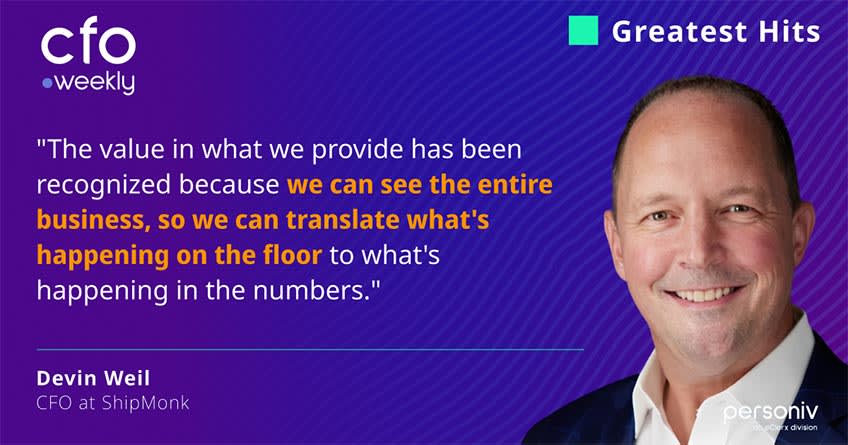
"The value in what we provide has been recognized because we can see the entire business, so we can translate what's happening on the floor to what's happening in the numbers." Weil said. - 00:20:03 - 00:21:09
Want more insights? Explore our full library of podcast blogs here.
To listen to the full conversations, check us out on Apple Podcasts, Spotify, and our RSS or your favorite podcast player!
Instructions on how to follow, rate, and review CFO-Weekly are here.
Ready to optimize your operations? We deliver premier finance and accounting solutions tailored to support CFOs looking to drive efficiency and growth. Drop us a line today to learn more.


