


In this episode of CFO Weekly, Courtney Stoner, VP of Finance Shared Services at Iron Mountain, joins Megan Weis to explore why the companies that win with agentic AI are the ones that redesign their processes first and add technology second, and why every finance leader needs to become a student again. Courtney brings a rare blend of operational and financial fluency, shaped by a career that began in civil engineering and now spans operations, commercial leadership, M&A, and finance.
With a foundation built as an operational forecast analyst and a three-year stint as a technical auditor, Courtney has spent her career connecting how a business runs with how it creates financial value. She shares a practical framework for evaluating AI use cases, explains where agentic AI can run on its own and where human judgment must stay in the loop, and unpacks the metrics CFOs should track beyond hours saved. She also covers how to redesign controls for an agentic world, how to keep AI from becoming a black box, and why a messy data foundation is no reason to sit on the sidelines.
Show/Hide Transcript
[00:46] Megan: Today I'm joined by Courtney Stoner, Finance, Shared Services and Operational Excellence VP who has held roles at Iron Mountain, GE Renova and GE Aerospace. Courtney brings nearly two decades of experience across finance, operations, commercial leadership, M and A, and business transformation, with experience spanning energy, locomotive and aircraft engine services, and audit and advisory. In this episode we'll explore how CFOs can move beyond the generative AI hype cycle and build a practical playbook for agentic AI, from choosing the right use cases and measuring ROI to redesigning workflows and keeping human judgment where it matters. In this episode, we'll explore how CFOs can move beyond the generative AI hype cycle and build a practical playbook for agentic AI, from choosing the right use cases and measuring ROI to redesigning workflows and keeping human judgment where it matters. Welcome to the show, Courtney, and thank you so much for being here with me today.
[01:48] Courtney: Thanks Megan, for having me. I'm excited to talk about the wonderful things happening in the world of AI
[01:55] Megan: Finance and accounting and AI. It's very exciting place to be these days. So you actually started out in civil engineering before building a career across operations, commercial leadership, M and A, and finance. So looking back, was there a moment along that journey when you realized that your real strength was connecting how a business operates with how it creates financial value?
[02:20] Courtney: Megan, that's a great question. I realized my real strength was connecting operations to financial value very young in my career when I was a operational Forecast analyst and in that role we had to forecast out maintenance events and required work scopes. But I would do something additional. I would always include this, so what Summary? And that summary would be things like, hey look, this year's forecast has more events than last year. Our budget doesn't have the material cost for that. Or this forecast has more repairs than last year. We don't have the labor for that. And I started to make those connections in that role and my managers loved it. And so I spent further parts of my career just honing that through financial roles.
[03:09] Megan: I'm just curious, how did you make where along the way did you switch from engineering to finance? And did that require you to go back to school at all?
[03:19] Courtney: That's a great question. I switched in 2009, I was in meetings and struggling to keep up with how the CFO was explaining the various levers of the business. So I joined a financial program called Audit Staff and became a technical auditor for three years. And I traveled to different businesses every three months, auditing their balance sheet and income statements, reporting out to CFOs what I saw in terms of risk and opportunity. And that was my schooling, if you will. And three years later, coming out of that program, I was able to feel more confident and more clearly see the connectors between business models, operations and finance. And doing that across industrial businesses, heavy manufacturing businesses, and financial service businesses.
[04:11] Megan: That's really cool. I've never heard of such a program. And you've spent much of your career improving performance inside large, complex operations. How has that experience shaped the way that you look at AI today? Especially when everyone is promising transformational results,
[04:28] Courtney: You're trying to improve performance inside a large, complex operation. You need two things. Clear understanding of the activities, the people doing them, process, and the tech involved. And then you need to know how those items impact the customer. And this thought leadership around understanding the work that's happening is the exact same thought leadership you need when developing a solution. Benefits can only be realized when you have clarity into what your team is doing, what activities are being executed, and where the AI can further optimize and enable that process. I do agree there are a ton of promises when it comes to AI benefits, but that promise is on the technology itself and on the capabilities. Businesses have to identify if those capabilities are complementary to solving their needs. And only then can you drive towards savings.
[05:27] Megan: And we've spent the last few years hearing about generative AI, and now the focus is more on agentic AI. So from a CFO's perspective, what's meaningfully different about this next phase?
[05:42] Courtney: I'm excited about the next phase. The next phase is meaningful because the technology can partner with you and it can work toward goals, proactive goals. So for example, if your CFO says, hey Courtney, we have to get our AR under control and we need to reduce our past dues, we the agentic AI can help build workflows to trigger outreach when a risk signal is observed. And similarly on ap, if the goal is to have a stable payment, cash run, workflows can be built to proactively manage and resolve discrepancies that could prevent that. And so I think in this era we should be thinking about how can we proactively manage our business and use agentic AI as our partner.
[06:30] Megan: And I know it's important to have a clean process to start or a process that's actually pretty well optimized. Are you seeing AI helping people to optimize processes or is that still something that needs to be done within the organization to start?
[06:51] Courtney: That is the absolute starting point. And in order for a business to even decide what technology solution is helpful for them, they have to have a clear articulation of their current state operation and their current state process. And Megan, it has to be end to end. It has to start with the customer and end with the customer. And then the business seems to have a vision of what do they want the future state process to be and how their teams are impacted by that. And once that reengineering is complete, then you talk about technology because you have an idea it's prescriptive of. This is my end to end process and these are the activities involved, this is where my team is involved. And then what technologies can help me further optimize that.
[07:41] Megan: And when a finance leader is presented with, let's say, 10 possible AI use cases, how do you decide which of those is actually worth pursuing and which order they're pursued in and which has to be true? What has to be true for you to say there's a business case here?
[08:00] Courtney: Yeah, I love that question. And first I want to say if someone comes to you with 10 ideas, thank goodness they're ideating on how they can use the technology and they're trying to be part of the conversation. In terms of what I like to see from a diagnostic perspective is I love for teams to be able to come in and tell me what is happening in the current state, what is the team executing, what is the end to end process, what are the process metrics of that current state, how do they compare to best in class? And then what's our stakeholder feedback? And then root that with the problem statement. And I think it's really important for teams to be able to articulate what is the problem in the current state. And then I like to see based on that problem definition, what is our hypothesis of what the future state could be to reach a new best in class metric, a new business goal or financial goal. And then lastly inform what activities in that future state would need to be enabled by AI. And that tells me, number one, that the team has done the upfront due diligence of what's breaking in the current state are not aligned to what to the financial goals of the company. And the team has thought about their future state and they're designing for sustainability. And when that's complete, the team will be able to articulate and calculate hey look, if we reduce this human capital work with agentic flow, these are the financial outcomes that we'll see because we've improved our operational process that's tied to either revenue or ebitda.
[09:43] Megan: And shared services seem like a natural testing ground because there's so many repeatable high volume processes. Where do you see the strongest opportunities for agentic AI in finance shared services and where would you still be cautious?
[10:00] Courtney: I love the order to cash space. It's a space that has several repeatable high volume transactions and several of those transactions are what I like to call low human accountability where you're doing outreach, you're doing assessments, you're referencing the customer's past dues with their communication, and then you're drafting tailored payment reminders adjusted for tone and sentiment to remind the client that they have an overdue It's a wonderful place to pilot test and then roll out. Another place that I love is customer contact data management. I think we've all heard in the shared service space we struggle with keeping contacts up to date, addresses, emails and using agentic agents internally to monitor where there's discrepancies or changes in customer data and generating workflows to resolve those. With the various needs in the business, I would still be cautious on heavy month end close type activities. So subledger to GL reconciliations, bank feeds, audits, variance analysis. These are the type of activities where agentic can help you prep, but you still need that judgment human expertise to review, sign off and close. I would encourage us to not just think of the agentic agents as autonomous on these low human accountability tasks like in order to cash, but in high human accountability tasks like in month and close I would be thinking about then how they can help me prep before I post and let's talk about ROI
[11:46] Megan: because that's where the hype eventually meets reality. What should CFOs actually measure when evaluating an agentic AI initiative beyond simple hours saved or headcount avoided?
[11:58] Courtney: I love this question because it speaks to how if you implement the agentic AI from a process and people perspective, then you truly understand that your metrics will probably need to change, be modified or some of them will need to be retired. And so I would be asking as a cfo, you know, what's your agentic completion rate for your agents? How many times did you have a human in the loop escalation or did you have a human override? I would be laser focused on did we reduce the end to end cycle time because we've injected some agentic automation? And then lastly I would be asking for what are the changes in our core SLAs? Did we have 24 hour response time for service centers? Did we have 48 hour response on AP reconciliations? And then lastly I would be looking at changes in customer satisfaction before and after the CSAT. It bore for and after the agentic AI.
[13:03] Megan: And you've led cost control and performance improvement initiatives throughout your career. Have those experiences changed how you think about the difference between automating a task and actually improving the underlying process? And I know we touched on this
[13:18] Courtney: a bit already, so we did. And I love this question because earlier in my journey I did consider automation to be process improvement. And I've learned over time that when you're executing process improvement, you're challenging the status quo and your goal is to eliminate waste, remove bureaucracy, empower your teams, improve the employee experience and then drive business value. And all of that happens before technology enters the discussion. And I think that's really paramount and to really want to emphasize that because that's how you drive sustainability. Once you apply the the technology is because you flushed out and removed all of the noise, the waste, the bureaucracy, unnecessary handoffs, and you're injecting technology into
[14:11] Megan: a gold standard process and controls accountability. These are big, big topics these days. Agentic AI can potentially take action rather than simply just surfacing information. So how does that change the conversation around controls and human oversight? Ins, finance?
[14:32] Courtney: Yeah, I think it presents a wonderful opportunity to redesign controls and finance oversight frameworks with internal audit committees as part of the path and the process to implement agentic AI, there should be very prescriptive documentation on these are the decision rules of the agentic AI. These are the escalation rules of the agentic AI. These are the thresholds that the agentic AI can execute before the human is entered into the process. And all of that should be part of the package before you go live and essentially should be how the controls are designed. And so earlier in our conversation I talked about two type of tasks, Low human accountability and high human accountability. Even though I'm saying low human accountability, you still need oversight and you still need an audit plan and a control plan that checks. If my email triggers for example age debt went out on time, did my agentic AP agent find all the discrepancies before the cash run? Are they resolving things without my human approval? The audit test plan around your future state has to keep in mind the new thresholds you've given your agentic AI. In the high accountability ones that I mentioned, the cure review, prep, accrual review prep, heavy human engagement. I think it's management controls. How do you check and ensure that the prep that your identic agent has completed gets you to the right answer before you post? And why I say it's exciting it's because I believe that we could use this new world of agentic AI to build out broader roles in the audit committee for how do we set ourselves up for success and redesign our control framework and partner with the business as they go on this journey?
[16:32] Megan: And what advice do you have for people working with agentic AI to actually understand what's going on inside what could just be a black box and truly question what's coming out of it.
[16:47] Courtney: My first piece of advice for finance professionals and executives that are working in this space is that the change has to be done with the employee and having a program that implements AI, I would definitely recommend pulling SMEs from execution that can be your voice of the customer and then go back and advocate for other team members who may use the solution that these are the decisions that's being made and this is why it's advantageous for us to adopt it. I think on the other side, for those of us who are building and developing these for others to use, we have to build with transparency and we have to build with collaborative partnership and publish like you would a normal functional spec for an erp. What it is we've designed the agent to do and bring the organization, the employees along on the journey so that it isn't a black box as you say. Or the employee doesn't spend time fact checking what the agent's telling them because they didn't have the underlying understanding for what it's doing. And so I believe both sides of success looks like the employees being brought into the build and being part of the sign off and review and then the builders collaborating, proactively documenting and sharing what those triggers and decisions are.
[18:16] Megan: And I know we've touched on how important it is to get the process right to begin with, but you've also worked extensively in M and A and integration. So when companies already have different systems and data standards that are just been stitched together over time. How important is getting that foundation right before introducing AI agents? So I guess this question is more about underlying technology.
[18:42] Courtney: With the pace of M and A, you know, today I know it's on everyone's mind and it is important. Your data has to be stitched together in a manner that it can be pulled and used inside these systems. And if you're a company and you're on multiple erps, you don't have a line of sight into one platform. I would be thinking about what's the structure of my data warehouse and my data lake. And I would be thinking about, even if my data sits in different systems, does it look the same when it's ingested into our data lake in our data tables? And then have we thought about how to translate all of our data in different pockets so that we can bulletin reporting, we can understand our operation and then we can build systems around it. My advice is if your company doesn't have a data lake or a data table that houses all of your information from multiple systems, then I would be thinking about how can I do something more localized where the data structure is clean and it's understood, and starting in small pockets where there's clarity on what's being ingested, the timing and the sequence. I would also encourage individuals and companies to not remove themselves from adopting it. If your data structure isn't as clean as you want it to be, I would set yourself up on a roadmap that helps you understand, where is my data clean or better than the most? And where can I start piloting and getting my company to ideate and be entrepreneurial on how we could use this in our operation? Because that would also help inform you if you move toward a data lake system, how do you design your data structure so that you can scale it across your business?
[20:39] Megan: And looking ahead, how do you see the role of the CFO evolving over the next, say, two to three years? Because I don't even think we can predict five to 10 years out of it anymore. And what new skills or mindsets are going to be critical as CFOs become more integrated into shaping company strategy and culture?
[20:58] Courtney: Oh, your first question. The most fun I've had with my CFOs have been where we're in operations together. We're talking the same language. We are talking about what we've built, what we've shipped, and how that flows into our financial statements. And we just talked earlier about what different metrics will we need to establish with AI. Those are operational metrics, those are value driver tree metrics that help you understand the health of the business. And I'm excited for CFOs to embrace that. To embrace getting excited about understanding how the operations is performing and then holding their teams accountable for that, materializing in P and L and having really great discussions around that. I think for the Chief accounting Officer roles, you know I'm excited for them as well. As I mentioned earlier with thoughts on how you expand and create new things in the in your audit committee. But I would say let's be open minded and think through how we can help our business partners get to the answer faster by incorporating some cool snazzy things into the month end close process so we understand the health of the business and our business results as it relates to this technology. My thought process, Megan, is that everyone has to be a student again. Whether it's a free webinar on Google's website or the Academy in Claude or something on course we all have to become students again and really demystify for ourselves. What is this hype about and can it really help me and my team deliver for the customer and do so in a cost effective manner? I believe that that will help companies adopt something that works for them versus adopting something because it's popular on the news.
[23:03] Megan: Great answer. And Courtney, thank you so much for taking the time to be here with me today. I really appreciate the insight you've given us.
[23:12] Courtney: Thanks Megan. I love the podcast. Love to keep the conversation going. Thanks so much.
[23:17] Megan: Yep. And to all of our listeners, please tune in next week. And until then, take care.
What You'll Learn:
-
Why process re-engineering must come before any technology decision
-
How to evaluate AI use cases with a diagnostic that ties directly to revenue or EBITDA
-
Where agentic AI works best in shared services, and where to stay cautious
-
The ROI metrics that matter beyond hours saved and headcount avoided
-
How to design controls, audit plans, and oversight for AI agents
-
How to start with AI when your data foundation isn't perfect
-
Why every finance leader needs to become a student again
Key Takeaways:
Fix the Process First, Then Pick the Tech
Here is the uncomfortable truth about agentic AI: the technology is rarely the starting point. Courtney is blunt that every business must first map its current state end to end, from the customer's first touch to the customer's last, and decide what the future state should look like. Only after that re-engineering is done does the technology conversation begin. When a team arrives with ten shiny use cases, she wants a diagnostic, not a wish list: what is happening today, how it compares to best in class, what stakeholders are saying, and what problem is actually being solved. Then comes the payoff test. Can the team calculate the financial outcome tied to revenue or EBITDA? If they can, you have a business case. If they can't, you have a demo.
“It has to be end to end. It has to start with the customer and end with the customer.” Stoner commented. - 00:04:10 – 00:08:41
Low Accountability Gets Autonomy. High Accountability Gets a Co-Pilot
Not every finance task deserves the same level of trust in AI. Courtney sorts work into two buckets. In order to cash, with its repeatable, high-volume, low human accountability tasks like tailored payment reminders and customer contact data cleanup, agents can run with real autonomy. It is the ideal pilot ground. But heavy month-end close work, including subledger to GL reconciliations, bank feeds, audits, and variance analysis, is a different story. Agents can do the prep. Humans still review, sign off, and close. It is a simple mental model that keeps ambition high and risk in check.
“In high human accountability tasks like in month end close, I would be thinking about how they can help me prepare before I post.” Stoner shared. - 00:08:41 – 00:10:51
Stop Counting Hours Saved
If your only AI scorecard is hours saved, you are measuring the wrong thing. Courtney says that once you truly implement agentic AI, your metrics will change, and some will need to be retired altogether. She points CFOs toward agentic completion rate, the frequency of human escalations and overrides, end-to-end cycle time, changes in core SLAs, and customer satisfaction before and after. She also shares a lesson from her own journey: she once mistook automation for process improvement. Real improvement means challenging the status quo, eliminating waste, and removing bureaucracy before technology ever enters the room. Automate a broken process and you get a faster broken process.
As Stoner said, “You're injecting technology into a gold standard process.” - 00:11:08 – 00:13:32
Build Controls Before You Go Live and Never Ship a Black Box
Agentic AI doesn't just surface information. It acts. That makes this the moment to redesign controls alongside internal audit and the audit committee. Courtney calls for prescriptive documentation before launch: decision rules, escalation rules, and the thresholds an agent can act on before a human steps in. Even low-accountability agents need an audit plan, and high-accountability work needs management controls that confirm the agent's prep gets to the right answer before anything posts. Just as important is the human side. Bring subject matter experts into the build and the sign-off, and publish what the agent does the way you would publish a functional spec for an ERP. When people understand what the agent is doing, they stop fact-checking it and start trusting it.
“We have to build with transparency and we have to build with collaborative partnership.” Stoner mentioned. - 00:13:52 – 00:17:57
Your Data Doesn't Have to Be Perfect to Start
M&A has left many companies running on multiple ERPs with no single line of sight. Courtney's advice is neither to wait for perfection nor to charge ahead blindly. Ask whether data that lives in different systems looks the same once it lands in your data lake or data tables. If you don't have a unified lake yet, start small and local, in pockets where the data structure is clean and the timing and sequence of ingestion are well understood. Build a roadmap that shows where your data is already strong, pilot there, and let your teams get entrepreneurial. Those early wins will also teach you how to design a data structure that scales across the business.
“Does it look the same when it's ingested into our data lake in our data tables?” Stoner pointed out. - 00:17:57 – 00:20:41
Why Every Finance Leader Needs to Become a Student Again
Courtney's best moments with CFOs have come when finance and operations share a language: what we built, what we shipped, and how it flows into the financial statements. She expects the AI era to push that even further, with new operational and value driver metrics becoming part of the CFO's vocabulary and chief accounting officers finding creative ways to speed up the close. Her prescription is humble and practical. Everyone, from the CFO to the analyst, has to become a student again, whether through a free webinar, an academy course, or Coursera. The goal is to demystify the hype and adopt what actually works for your team and your customer, not what happens to be trending in the news.
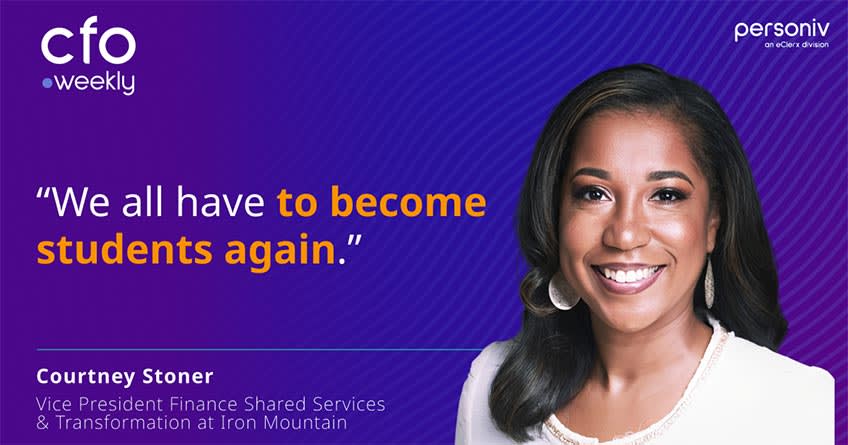
“We all have to become students again.” Stoner remarked. - 00:20:41 – 00:23:16
Want more insights? Explore our full library of podcast blogs here.
To listen to the full conversations, check us out on Apple Podcasts, Spotify, and our RSS or your favorite podcast player!
Instructions on how to follow, rate, and review CFO-Weekly are here.
Why every finance leader needs to become a student again comes down to one thing: having the time to actually rethink how your team works. But if you're stuck in month-end closes, that learning never happens. We handle the routine accounting work so you have the room to lead. Get in touch to see how we can help.


