


In this episode of CFO Weekly, David Liu, Chief Financial Officer at SuccessKPI, joins Megan Weis to explore the debate over breadth vs. specialization for CFO readiness, unpacking what it truly takes to grow into the role, from early rotational programs to navigating career pivots across vastly different organizations. David brings a grounded, experience-driven perspective shaped by roles at GE Capital, Amazon, Framebridge, and high-growth SaaS companies, ultimately stepping into the CFO seat at SuccessKPI, an AI-driven platform helping organizations transform customer experience through data and automation.
With a career defined by intentional learning, cross-functional curiosity, and a willingness to embrace uncertainty, David shares how exposure to diverse environments both large enterprises and scrappy startups, built the judgment and perspective needed to lead at the executive level. Currently serving as CFO at SuccessKPI, he offers candid advice for aspiring finance leaders on what accelerates the path to the CFO role and what common missteps to avoid.
Show/Hide Transcript
Megan - 00:50
Welcome back to CFO Weekly. Today, I'm joined by David Liu, chief financial officer at SuccessKPI, an AI-driven platform helping organizations transform customer experience through data and automation. David has built his career across a range of finance roles, from risk management at Citigroup to finance leadership positions at Amazon, Framebridge, and high-growth SaaS companies, ultimately stepping into the CFO role at SuccessKPI. In this episode, we'll explore David's career journey to the CFO seat, the pivotal decisions and experiences that shaped his path, and what aspiring finance leaders can learn about building the skills and perspective needed to step into a top finance role. Welcome, David. I'm so honored to have you on the show today.
David - 01:45
Hey, Megan. Great to be here. Thank you.
Megan - 01:48
So if you go back to your early days in finance, was there a moment when you first thought that you definitely wanted to be a CFO or did that ambition take shape later as your career evolved?
David - 02:01
At least for me, having majored in finance undergrad and feeling relatively sure about what I wanted to do, I think most people with that background think immediately, I want to be CFO. That's the top spot. For me, early on, I did want to be a CFO. That was one of the first things I thought when I began my career. I think the interesting thing about that is you don't necessarily know what that means or just everything that's wrapped into that. That's something that I had to learn over the course of my career.
As you grow and as you change roles and as you develop, wanting to be a CFO might not necessarily be as clear as it was when you first started your career, but ultimately later on in my career when I really set my sights on wanting to be a CFO, it was because I felt like that's where I could have the most impact on the business—in a financial leadership role. So a little bit of a journey there, but the reality is it's ever-evolving and it's something that took a little bit of time to really solidify despite having that early ambition.
Megan - 03:06
And looking back, which role or experience do you think most accelerated your path toward becoming a CFO?
David - 03:12
It's interesting because it's really early in my career. I think the most defining role in my career, even now prior to the current role that I have, was GE's Financial Management Program right out of college. It was a two-year rotational program, took associates across various business units at GE Capital and across various functions. In addition, we had coursework taught by the professionals at those same businesses. A course teacher was somebody's boss that was an associate in the Financial Management Program, or FMP, as we called it. So it just gave me a much broader set of experiences and perspectives from different professionals in a really compressed amount of time.
In addition, it gave me a lot of interaction with great peers. There's a little bit of competition in that program as well, so we were all pretty ambitious and worked really hard, but we had a lot of great fellowship and I've made some of my closest friends through that program—people that I keep in touch with pretty regularly today. I think the way it's accelerated that journey towards CFO is just that breadth and experience. People say there's a compounding effect, right? I got a big chunk from that program early on, and I think that's paid dividends throughout my career.
Megan - 04:24
Yeah. I've always heard amazing things about that program, and I think it produces a lot of leaders. I'm surprised that more organizations don't have something similar.
David - 04:33
I do share about rotation programs here and there, and maybe it's a little bit of bias, but during the time I was there and even thereafter, my impression was always a lot of those programs at GE—it wasn't the first one, but GE, I think, was the best one. As I hear about these programs, I think the main difference is just there is a continuity and I might even say a heritage to it. The CFO of GE Capital was himself in that program. There are many very senior leaders that we had access to that we would have never had access to in any other situation that early in our careers. Just to see the way that they approached decision-making, their demeanor, the way they carry themselves, the way they thought about problems made some of those executive-level decision-making and action-taking seem very familiar and at home at a time in our careers where we were potentially decades away from being in those same roles. Again, it was just one of those things early on that just pays such dividends throughout your entire career.
Megan - 05:34
And you've moved across industries and roles from risk to analytics to finance leadership. So how intentional were those moves, and how did they shape your perspective as a finance leader?
David - 05:46
Well, I like to say that there was some grand plan, but the reality is that life and the world around me played just as much of a role as any kind of career plan. Early in my career, it was around 2008. I had a couple years of work experience behind me, but in 2008, there was a financial crisis that was brewing and really became the major driver of the economy. So I think the path that I and many of my peers had envisioned up to that point didn't seem so certain anymore.
With that said, I learned early on in my career not to fear change. In fact, as I said with the rotational program, I spent most of my time rotating to a new role and new business every six months. I think the important thing that I kept in mind was just to keep learning and developing my skills as both a practitioner and a potential leader one day. It's the reason why I kept looking for new challenges, and looking back across my LinkedIn or my resume, it's fun to see how many different places I've been and how many things I've done. Always keeping that attitude and that curiosity to learn new and different things is probably the main driver for why I've had a diverse set of experiences. Again, I think all of those things play an important role in becoming a finance leader because you do have to know a wide variety of things and a wide variety of approaches. The world has a lot of uncertainty and experience counts when it comes to that.
Megan - 07:08
Along those same lines of diverse experience, you've worked at both large organizations like Amazon and GE and smaller high-growth companies. How did those different environments prepare you for the CFO role in different ways?
David - 07:23
I'd say it's not variety for its own sake. What you get from a lot of these places—having worked at a diverse profile of companies—is an understanding of what works and why. Many times people who've been in a place for a very long time have some understanding of some process or why things are the way they are, but until it's tested, you don't really know. Just having seen how things work at larger companies and how things work at smaller companies, you realize that the same playbooks don't necessarily work from company to company. Some of it has to do with the internal dynamics of the company, but a lot of it has to do with just what a company needs at a particular stage.
As I mentioned, I was at GE Capital—a lot of controls, a lot of infrastructure, a lot of technology support back every decision. I think the same thing is very much true at Amazon. They try their best to make everything knowable so that everything can be analyzed and improved upon. But the reality is smaller companies can't dedicate those resources to that. Decisions still have to be made. There are limitations to what you can do and how much time you have to do it because resources are limited. The balance sheet is much different than a large company. The investments are much different. And yet those business decisions still have to be made. How do you still do that is one of the challenges between larger and smaller companies. Ultimately, that diversity of experiences is one of those things that drives your ability to make decisions. It's the uncertainty thing, right? You will face uncertain circumstances, and having that broad set of experiences will inform you to help make better decisions.
Megan - 09:09
Was there a point in your career that you realized that technical finance skills alone weren't enough to reach the CFO level?
David - 09:16
I think it's something that I learned early on as well. I'd worked with a number of subject matter experts, SMEs as they're commonly referred to. What I learned working with those folks is there are some who want to be very knowledgeable or very proficient in a particular area and didn't necessarily want to have a leadership role. When you interact with a senior leader or an executive, that's not the case. Having a certain degree of expertise in an area is important, but not at a very deep level to the degree that an SME might have. CFOs have to worry about much more than that. They have to be able to negotiate amongst their internal stakeholders. They have to be able to talk to external board members or investors, and those skills go beyond just purely knowing the math or knowing the accounting. Having worked with both business leaders and a number of SMEs in my career and seeing the differences, it made it really clear that to be a CFO required a broader skill set.
Megan - 10:18
How did your experience partnering with different functions like operations, marketing, and product help prepare you for leading finance at the executive level?
David - 10:29
I think at some level, an executive should always be leading from an organizational perspective, especially true for finance leaders. What will allow a company to achieve its goals is a team sport. If you don't know your teammates and the world they live in, you're really limited in your perspective and decision-making. I have spent a lot of my career partnering with different functions, learning their day-to-day challenges and what pressures they face. Having that breadth of experience allows me to take their challenges more into consideration. Ultimately, the decision-making is understanding the whys and the complexities, and that partnership that I've had across my career has played an invaluable role.
Megan - 11:17
When you first transitioned into the CFO seat, what were some of the biggest challenges that you faced when taking on that first role?
David - 11:26
In my current role as CFO, I performed essentially many of the functions of a CFO while I was the VP of Finance, but I think maybe a better transition would have been when I was a director moving into a VP role. Again, it's something where as a manager or a director of finance, you may have some cross-functional experience and some point of view as to what's the best course of action for a particular initiative or set of challenges. But I really had to learn how do you drive success for the entire company? That requires a lot more interaction at the executive level with different functions. For us, it's marketing, operations, our R&D department, and really helping to align the goals of the entire organization. That's a broader task and mandate than you would normally have as a director, and learning that has really been the biggest jump in perspective and skill set now that I'm CFO.
Megan - 12:34
Many aspiring finance leaders struggle with knowing when they're ready for a CFO role, so how did you evaluate that for yourselves?
David - 12:43
I think about that more simply. It was just when I felt confident that I could do more as the CFO than in any other role. Part of that is gaining certain competencies in accounting and finance at the manager or director/VP level, but then saying, "I've done that, I can build teams that can do that, but there's another level." It goes back to how do I help the company achieve their overall goals? When I felt like I needed to have that higher level of influence in the company and where I felt like I could build a team that could cover most of the ground that I'd been covering earlier in my career in just finance and accounting, that's when I really felt like I was ready for the CFO role.
Megan - 13:29
You mentioned some of the amazing leadership that you had access to while at GE Capital, but what role did mentorship, leadership development, or learning from peers play in your progression to CFO?
David - 13:41
It had a really big influence and impact on my progression. As I mentioned before, I've had a lot of great mentors and people to model myself after. When I moved into more of a high-growth company tech space, I had close relationships with all of my CFOs, and I think a lot of it was learning from them, but also learning from peers. We all try our best, and we all see people who perform amazingly. My perspective has always been to learn from others and to improve myself when I see someone doing something admirable or something that I just want to model myself after.
There are always people that we can learn from every day around us. Aside from just the great leaders that I've encountered throughout my career, it's also just the people that I work with—seeing their passion, the energy they put into their jobs, and seeing the things they can do with seemingly nothing. It's inspiring in a way. It tells me to think outside the box that I put myself in some instances, expand that box, learn new things, and have a bigger perspective. Years of that has definitely had a big influence on my progression as CFO.
Megan - 14:55
For finance professionals aiming to become CFO, what are specific missteps or potholes that you hope they can avoid early on in their careers?
David - 15:05
I think a lot of folks maybe think of finance or accounting as a very technical skill set, and I agree that it is. But in the sense that it can cause someone to stay in one place for too long—that to me is the biggest specific misstep I can call out. Broadening your perspectives, learning from new people, seeing the same thing done in different ways, and testing your understanding of what really works or doesn't work is really important. Ultimately, when you're sitting in that seat and you face uncertainty, you're going to have that universe of experiences that you've taken with you up to that point. The broader and wider number of perspectives you can draw to make decisions under uncertainty is a huge asset to whatever company you're working for. For me, it's just: don't stay in one place too long, continue to learn, and continue to broaden your horizon.
Megan - 16:06
With how quickly the world is changing, looking ahead, how do you see the role of the CFO evolving over the next three to five years? What new skills or mindsets are going to be critical?
David - 16:19
Ultimately, CFO or finance in general sits at the hub of so many different interactions in the business. We sit in the middle of operations, marketing, R&D, and sales. We see it all. A lot of people talk about how we can leverage AI to have a bigger impact across the company. CFOs and any other department will certainly be impacted by that, but I think it's a force multiplier for something that the CFO should really always be thinking about: how do I use the fact that I'm sitting at the crossroads of all of these functions in the business and help optimize those interactions, help optimize the decision-making and the investments that a business will make across all those functions to help achieve the goal? That won't necessarily change. The way we do it may change and the way that we interact with our peers might change, but that is the big value-add that finance leaders can be for their organization. I wouldn't say that changes, but the way that we do it and the scale at which we can do it will hopefully change as technology enables that and helps us do that.
Megan - 17:33
David, this has been such a valuable and honest look at what it really takes to grow into the CFO seat. It's clear that the path isn't linear, but rather it's shaped by intentional experiences, strong partnerships, and a willingness to step outside of traditional finance boundaries. Thank you so much for being here and for sharing your journey and insights with us today.
David - 17:54
Thank you so much for having me. Appreciate it.
What You’ll Learn:
-
How early rotational programs can create a compounding career advantage
-
Why breadth of experience matters more than deep specialization for CFO readiness
-
How working at large enterprises versus high-growth startups prepares leaders differently
-
Why technical finance skills alone are not enough to reach the CFO level
-
The role of cross-functional partnership in executive-level decision-making
-
How to know when you’re ready to step into the CFO seat
Key Takeaways:
Embracing Change as a Career Strategy
David’s career moves were not driven by a grand plan but by a consistent mindset: never fear change, always keep learning. After the 2008 financial crisis disrupted assumed career paths, he leaned into curiosity and continued seeking new challenges across industries and functions. That diversity of experience from risk management to finance leadership became his most valuable asset in facing uncertainty as a CFO.
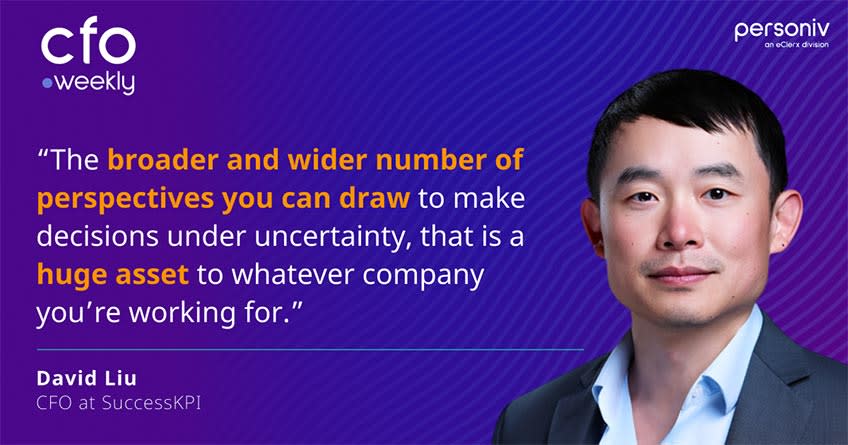
“The broader and wider number of perspectives you can draw to make decisions under uncertainty, that is a huge asset to whatever company you’re working for.” Liu noted. - 05:57 – 07:24
Cross-Functional Partnership as a Leadership Foundation
Finance cannot drive company results in isolation. David consistently invested in understanding the day-to-day realities of other functions, operations, marketing, and product because that knowledge deepens decision-making quality and builds the trust needed to influence without authority. For finance leaders, knowing your teammates and the pressures they face is not optional; it is foundational.
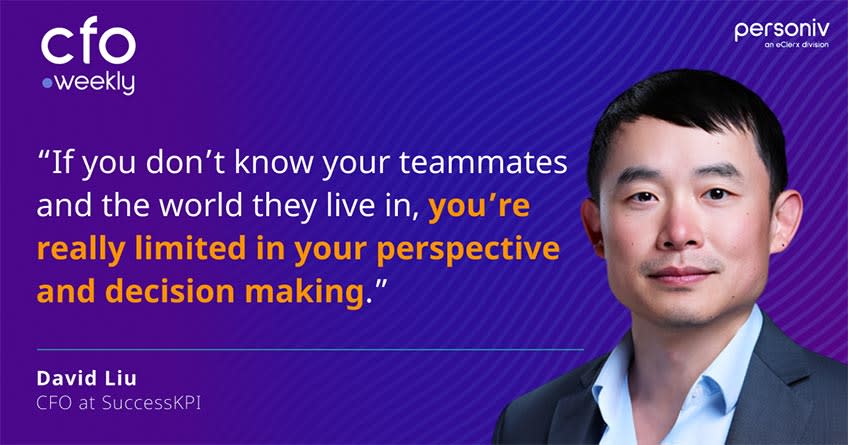
As Liu explained, “If you don’t know your teammates and the world they live in, you’re really limited in your perspective and decision making.” - 10:50 – 11:39
Knowing When You’re Ready for the CFO Role
David’s signal for CFO readiness was simple: he felt confident he could have more impact in that role than in any other. That moment came when he knew he could build a team capable of handling the technical finance and accounting work, freeing him to focus on higher-level organizational alignment and company-wide goal achievement. Readiness is less about credentials and more about the scope of influence you are prepared to take on.
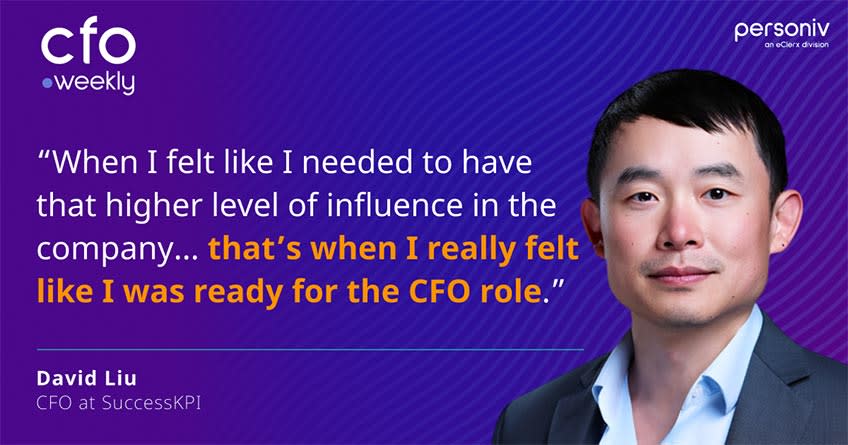
“When I felt like I needed to have that higher level of influence in the company… that’s when I really felt like I was ready for the CFO role.” Liu pointed out. - 13:06 – 13:51
The Biggest Misstep Aspiring CFOs Make: Breadth vs. Specialization
The single biggest misstep David identifies for finance professionals aiming for the CFO role is staying in one place for too long. While finance and accounting are inherently technical disciplines, treating them as purely technical can trap leaders in narrow specializations. The CFO seat demands a wide universe of experiences and perspectives precisely because the role is defined by decision-making under uncertainty. The more varied the experiences a leader has accumulated, the better equipped they are to navigate the unknowns that inevitably arise.
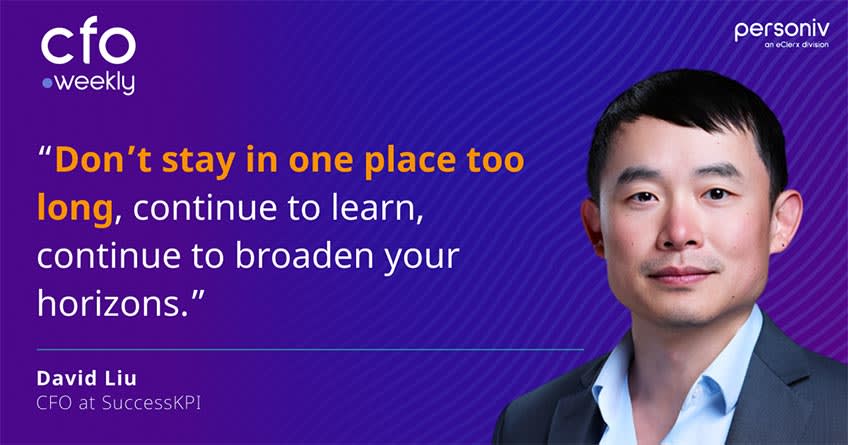
“Don’t stay in one place too long, continue to learn, continue to broaden your horizons.” Liu remarked. - 15:29 – 16:31
How the CFO Role Will Evolve: Breadth vs. Specialization
David sees the CFO’s core value proposition remaining constant: sitting at the crossroads of every major business function and using that unique vantage point to optimize decisions and investments across the organization. What will change is the scale and speed at which finance leaders can deliver that value. AI acts as a force multiplier, not by replacing the CFO’s judgment, but by enabling finance leaders to have broader, faster impact across operations, marketing, R&D, and sales. The fundamental mission of helping the business achieve its goals will not change; the tools and reach available to pursue it will.
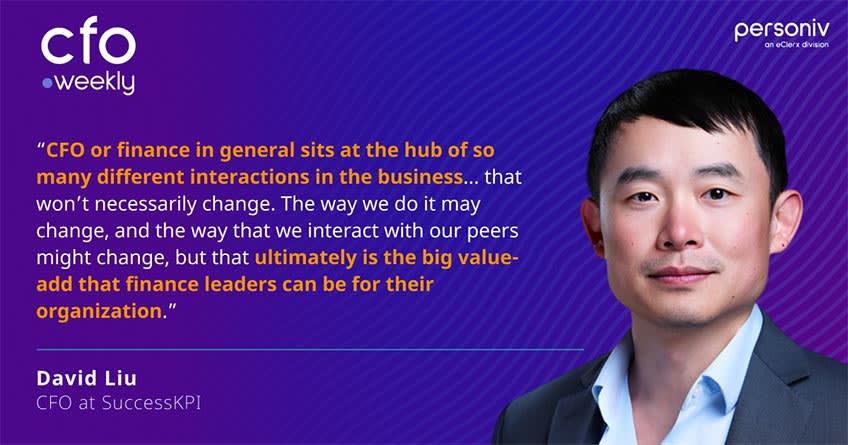
“CFO or finance in general sits at the hub of so many different interactions in the business… that won’t necessarily change. The way we do it may change, and the way that we interact with our peers might change, but that ultimately is the big value-add that finance leaders can be for their organization.” Liu commented. - 16:44 – 18:00
Want more insights? Explore our full library of podcast blogs here.
To listen to the full conversations, check us out on Apple Podcasts, Spotify, and our RSS or your favorite podcast player!
Instructions on how to follow, rate, and review CFO-Weekly are here.
Ready to build a finance department that can handle any challenge? Navigating the balance of breadth of experience vs deep specialization for CFO success requires the right support system. We provide scalable, dedicated accounting teams to free up your time for cross-functional leadership. Reach out today to learn about our customized solutions.


