


In this episode of CFO Weekly, Jack McCullough, Founder and President of the CFO Leadership Council, joins Megan Weis to unpack the Rodman Paradox: the idea that a company's most valuable employee may not be its best-performing one, and exactly why your most valuable employee may not be your best one, but rather the person whose skill set is the most irreplaceable. Jack brings decades of experience as a CFO, CEO, board advisor, and leadership author, along with nearly two decades leading the CFO Leadership Council, one of the largest and most influential communities of senior finance executives in North America.
Jack is the author of several acclaimed leadership books, including Secrets of Rockstar CFOs and his newest release, The Rodman Paradox. Named after legendary NBA rebounder Dennis Rodman, the paradox challenges leaders, and CFOs in particular, to look past traditional metrics and org charts to identify the quiet specialists, crisis preventers, and irreplaceable “glue” employees who keep an organization running, even when they never show up as the highest performer on paper.
Show/Hide Transcript
Megan - 00:51
Welcome back to CFO Weekly. Today, I'm joined by Jack McCullough, founder and president of the CFO Leadership Council, one of the largest and most influential communities of senior finance executives in North America. Over the course of his career, Jack has served as a CFO, CEO, board adviser, author, and leadership expert, helping companies navigate growth, transformation, and executive decision making. He's also the author of several acclaimed books on leadership, including Secrets of Rockstar CFOs and his newest book, The Rodman Paradox, which explores why organizations often overlook some of their most valuable contributors. In this episode, we'll discuss the Rodman Paradox and why leaders so often struggle to recognize high-impact employees who may not fit traditional definitions of success. We'll explore what finance leaders can learn about talent, culture, leadership bias, and building teams that truly drive performance. Welcome back to the show, Jack.
Jack - 01:51
Well, great to see you, and thanks for having me back. I guess that means I passed the audition the first time.
Megan - 01:56
Yeah. I'm very excited that you're back. Excited about this topic today too.
Jack - 02:00
Oh, thank you. I'm excited as well, so thanks for having me.
Megan - 02:03
So, Jack, can you walk us through your career journey and what ultimately inspired you to write The Rodman Paradox?
Jack - 02:12
Sure. I think you could describe me as a classically trained traditional CFO, although I'm no longer a CFO. I started out with one of the big accounting firms, Peat Marwick Mitchell, which some may know as KPMG today. And then I did a series of accounting manager controller type roles, picked up an MBA along the way before getting my first CFO job at a venture-backed startup in 1997. Gosh. That's almost thirty years. Hard to believe. I worked for several along the way, and then I started a group called the CFO Leadership Council, which is a professional association for CFOs. Turned out I liked that more than being a CFO, and I've been doing that for the last twenty years. So it's a fun way to make a living.
In terms of the Rodman Paradox, I was actually inspired to write it by one of my members. Unfortunately, his company was struggling a little bit, and he described a scenario in which he had to do a reduction in force, and there was a controller he really liked. In fact, he saw her as a future CFO. She was everything he would want in a controller. She was a good leader. She was thorough. She was respected. She basically had all of the controllership skills and, as I said, would likely be a CFO at some point. However, there was a person who was just with one year of experience, but what she was a master of was generative AI. And through her work in that and her limited ability in accounting, she actually turned out to be a more valuable employee than the controller, or at least a more irreplaceable one because she was actually empowering the CFO and the entire C-suite to make better, faster decisions. And that got me curious about whether or not this was a common thing. Were people picking elite specialists over versatile leaders very often, or is this just an aberration type of thing? And it turns out a lot of people do indeed pick elite specialists over those versatile leaders, and I make the argument in the book that these elite specialists, because of their skill set, are more valuable than even members of the C-suite.
Megan - 04:16
And for listeners who are hearing the phrase for the first time, what exactly is the Rodman Paradox, and why do you think it resonates so strongly in today's workplace?
Jack - 04:26
Sure. The paradox itself is the idea that your most valuable employee may not be your best employee. It may be the one with the most irreplaceable skill set, and if you lose that person, it would be a catastrophe. And I named it after the basketball player, Dennis Rodman. And the thing about Dennis Rodman for those who might not be familiar with his basketball career—and a lot of people think of his dating Madonna and his friendship with Kim Jong Un, as unlikely as that sounds—but he was only good at two things, defense and rebounding. But he played on five championship teams, and believe it or not, Megan, he has the highest winning percentage of any player in NBA history. Wow. Even more than Michael Jordan and everyone. But he was never considered the best or even the second-best player on his own team and was never an all-star, yet he had this underappreciated role that contributed to winning more than just about anyone ever. And why that matters today is specialization is an incredible art. The world is becoming more and more specialized partly because of generative AI, but not exclusively because of that. But the employee who understands Gen AI, who understands cybersecurity infrastructure, who can master customer relationships, even if they're not versatile, they may be the most important person on your team.
Megan - 05:49
And when you think about a finance organization specifically, where do you most often see the Rodman Paradox play out?
Jack - 05:57
It's tough to answer that to an extent because it's not by titles. It's borne by the role that they fill. It's the person who's doing things that nobody else in the company can do. It's the person that people turn to during a crisis or, more importantly, silently prevent crises from happening in the first place. These aren't people you necessarily notice right away, the crisis preventers, but they play a critical role. And elite CFOs know exactly who these people are. They're not always the highest paid, and they don't necessarily rank the highest on the org chart, and they're certainly not the loudest people in the room. But they're the ones that if they resign on Friday, the CFO is going to have a really bad weekend.
Megan - 06:37
And how do metrics, KPIs, and performance evaluation systems sometimes fail to capture the true value that these employees are bringing to the business?
Jack - 06:48
I would like to answer that with a metaphor. I grew up with a kid—well, he's an adult now like me—but he grew up to be the fire chief in my hometown, and he's one of the most respected people in town. He had a very visible job, and he was saving people. But I had a conversation with him a few years ago, and he was talking about the fire preventers. These are people you probably don't even know exist, but they are literally going and inspecting for faulty wires. They are making sure that smoke detectors are working, that fire extinguishers are up to code. They are literally checking for things like the flashlights in the battery and smoke detectors. It's a very underappreciated role, and it is actually a good metaphor for business in a lot of ways. Because when you think about it like cybersecurity, right, we praise people who catch hackers. That's a wonderful thing. But what about the person who prevented your company from being hacked in the first place? How do you measure that? How do you recognize that, and how do you reward somebody for a hack that never happened? It's difficult to do. Right? You don't know what would have happened without the person, but you wake up every morning and you feel good about your cyber environment, and that doesn't happen by accident. There are people in the background who are making sure that that's the case.
Megan - 08:00
And finance organizations, they tend to reward measurable output. So do you think that makes them more susceptible to overlooking Rodman-type contributors than other departments within the organization?
Jack - 08:13
I think they probably do. Right? Because it's very easy to reward positive things. Like, if you're measuring your sales team, okay, who is the person that brought in the new customers? A perfectly valid measure, by the way. But there's also a skill of keeping customers happy, of making sure that the follow-on sales are there, that they become long-time loyal customers. Those are, again, a little bit more difficult to measure. Right? How do you measure the customer that you didn't lose, for example? It's a little bit more difficult to do than measuring revenue, which is why people focus on revenue. I'm not suggesting revenue is unimportant. Clearly, it's critical. Keeping customers happy is just as critical as bringing them in the first place, making sure nothing goes wrong, and it doesn't lend itself to easy measurements.
Megan - 09:00
And what are some common leadership biases that prevent executives from recognizing this hidden or unconventional talent?
Jack - 09:07
I think all of us are probably attracted to charismatic people for leadership roles. We notice the great presenter, the great networker. There are just some people who walk into a room and they own the room, and you look at that person and you say, "There is a future leader." And sometimes, unfortunately, we draw that conclusion without regard to their actual capabilities. Just they seem like our preconceived notion of what a leader should be like. What we often miss is the quiet specialist who sits in the corner in company meetings and doesn't talk, but they are quietly solving problems that nobody else can solve. And, frankly, sometimes they are preventing problems that no one else in the company even knows exist. Again, it's easy to overlook that sort of thing.
And the other thing in the modern world with a lot of people working from home, leaders associate value with proximity. They may overrate somebody because that person is physically in the same office space as them. If you're a leader of a company in New York, it might be easy to recognize people who work in the same office in New York. But if someone is doing a work from home thing in the suburbs or in Ohio or something like that, how do you recognize her, right, if you're not seeing her all the time? It's easy to miss. And then the other reality is teams now are so far-flung, and, unfortunately, there is an out-of-sight, out-of-mind mentality to it. You don't see them. You don't talk to them daily. They're not participating in the water cooler conversations. Therefore, you underestimate the value that they can bring to your organization.
Megan - 10:39
And just curious. So the quiet specialist, do they oftentimes get stalled out in their careers? I think of a specialist as someone who maybe is not going to rise to the level of a CFO.
Jack - 10:52
I call them Rodmans in the book. A lot of them, if you manage them properly, won't get stalled out, although they do tend to get easily bored. So if the company's not growing and they don't see interesting, challenging work, they may not see a future for themselves. But the biggest managerial mistake that people make with these Rodmans is that they want to promote them, and it's perfectly understandable why they would want to promote them. Hey, this person did a great job. Let's promote her into a new role. But it's usually a mistake.
First of all, it's a mistake on multiple levels. First of all, they don't necessarily want the promotion. In fact, many of them think that it's punitive. They really just want to do interesting, challenging work that they view as important. They want to dig; they don't want to climb. The other thing is they tend to make poor managers for the most part. They don't have the skill set that it takes to manage a project, much less an entire department. So you're putting somebody in a role that they don't want and that they're not necessarily well suited for. And the other thing is if they're really elite at their job, who are you going to get to replace them? Right? If you've got a cybersecurity expert who really likes working in the background and strengthening the architecture to prevent hacks and you take them away from that, well, that's great. You promoted them. Let's hope the person that replaces them is as good as they were. And the thing about these types of geniuses, when they're moved from a role, it's not that they're uncooperative or anything like that—not at all—but they are not the type of people that write playbooks. They don't exactly map out all the things that they do well so that the next person can come in. They're not hiding anything. They just do things. They don't necessarily document how they do things. So moving them from the role can be the biggest managerial mistake somebody can make.
Megan - 12:43
So how do you make these employees feel valued? Is there more to it than just giving them interesting work?
Jack - 12:50
Yeah. And they do like cash rewards the way everybody else does, a high pay, but it gets into—I'm not sure, are you familiar with the dual career path models that some companies employ? Not everyone does. They're pretty big in tech companies, but I believe IBM was the first one to do it really well. But IBM realized that they were losing inventors or engineers or scientific types by forcing them into this leadership path. They didn't want it. They just kind of wanted to work on their science, and they didn't want to manage people. They didn't want to deal with bureaucracy. So what they did is they created a dual career path where they could grow professionally and still do challenging work and get recognized for it, not only from a compensation standpoint, but through the title. They tend not to care about it, but take a traditional career path: a traditional engineer at IBM may come in as staff engineer, senior staff engineer, engineering manager, and the really good ones might become a VP of engineering. But take one who is not on that traditional path and isn't suited for it, yet they're doing invaluable things. They start off at the same point, but they become like principal engineer or principal scientist, and it tends to cap at distinguished engineer, which to their world is actually a more important and more respected title than VP of engineering, and they usually pay about the same amount of money. But by opting into these dual career paths, you can give people who don't want a traditional role a place to grow and be recognized professionally.
By the way, have you ever heard of a distinguished accountant in a company? No. I never heard of that. I think the closest part is chief accountant. Right? Yep. Maybe somebody who doesn't want to be the CFO, but boy, they're really good technically, irreplaceable, but they don't want the burden and some things that come with being a chief financial officer. But give them a technical challenge, they are right on it. And I've seen chief accountants as primary reasons companies can't go public without them because the reporting requirements come up. So they do exist in the finance and accounting world as well.
Megan - 14:57
And you've interviewed and worked with many top CFOs. So what separates leaders who successfully identify and develop overlooked talent versus those who miss it?
Jack - 15:07
Yeah. You know, I would say curiosity and empathy. I think most CFOs—I think we all probably recognize that CFOs are curious. What I didn't realize until I started in my current role is just exactly how empathetic they are and how much they care about their team. But they don't just ask who are the high potentials. They will ask the question too, "Who am I most terrified to lose, and how do I make these people satisfied and give them a rewarding career within the company even if their skill set is a little unconventional?" So, you know, they'll actually spend time, elite CFOs, understanding how work actually gets done inside not only the department but across the entire enterprise. They recognize who the people are that everyone turns to in a crisis. And during a crisis moment, people don't necessarily turn to the executives. They turn to the people with the highest level of relevant expertise. They know who fixes problems before anyone else even notices the problems exist. And the leaders that just kind of focus on a traditional path, an up-or-out type of leader, they miss the Rodmans. If they rely on a traditional org chart, they might be missing out on the reality that exists in their organization. And are you familiar with organizational network analysis?
Megan - 16:26
No. Again, no.
Jack - 16:27
Oh, cool. So the traditional org chart, which we've all seen, it sort of looks like a pyramid with the CEO at the top. That was developed by a railroad employee in the 1830s. And the reason he developed it, he was actually just simply having trouble remembering who was who, so he developed it to help with his memory issues. Not that he had poor memory, but the railroads are just big and complex. And even though he sort of developed it for himself, most companies to this day still use the traditional hierarchical org chart. And it's fine. It certainly has its purpose, but it's not the best tool within a company. But there's a thing called the network analysis, ONA. And what that does is it measures influence in the company, not hierarchy within the company. So it helps you identify the people that maybe work cross-functionally, who people go to during crises, or if they have a problem, whom they go to. And it's a really interesting tool. And an example that I mention in the book, it's a support engineer. I could make the argument she has more influence within the company even though she sits in the middle of a traditional org chart because of the sheer number of people who rely on her. Marketing calls upon her, product marketing, engineering, sales, operations, even finance knows who she is, and that makes her basically an irreplaceable employee despite sitting in a relatively moderate spot on the traditional org chart.
Megan - 17:55
And just along those lines, how do you measure influence? How can you map out someone's influence in an organization?
Jack - 18:04
It's interesting because there were tools to do it. When I read, it was simple. They were looking at who is invited to a lot of meetings outside their own department or whose name is referenced most frequently on the company's Slack message board, things like that. The easiest way is who do people turn to during a crisis, although you're probably wondering you don't have crises every day. How do you do that in a non-crisis moment? But you can check on email volume, who is getting a lot of incoming email from their colleagues, who is most appreciated by the people, not at the C-suite level, but at the next level, who really know the nuts and bolts of what is making things happen. And those are the people with influence, the ones that are part of every important conversation that the company has. And even though they tend to be a bit of lone wolves, people really recognize and appreciate the contribution. And they love that, by the way. They love helping as long as it's done in a respectful way and they don't want to deal with a lot of bureaucracy.
Megan - 19:01
And can you think of any warning signs that an organization is overvaluing visible performance while undervaluing actual business impact?
Jack - 19:11
I think what is happening is that a lot of times, we tend to overrate the impact of members of the C-suite, and there is a lot of study and research that supports this sort of thing. Again, during a crisis, it comes out. There is a report called Let's Hear It for the B Players by Harvard Business Review. And what that showed is that during a crisis and even on an ongoing basis, the B players—it is maybe the controller, not the CFO, that really are the people that keep a company going on a day-to-day basis. I'm not suggesting the C-suite doesn't have its place. It's just that the B players are often overlooked and play a more important role than you might think.
There's actually a research report on supposed superstars on Wall Street, and it looked at their performance after they switched firms. These are the heavily recruited people, but it turns out when they switch firms, even if they go from one elite firm to a different firm, their performance drops almost immediately, and it doesn't recover for three to five years on average. And the reason for that is they had a great bench reporting to them in their old organization, and nobody knew who these people were. They were anonymous. They weren't winning awards and keynoting conferences or anything like that. But when the superstar left and his team didn't go with him or her, they just weren't the same performer. It took them a while to come back. I do think companies do have a tendency to overvalue superstars and undervalue middle management and the elite role players who really make an organization work on a daily basis.
Megan - 20:46
And in a world increasingly driven by AI and automation, do you think that uniquely human contributions like collaboration, resilience, and institutional knowledge become even more important?
Jack - 21:00
Absolutely. AI is going to continue to automate a lot of routine work. It won't replace, at least not in the near term, things like judgment, trust, creativity, resilience, and it doesn't really fully understand context at this point. I actually think that AI makes the Rodman Paradox even more relevant, not less relevant. As technology handles more general tasks and more repeated tasks, the people who combine deep expertise with human judgment become ever more valuable. And I believe that there's a saying somebody once said, "Will AI replace CFOs?" And no, it will not. However, CFOs that embrace AI will certainly replace CFOs who do not. The future doesn't belong to people who compete with AI. That's a losing battle. It belongs to people who know how to use AI while contributing things that AI simply cannot do.
Megan - 21:54
And how do you think CFOs should rethink talent management in a world where technical skills become increasingly automated?
Jack - 22:03
It's a tough one because there is probably always going to be a role for the versatile leader. But what you should be thinking when you're looking at talent management, look beyond the superficial things like presenting and things of that nature, and look at who is actually getting things done in the company. Who is irreplaceable, and who would the company really hurt if you lost them? And then create an environment in which they can flourish. Protect them a little bit. Get to know them, find out what drives them, and also what they hate. Ask them the question, "Am I doing anything that's making your job more difficult or more unpleasant?" And if they can give you some things, then work on those. Naturally, you can't give them or any employee everything they want, but if they are easy things that you can change, change them.
I don't know if you ever saw the movie Office Space. It was Jennifer Aniston before she was famous, but do you remember TPS reports? That was the guy who had to fill out a TPS report for eight different bosses that he had. Rodmans are not going to fill out TPS reports. Ask them what's going on, and they'll tell you candidly, but they don't want bureaucracy. They don't want to have to document everything they do. Just find out what they're good at, give it a context that brings value to the organization, and let them go. That's the best thing you can do with these elite specialists.
Megan - 23:21
And you might have just answered it, but if every CFO listening today could make one change in how they evaluate, develop, or recognize talent based on the Rodman Paradox, what would you tell them to do first?
Jack - 23:34
I would do an audit of people and ask your team and even outside the finance team. Just ask them the simple question, "Who is the one person that I may not necessarily know, but if we lost them, we would be in deep trouble?" And then gauge people, okay, so what happens if we lose that individual? And if the first answer confuses you because indeed you haven't heard of the person or you barely knew them, and if the second answer scares you, you've probably identified who your Rodmans are. Really rely on the people who are in the trenches on a day-to-day basis making the organization great and rely on what they recognize, then come up with a plan. Audit what it is that they do.
And I mentioned earlier, they are not exactly the type that is going to document everything and complete policy manuals, and they don't make good leaders. But what they love to do is they love to take on mentees and apprentices. So if you've discovered that you have one of these people, that they are a single point of failure, that no one in the company can do what they do, have them take on a protégé. It's not to replace them. It's to give them redundancy in case they do leave or decide to retire, whatever it might be. You just need to have a plan in place to replace them because losing them is problematic if they do indeed have that unique skill set.
Getting back to Dennis Rodman, the basketball player, every team he went to, at least initially, he was kind of a nut, and he wore his welcome out eventually. But he improved them dramatically when he joined the team. And then when he left, for the most part, they struggled after he left because there wasn't anybody who could rebound like him. Even like—I make the argument when he was on the Chicago Bulls, absolutely not saying he was a better basketball player than Michael Jordan. He was probably the best player I've ever seen, at least. But I do make the argument he might have been more valuable because if you lost Jordan, great player, but you could replace him with a similar player, an elite scorer, maybe like Kobe Bryant or someone like that. But if you lost Rodman, there was certainly no one on the roster who could do what he did, and there was probably no one else in the league that you could even recruit to replace him. Sometimes, the irreplaceable skill set is indeed more important than the versatile leader, even when that leader is Michael Jordan-level talent.
Megan - 25:51
Jack, thank you very much for taking the time to be with us here today and sharing your experience and knowledge.
Jack - 25:57
Always great to see you, and thanks for the opportunity, and look forward to continuing the conversation.
Megan - 26:02
And for listeners who would like to read this book, where can they find it?
Jack - 26:06
I used to sound like a commercial, but everywhere books are sold, as they say. But it comes out July 21 on Amazon and everywhere else.
Megan - 26:14
Well, Jack, best wishes to you as always. And to all of our listeners, please tune in next week. And until then, take care.
What You'll Learn:
-
What the Rodman Paradox is and why it's named after NBA legend Dennis Rodman
-
Why finance organizations are especially prone to overlooking their most irreplaceable talent
-
The leadership biases that cause executives to miss quiet specialists and “crisis preventers”
-
Why promoting your best specialist is often the biggest managerial mistake a CFO can make
-
How organizational network analysis reveals hidden influence that traditional org charts miss
-
Why AI is making the Rodman Paradox more relevant, not less, in finance today
Key Takeaways:
Naming the Paradox After Dennis Rodman
Jack explains that the Rodman Paradox describes an employee who may not be a company's best performer but is its most irreplaceable one. He named the concept after Dennis Rodman, who was only elite at two things, defense and rebounding, yet holds the highest winning percentage of any player in NBA history despite never being named an all-star. Jack argues that as the world becomes more specialized, partly due to generative AI, the employee who masters one critical skill can matter more than a versatile all-around performer.
“The paradox itself is the idea that your most valuable employee may not be your best employee. It may be the one with the most irreplaceable skill set.” McCullough said. - 04:16 – 05:49
Why Finance Rewards the Wrong Things
The Rodman Paradox often plays out through role, not title. Jack describes the people everyone quietly turns to during a crisis, or who prevent one from happening in the first place. He compares it to a fire chief's “fire preventers,” the inspectors checking wiring and smoke detectors that no one notices until something goes wrong. In finance, the same dynamic applies to cybersecurity and crisis prevention. These employees aren't always the highest paid or highest on the org chart, but their absence would be felt immediately.
“It's the person who's doing things that nobody else in the company can do.” McCullough remarked. - 05:57 – 08:00
Why Your Most Valuable Employee May Not Be Your Best One
Leaders are naturally drawn to charisma, the great presenter or networker who “looks” like a future leader, while overlooking the quiet specialist solving problems in the corner. Remote work compounds the issue, since leaders tend to associate value with physical proximity. Jack also warns that promoting a Rodman is usually a mistake: most don't want the role, aren't suited to managing people, and rarely document their own processes, which makes them even harder to replace once they're moved.
In McCullough's words, “They want to dig. They don't want to climb.” - 09:07 – 12:43
Why AI Makes the Rodman Paradox More Relevant, Not Less
Jack cites Harvard Business Review research on “B players” and studies of Wall Street “superstars” whose performance drops for years after switching firms, evidence that organizations consistently overvalue visible stars and undervalue the role players who make them successful. He argues AI will accelerate this dynamic: as automation handles routine work, the people who combine deep expertise with human judgment become even more valuable.
“CFOs that embrace AI will certainly replace CFOs who do not.” McCullough emphasized. - 19:11 – 21:54
The One Audit Every CFO Should Run
Jack's advice for CFOs is simple: ask your team who they'd be most surprised to lose, and who would create the biggest problem if they left. Since Rodmans rarely document their own work, the fix isn't promotion, it's giving them a protege for redundancy. Jack closes with Dennis Rodman himself: every team he joined improved dramatically, and every team he left struggled to replace what he uniquely provided.
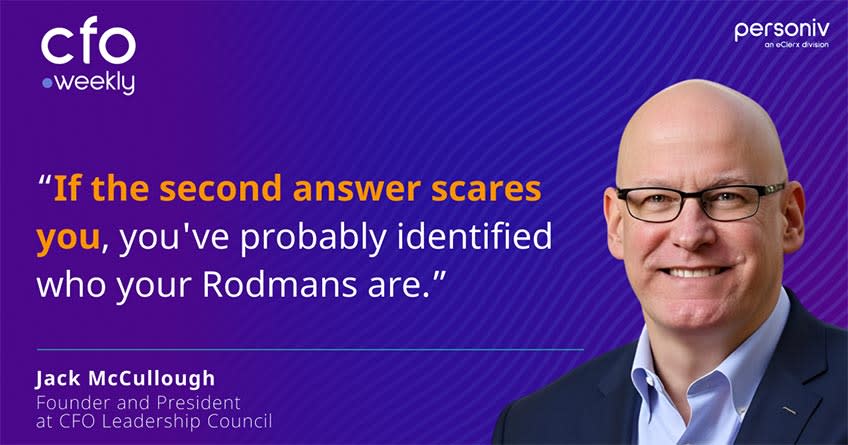
“If the second answer scares you, you've probably identified who your Rodmans are.” McCullough commented. - 23:34 – 25:51
Want more insights? Explore our full library of podcast blogs here.
To listen to the full conversations, check us out on Apple Podcasts, Spotify, and our RSS or your favorite podcast player!
Instructions on how to follow, rate, and review CFO-Weekly are here.
Understanding why your most valuable employee may not be your best one requires leaders who have the time to evaluate real impact. We provide scalable, dedicated finance teams to handle the daily operations so you can focus on talent strategy. Drop us a line today to learn more.


