


In this episode of CFO Weekly, Anne Napolitano, CEO and Founder of Anne Napolitano Consulting, joins Megan Weis to explore how food and beverage operators can transform their financial function from a back-office necessity into a true front-of-house competitive advantage, and ultimately, how finance helps restaurants survive. Anne brings a rare perspective shaped by more than two decades of experience in corporate accounting and financial leadership, including her time as Controller for the US operations of Hermès, where she led financial reporting and operational oversight for a globally recognized luxury brand.
With a background that bridges high-end corporate finance and hands-on kitchen experience as an accountant turned chef turned accountant, Anne shares how her firm helps restaurant and bar operators gain clarity, control, and confidence in their finances. Currently serving as CEO and Founder of Anne Napolitano Consulting, Anne discusses why so many food and beverage businesses run on gut feel and bank balances instead of real financial data, and what it takes to move from reactive management to proactive, data-driven decision-making.
Show/Hide Transcript
Megan - 0:52 Welcome back to CFO Weekly. Today, I'm joined by Anne Napolitano, CEO and founder of Anne Napolitano Consulting, a firm dedicated to helping food and beverage businesses gain clarity, control, and confidence in their finances. With more than two decades of experience in corporate accounting and financial leadership, Anne previously served as controller for the US operations of Hermès, where she led financial reporting and operational oversight for a globally recognized luxury brand. Anne is also an accountant turned chef turned accountant, which allows her a unique combination of industry plus finance experience. Today, we're exploring how finance can move beyond bookkeeping to become a true operating partner, particularly inside food and beverage businesses. From understanding margins and managing cash flow to making smarter growth decisions, we'll talk about how financial insight can help operators not just survive but scale with confidence. Anne, thank you for joining us today.
Anne - 1:55 Thank you very much. It's a pleasure to be here.
Megan - 1:57 You've had a unique journey from corporate finance at Hermès to running your own business and now advising food and beverage operators. What was the moment that made you realize that this industry needed a different kind of financial partner?
Anne - 2:12 It was when I started talking to restaurant and bar owners and kept hearing the same thing: my accountant just does my taxes, they really don't get my business. Sometimes they only speak to them once or twice a year. The industry runs on thin margins and long hours, but financial support really hasn't caught up with that. I knew I could help bridge that gap because I've lived on both sides of it.
Megan - 2:34 Having sat inside a luxury brand, what fundamentally surprised you about how differently financial discipline shows up in food and beverage?
Anne - 2:47 At Hermès, financial discipline is baked into every single decision — systems, processes, reporting. We had to answer to the parent company in Paris, so there was a lot of structure and requirements. But in restaurants and bars, you often have talented people making decisions based on gut feel and a bank balance. I see so many operators just looking at their bank statement and thinking that's how well they're doing. It's surprising how much of a competitive advantage solid financials can be in this space, and that's why our clients are really happy with the service they get.
Megan - 3:29 Am I right that you were a chef at one point?
Anne - 3:33 I was a chef. I took some time off after I had my kids, went into that for a bit, and really enjoyed it. I love to cook — it's a passion of mine. One of my clients says that's the reason he stays with us, because I understand the business so well.
Megan - 3:52 When you first start working with a restaurant or bar, what are the most common financial blind spots you see?
Anne - 4:01 Three big ones. First, payroll as a percentage of revenue — most owners have no idea where they stand on that. Second, unchecked comps and voids, which chew into margins. Owners may not be on-site all the time and aren't aware of how many comps are being given out. Third, cash flow forecasting. Everyone is looking at their P&L, which shows them what happened last month, but what they really need is to be looking at the next ninety days.
Megan - 4:32 On payroll — is there a percentage companies should be targeting, and does it differ by restaurant type?
Anne - 4:44 It really varies by concept. Fast casual operations have less staff; full-service restaurants have more. The target really depends on the type of restaurant.
Megan - 4:56 Where are operators most often wrong about their margins?
Anne - 5:06 Generally, they haven't fully accounted for labor, waste, shrinkage, or approved overtime. They don't understand how it all plays together. True profitability is a full-picture number, and most operators are working from a very partial picture.
Megan - 5:22 You mentioned cash flow — what are operators consistently underestimating?
Anne - 5:34 The timing gap. Revenue looks fine on paper, but cash is tight because they paid suppliers on Tuesday and payroll on Friday, then revenue from the weekend doesn't hit the bank until Monday or Tuesday. We help them plan around that timing gap — when to pay vendors, how to take advantage of vendor payment terms. Those things can make a huge difference.
Megan - 6:05 Many of the restaurant owners you work with probably don't have much of a financial background. How do you help them become more fluent in finance and accounting?
Anne - 6:24 We found that handing restaurant operators financial statements doesn't really help. They don't want to ask questions because they don't want to appear as though they don't know what they're talking about. What we found is that dashboards, graphs, and charts paint the picture far more effectively. We started doing that about two years ago, and it's been a real game changer. We schedule a monthly meeting with each client to review the dashboard and reports together.
Anne - 7:04 We've also used AI to help pull together some of the numbers. We compare this year to last year so clients can see what's different and start to understand seasonality — whether they're heading into their busy season or a slower one — so they can prepare accordingly.
Megan - 7:44 Has consumer confidence been impacting restaurants this year? It feels like an uncertain time.
Anne - 8:01 Restaurants have seen uncertain times over the past six years — COVID and everything since. Strong restaurants still remain strong. One thing we've noticed lately is a decline in alcohol consumption. Restaurants depend heavily on the margins from alcohol sales, so that's been a real shift. Mocktails can help offset some of it, but not completely.
Megan - 8:38 Younger people just aren't into drinking.
Anne - 8:43 It's true. We've really seen that reflected in our clients' numbers.
Megan - 8:48 If you had to pick one metric every restaurant owner should be watching weekly, what would it be?
Anne - 8:55 Prime cost — cost of goods sold plus labor as a percentage of revenue. It's the one number that tells you whether your business is structurally healthy. If your prime cost is consistently over 65%, you have a problem somewhere and need to find it fast. Most owners check it monthly at best, but weekly is better. You can catch small issues before they become big ones.
Megan - 9:21 For a business that feels busy but isn't profitable, where do you typically start?
Anne - 9:27 I go straight to the P&L, line by line, and ask: does this number make sense? Nine times out of ten, there's either a labor issue or a purchasing issue — sometimes both. Busy doesn't equal profitable. You can be slammed every Saturday night and still be bleeding money if your cost structure is off. We fix the structure first, and then everything else starts to work.
One thing we often find is that owners price their menu based on food cost alone, without factoring in labor, rent, insurance, or other overhead. Once we show them they're not even covering their costs, we help them adjust their pricing accordingly.
Megan - 10:21 At what point does a food and beverage business need to move from basic accounting to true controller-level support?
Anne - 10:35 It's generally when the decisions get bigger than the data you have. If you're opening a second location, negotiating a lease, or thinking about outside investment and you're still running on QuickBooks and a prayer — that's the signal. Other signs include multiple revenue streams you can't see clearly, a bank balance that doesn't match your P&L, or realizing after the fact that you didn't actually know your numbers when it mattered.
We've also had clients tell us it cost them tremendously to try to handle it themselves early on, because they didn't set things up correctly. Getting proper financial guidance from the start is well worth the investment.
Megan - 11:26 With third-party delivery apps complicating things further — and you offer a three-tier model — how do you guide clients on when it's time to step up to FP&A and more strategic finance?
Anne - 11:44 I generally ask one question: what decisions are you trying to make that you can't make confidently right now? If the answer involves forecasting, budgeting, scenario planning, or investor conversations, that's the FP&A tier. Most clients start at the foundation — clean books, consistent reporting — and then want to move up because they can finally see what's possible with good data in their hands. We actually just signed a new client today who went straight to the highest tier because she recognized that strategic advisory is exactly what's been missing in her business.
Megan - 12:24 What separates operators who successfully scale from those who stay stuck?
Anne - 12:33 The willingness to let go of the idea that they have to know everything themselves. Operators who scale bring in the right support, trust their numbers, and make decisions proactively instead of reactively. The ones who stay stuck are usually doing too much — including the finances — and never quite get ahead of the business. Scale requires systems, and systems require faith in the process. And honestly, once they have an expert alongside them, it's quite a relief.
Megan - 13:04 If you're doing everything yourself, it's impossible to scale.
Anne - 13:12 Exactly. We talk to clients about what keeps them up at night, and that usually points us in the right direction for the kind of support and advice that will help them grow.
Megan - 13:25 What does it actually look like when finance becomes a true partner to an operator rather than just a bookkeeper?
Anne - 13:36 When our true-partner clients call me before they do things — before they sign a new lease, before they enter a new operating agreement with partners, before changing vendors. The scorekeeper tells you what's happened; the partner helps you figure out what's next. That's the difference.
Megan - 13:58 How do you build trust with founders who don't naturally gravitate toward financial data?
Anne - 14:07 I meet them where they are and speak their language. I understand what they're going through, and that makes a big difference. Presenting them with slides or a pitch deck doesn't help — it frightens them; they don't feel confident enough to engage with it. But when I can show them what the numbers mean, help them solve problems, and demonstrate that finance can actually answer questions and guide their next steps, the numbers stop being scary.
Megan - 14:39 Your background as both a chef and an accountant is rare. How does that change the way you advise clients compared to a traditional firm?
Anne - 14:51 I've been there, so I understand the reality of the situation. We're not just on the outside looking in — we genuinely get what operators go through, and I can talk to them in a language they understand. A traditional firm might give you technically correct advice that's disconnected from how the business actually runs. I try to bridge that gap and be a real sounding board. Sometimes I feel like a financial therapist.
Megan - 15:21 Were you a chef first, or an accountant who took a break to cook?
Anne - 15:28 Accountant first. I worked at Hermès and a few other corporate roles, then took a break to pursue cooking, and came back to accounting. I started my firm ten years ago — we just celebrated our tenth anniversary. We began as a general practice, and over the past five or six years really honed in on the food and beverage space. Defining that niche has been a game changer. I genuinely love working with people in this industry, and they appreciate it too.
Megan - 16:08 You use a dedicated three-person team model. Why is that important, and how does it change the client experience?
Anne - 16:17 Relationship continuity matters. When you call us, you're not explaining your business to someone new every time. You have a team that knows your vendors, your seasonality, your quirks — all of it. The context is where the real value lives. A lot of firms cycle clients to whoever has bandwidth. We deliberately don't do that. You're assigned team members, and you'll always work with them.
Anne - 16:49 We understand our clients' businesses, their vendors, their customers, the issues they've had in the past, and what's coming up. That's why they feel comfortable calling us and saying, "We're struggling with X — how can you help?" or "We have a new investor coming in — what do we need to do?" And when we don't have all the answers, we make sure to connect them with the right partners. We keep tax accountants on call, for example, since we don't handle tax ourselves, and we make that referral process seamless for clients.
Megan - 17:44 How are you seeing technology and automation change the way restaurants manage their finances?
Anne - 17:58 There are some really exciting developments. We're very tech-forward and try to take advantage of as much as possible. Tools like QuickBooks Online, Gusto, and newer POS integrations are automating a lot of data entry — though they don't always get it right. AI is starting to surface insights that would have taken hours to pull manually, but the technology is only as good as the humans interpreting it. We need someone reviewing everything to make sure the foundation is solid before we can use AI and other tools to provide meaningful advice.
Megan - 18:56 Are there specific platforms you're excited about? I know there's Restaurant365 and one called Margin Edge.
Anne - 19:10 Most of our clients are on QuickBooks Online, and we've made it work well for us. On top of that, we layer additional reporting tools. Reach Reporting is one we use — it does a great job with budgets, forecasts, and dashboards. Margin Edge is another we've used with some clients. We actually just met with someone about a new platform looking to compete with Margin Edge. We try to stay current on all of these tools so we can give clients the information they need and help them interpret it. The key is knowing which questions to ask and which tools to use — otherwise the options become overwhelming. Claude has also been great for the AI side of things; we've been able to use it for a variety of tasks.
Megan - 20:10 If you were advising a new restaurant owner today, what would you tell them to get right from day one financially?
Anne - 20:18 Three things. Separate business and personal finances immediately. Know your prime cost before you open your doors. And build a ninety-day cash reserve before you launch. Most new operators are so focused on the concept and the build-out that they forget they're building this for the long term. Get the foundation right early — it's much harder to fix later.
Megan - 20:43 How do you see the role of finance evolving in the food and beverage industry over the next two to five years?
Anne - 20:52 Finance is going to move from back office to front-of-house competitive advantage. Operators who use real-time data and forecasting — rather than treating it as just a bookkeeping function — and make proactive decisions will outperform those running on intuition and bank statements. The industry is getting more scrutiny: investors, lenders, and landlords all want to see clean books and real projections. Our franchise clients, for example, are required to report their financials by the eleventh of each month — a tight deadline, with consequences for falling short. The operators who treat finance as a strategic tool, not just a compliance requirement, are the ones who will succeed. You can do really well in the food business, but you need to take care of all these pieces.
Megan - 21:49 Finance and accounting feels like an exciting place to be right now — a true strategic partner to any business.
Anne - 21:57 Absolutely. But part of our job is getting that point across to restaurant operators. They don't always see the value, and we're constantly trying to show them what a difference it makes to involve us before decisions are made, rather than coming to us after the fact. Whether it's the controllership side or the FP&A level, we can provide so much more value than just the basic bookkeeper.
Megan - 22:26 Anne, thank you so much for being my guest today. I really appreciated your insights.
Anne - 22:34 Thank you so much for having me. I really enjoyed it.
What You’ll Learn:
-
Why food and beverage operators are making decisions based on gut feel and bank balances instead of real financial data
-
How dashboards and visual reporting replace traditional financial statements for operators without finance backgrounds
-
The three most common financial blind spots in restaurants: payroll percentage, unchecked comps and voids, and cash flow forecasting
-
Why prime cost is the one weekly metric every restaurant owner should obsess over
-
How the timing gap between revenue and expenses creates cash flow crises even when sales look strong
-
When food and beverage businesses need to move from basic accounting to controller-level and FP&A support
-
How finance is evolving from back-office compliance to front-of-house competitive advantage in the food and beverage industry
Key Takeaways:
The Industry Gap That Sparked a Consulting Firm
Anne’s decision to focus on food and beverage came from a recurring conversation with restaurant and bar owners who kept saying the same thing: their accountant just does their taxes and doesn’t really understand their business. The industry runs on thin margins and long hours, but financial support has not kept pace. Having lived on both sides of the equation inside a rigorous corporate finance environment at Hermès and inside the kitchen as a working chef. Anne recognized the gap and built a firm specifically designed to bridge it.
“The industry runs on thin margins and long hours, but financial support really hasn’t caught up with them.” Napolitano said. - 00:02:12 – 00:03:28
The Three Blind Spots Costing Operators Money
When Anne first works with a new restaurant or bar client, she consistently finds three major financial blind spots. First, payroll as a percentage of revenue, where most owners have no idea where they stand. Second, unchecked comps and voids that quietly erode margins, especially when owners are not on-site to monitor them. Third, the absence of a cash flow forecast. Most operators review their profit and loss statement to see what happened last month but are not looking ahead at the next ninety days, which is where the real danger lies.
“True profitability is a full picture number, and most operators are working from a very partial picture.” Napolitano shared. - 00:03:29 – 00:05:21
Dashboards as a Game Changer for Financial Literacy
Handing restaurant operators a traditional financial statement does not work. Owners without finance backgrounds are reluctant to ask questions because they do not want to appear uninformed, and the format does not translate to how they think about their business. Anne’s firm shifted to dashboards, graphs, and charts that visually paint the picture of performance. This approach, combined with monthly review meetings, has been transformative. Using AI tools and visual reporting software like Reach Reporting, the team now shows clients year-over-year comparisons, seasonality patterns, and trend lines that help operators understand their business and plan ahead with confidence.
“We found that by giving restaurant operators financial statements, it doesn’t really help. Dashboards, graphs, charts really help paint the picture and show them exactly how well they’re doing. That has been a real game changer for us.” Napolitano mentioned. - 00:06:05 – 00:07:43
Knowing When to Step Up to Controller and FP&A Support
The signal that a food and beverage business needs to move beyond basic bookkeeping is when the decisions get bigger than the data available. Opening a second location, negotiating a commercial lease, or pursuing outside investment while still running on QuickBooks and intuition is a warning sign. Anne’s three-tier model starts with clean books and consistent reporting, moves to controller-level oversight, and then advances to FP&A and strategic advisory for operators who need forecasting, budgeting, scenario planning, and investor-ready financials. The question she always asks: what decisions are you trying to make that you cannot make confidently right now?
In Napolitano's words. “Busy doesn't equal profitable. You can be slammed every Saturday night and still be bleeding money if your cost structure is off.” - 00:09:21 – 00:11:25
How Finance Helps Restaurants Survive
Looking ahead two to five years, Anne sees finance moving from a back-office compliance function to a genuine competitive differentiator for food and beverage operators. Investors, lenders, and landlords are increasingly demanding clean books and real projections. Franchise systems already require timely financial reporting with real consequences for missing deadlines. The operators who treat finance as a strategic tool rather than a compliance obligation—using real-time data and proactive forecasting instead of intuition and bank balance checks—will outperform those who do not. Finance is not just about knowing what happened; it is about shaping what comes next.
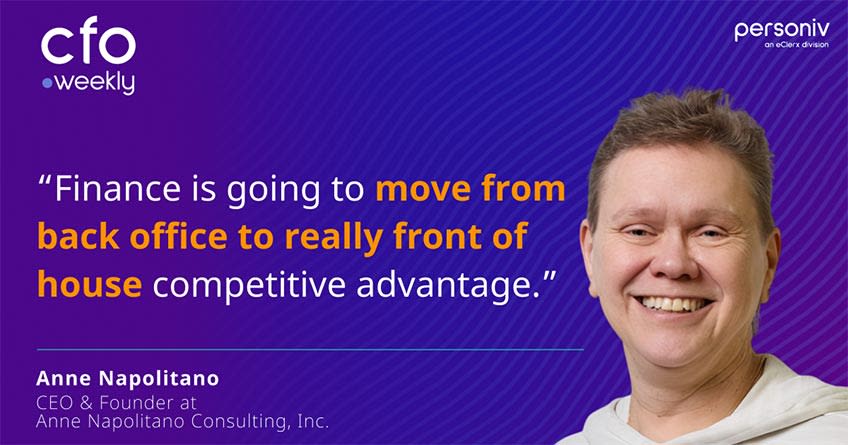
“Finance is going to move from back office to really front of house competitive advantage.” Napolitano pointed out. - 00:20:43 – 00:22:25
Want more insights? Explore our full library of podcast blogs here.
To listen to the full conversations, check us out on Apple Podcasts, Spotify, and our RSS or your favorite podcast player!
Instructions on how to follow, rate, and review CFO-Weekly are here.
Margins in hospitality leave no room for error, which is exactly how finance helps restaurants survive. We provide scalable accounting teams to manage your reporting and cash flow so you can focus on your guests. Drop us a line today to learn more.


