


In this episode of CFO Weekly, Courtney Colmenares, Chief Financial Officer at Crane Stationery, joins Megan Weis to explore why owning the data stack has become one of the most critical responsibilities of the modern finance leader and the evolution of the CFO as chief data officer. Courtney brings a rare blend of financial rigor and operational instinct, shaped by her time on Sarah Blakely's personal finance team at Spanx and her experience scaling a fast-growing startup from $10M in revenue with nothing but a self-built data lakehouse and a relentless focus on what matters most.
With hands-on expertise spanning accounting, FP&A, systems implementation, and data architecture, Courtney shares how she turned the finance seat into the strategic nerve center of every organization she's led. She unpacks why companies between $10M and $100M in revenue almost never have a chief data officer and why that gap almost always falls to finance to fill. She covers the three pillars of owning the data stack, the biggest pitfalls companies make when building a unified data foundation, and the mindset shift that separates reactive CFOs from those who help their teams see around corners.
Show/Hide Transcript
Megan - 0:59
Welcome back to CFO Weekly. Today I'm joined by Courtney Colmenares, Chief Financial Officer at Crane Stationery, a company with a two-hundred-year legacy of craftsmanship and design. Courtney is a finance leader known for helping high-growth brands scale with clarity, control, and confidence, bringing deep expertise across accounting, FP&A, systems implementation, and operational improvement. She's passionate about transforming finance into a true growth engine by simplifying complexity, improving decision-making, and building systems that actually work for the teams using them. In this episode, we'll explore the evolving role of the CFO as chief data officer, why owning the data stack is becoming essential for modern finance leaders, and how finance teams can move from reactive reporting to driving real-time, data-informed decisions across the business. Welcome, Courtney. Thank you so much for being here.
Courtney - 1:57
Thank you, Megan. I'm so excited to be here.
Megan - 2:00
Thinking back to earlier in your career, was there a moment when you realized that the real power of finance wasn't just the numbers, but in how the data behind those numbers was structured and used?
Courtney - 2:13
Absolutely. Early in my career, I worked for CFOs who really functioned more like controllers. They reported on what had happened in the business, but we were already a few weeks into the next reporting cycle and in a constant state of reacting to the next issue. I then moved to Spanx, where I worked on Sarah Blakely's personal finance team. The CFO there functioned more like an operator. She was in the data, in the weeds, discussing the most important problem in every meeting — spanning product, procurement, planning, and financials — but it was rarely about what had happened in the past. That's when I realized how much power there is in making decisions with real-time data. She used to say, "Decisions don't have to be emotional when they're backed by data." I think about that almost every week. That was the first time I saw a leader who came armed with data every single day and made quick, factual decisions. I've tried to emulate that ever since. In a small organization, the most important data can change wildly week to week, but I view the finance role as more of an operator role than a traditional accounting or finance role.
Megan - 3:57
These days, data feels almost limitless. How do you determine what's actually critical?
Courtney - 4:10
It depends on the organization and the stage it's in. In my seat, I try to take the biggest problem or question mark in the organization and trace it backwards. In manufacturing, for example, we're constantly focused on pricing and margins. I take that decision and trace the data all the way back — to retailer contracts, to pricing, even to merchandising on our website — and bring all of that to the team so we're unified around a common data set. Everything feeds back to what supports our business, which for us is gross margin.
Megan - 5:08
You've worked across accounting, FP&A, and systems implementation. At what point did you start to see the CFO role expanding toward something closer to a chief data officer?
Courtney - 5:28
The role that helped me see it was the one just before this one. I joined an organization that was rapidly growing but quite small — about $10M in revenues — with a very lean team. We needed to make decisions quickly and didn't have the systems to support sophisticated data, so we had to be scrappy. Prior to that, my roles had been more defined. At a place like Spanx, you have large teams, a data team, a planning team. But in that role, the CFO seat was the butcher, the baker, and the candlestick maker. I covered everything from inventory procurement to retailer sales contracts to pricing, and worked closely with our controller to make sure everything was recorded completely and accurately, while constantly reforecasting the business. We were running on QuickBooks, so I built a small data lakehouse to pull everything into one source and create quick — not pretty, but functional — daily dashboards we could refresh and act on. Until that was in place, the first six months were chaotic. I had to own that missing piece and put a stopgap in place to get visibility across the business. In companies from $10M to $100M in revenues, there typically is no chief data officer, so that role falls to the CFO. Who else is better positioned to own it?
Megan - 7:35
When you hear the phrase "owning the data stack," what does that actually mean in practical terms for a finance leader?
Courtney - 7:42
I think it means three things. First, understanding the architecture — where the data lives, how it flows through the systems, where it could break, and where the known gaps are. You don't necessarily have to write the code, but in small companies, sometimes you do. Second, being the organization's source of truth. All transactions ultimately flow to the general ledger, which finance owns. So you have to maintain a complete and accurate dataset at all times — with the processes, reconciliations, and controls in place so people trust what's coming out of the system. Third, owning what I'd call the decision layer on top of it: what KPIs need to be monitored, what are the red flags, what are the leading and lagging indicators you need to bring to the leadership team so everyone knows when you're on or off track. It's not helpful to flag, two months after close, that you're off on sales. So owning the data stack means understanding the systems, ensuring accuracy, and surfacing the right information to the executive team in a timely way.
Megan - 9:15
In many organizations, data still lives in silos across departments. Why is finance uniquely positioned to bring it all together?
Courtney - 9:27
Three reasons. First, accountability. Every department owns their KPIs, but they often need finance's help determining what those KPIs should be. I work closely with our sales and marketing teams to help set monthly goals, because I have more historical data at hand and I understand the forward forecast. Finance can allocate those KPIs and give teams clear goalposts. Second, neutrality. I'm not rooting for one department over another. My role is to meet the budget and forecast we've set for our board of directors, so I'm an unbiased party supporting each team with the data and reporting they need to hit the common goal. Third, finance acts as the universal translator. We see the marketing data, the sales data, the working capital data — all of it. A good CFO can bring that together and report back to each team in their own language — planned versus actual, where they're off track, what needs to be tweaked. Over time, that builds a lot of trust. People want to understand how they're performing, and data can do that.
Megan - 11:21
What are the most common challenges when companies try to build a unified data foundation for finance and operations?
Courtney - 11:32
The company I'm at right now is at a fork in the road — ready for a new ERP that comes with a heavy price tag and a long implementation timeline. One common roadblock is companies waiting for the perfect ERP. If you say "we'll wait," you could fly blind for months or even years, and that's never the right answer. You don't want to be held hostage by a big system transition. A bigger mistake is treating ERP or data improvements as an IT project. Early in my career, I led a QuickBooks-to-NetSuite migration and treated it exactly that way — and I consider it one of my bigger failures. Finance and accounting has to own the implementation, because who understands better how transactions flow through a system than the finance team? The third challenge is allowing departments to operate in silos. As a finance leader, you have to zoom out and see how all the dots connect, then implement systems accordingly. As a bridge while we evaluate new ERPs, I built a lakehouse — pulling data from our current ERP, AP system, AR system, banks, and shop floor manufacturing system, then joining and standardizing it so it can be filtered and reported on consistently. I also trained the team on common language: consistent terminology for sales channels, for product categories. It sounds simple, but it wasn't. What came out of it was everyone receiving the same reports every day with the same terminology. People quickly learned what their department was accountable for. The biggest pitfall is letting each department run its own reporting — you immediately end up with disjointed data and gaps everywhere.
Megan - 14:35
As you evaluate different ERPs, how are you choosing one you can grow into versus one you'll outgrow in a few years?
Courtney - 14:49
We've been very intentional and taken our time — about six months of scoping — and I've narrowed it down to a top three. Everyone thinks when they migrate ERPs, it's the last time they'll ever do it. I know realistically that may not be true, but I want at least five years of runway, ideally longer. So I'm looking for systems that are highly customizable, flexible, and have an open API. The best ERPs I've seen have libraries of prebuilt integrations, and I review those in detail: Does it integrate easily with Microsoft Office products? My data lakehouse? My AP software? Can I self-serve when I need to add something to the stack, without relying on developers or third-party contractors? That's the direction ERPs are moving — open access with prebuilt connectors. The other thing I keep reminding my team is: focus on the system that checks 80% of the boxes, not on what makes our company unique. If we discount every system because of that last 10% that's specific to us, we'll never find the right one. Accepting that has definitely sped up the process.
Megan - 16:46
How do you balance the need for clean, structured data with the reality that many systems and processes are still messy and manual, especially in a growing company?
Courtney - 17:00
You can't wait for clean. If you do, you'll never make a decision. I work in layers. I call the rawest data "bronze data" — it comes straight from the source, might be a little messy, might be a little inconsistent, but it's complete. I standardize it enough to join with data from other systems. A good example: we have two sides of our business — make-to-stock and personalized items — whose orders, invoices, and customer records land in two different systems with some overlap. For years, the company ran two separate daily sales reports. We simply joined them. It was messy, but it unlocked enormous insights. Instead of two teams looking at two separate reports, the whole organization looked at one. That led directly to pricing changes and staffing decisions across sales channels. If we'd waited for a clean solution or a new ERP, we'd have waited two more years. My biggest piece of advice: don't wait for clean. Make sure it's complete and accurate, then keep moving — or you'll always be behind the eight ball.
Megan - 18:48
As CFO, how do you ensure that data being used across the organization is both accurate and actually driving decisions rather than gut hunches?
Courtney - 19:04
For accuracy, I make sure there are strong controls and reconciliations in place. Every report I generate comes with a reconciliation file for my controller and me to review before it goes out. If we're sending an AR aging report to the sales team, the reconciliation confirms it ties to the GL. If it doesn't, we investigate, fix it, then publish. The worst thing finance can do is send out reports that turn out to be wrong — you lose trust, and it's very hard to earn back. I've learned that the hard way. We'd rather reports go out at 10AM and be right than go out at 8AM and be wrong. For usefulness, I review the reports constantly, and as soon as I notice something isn't being used or is no longer relevant, I kill it. I'm always reiterating the reporting packages I send to each team. If it was built for a specific product launch or a particular season, I retire it when that moment passes. I stay close to each team leader — talking to the COO, CEO, and head of sales daily or at minimum weekly — to make sure what I'm sending is still relevant. A lot of CFOs set it and forget it. A year later they hear through the grapevine that nobody looks at a particular report anymore. That's a missed opportunity. Owning the role means constantly improving what goes out — and nothing's more rewarding than when someone says, "That helped me make a decision" or "That helped me catch an issue."
Megan - 21:39
Beyond reporting, how has owning or influencing the data stack changed how you partner with other leaders?
Courtney - 21:48
Finance has shifted from the people who always say no to the people who help you see around corners. I'm regularly talking to the sales director about margins for a particular retailer, or to the CTO and web team about website promotions — things that ten years ago I would never have thought were a finance function. When you have visibility across the entire planning cycle and you're providing that data, it changes the conversations people bring to your desk. CFOs who operate only in the historical tend to be seen as the people who tell you that you can't spend money. But when you own the data and understand the technology — when you can trace how every transaction flows through the systems from beginning to end — people start bringing you different problems and looking to you for a different kind of input. When everyone owns their inputs and their KPIs but collaborates with finance, the whole organization benefits: forecasting gets better, KPIs get stronger, and there are fewer surprises at month end.
Megan - 23:50
Last question: looking ahead, how do you see the CFO role evolving over the next three to five years, and what new skills or mindsets will be critical?
Courtney - 24:02
The CFO seat in the next five to ten years will look completely different from what it is now. It won't just be about reading a dashboard — it'll be about understanding the underlying architecture and knowing how to ask the right questions of the data team. AI literacy is going to be huge. I try to stay close to it: understanding what should be automated versus kept human, where to use AI tools, how to deploy the right tools to your team, and how all of that fits within the organization's security framework. That's already disrupting the space. The CFO role will continue to lean further into the operator model. Accounting and reporting work won't disappear, but more of it will be automated — what's left for the CFO will be the high-level strategic work: capital allocation, scenario planning, organizational design, and being the spoke in the middle of the wheel that integrates all the functions of the organization. It can feel daunting given the pace of change, but I'm genuinely excited to see how it unfolds.
Megan - 25:40
Courtney, thank you so much for being here and for sharing your insights and experience with us.
Courtney - 25:46
Thank you for having me. I appreciate all of your questions.
Megan - 25:50
To all of our listeners, please tune in next week. Until then, take care.
What You'll Learn:
-
Why the CFO is uniquely positioned to own the data stack in mid-market companies
-
The three pillars of data ownership every finance leader must master
-
How to build a data lakehouse on a lean budget and drive real-time decisions
-
Why waiting for clean data is the single biggest mistake in finance
-
How finance acts as the universal translator across every department
-
What the CFO role will look like in the next five to ten years
Key Takeaways:
The Moment Data Changed Everything
Early in her career, Courtney worked under CFOs who functioned more like controllers, always two weeks behind in the rearview mirror. That changed when she joined Spanx, where the CFO operated like a true operator: armed with data every single day, driving decisions in the moment rather than reacting to the past. The lesson Courtney took forward was the core conviction that decisions don't have to be emotional when they're backed by data. That philosophy became the compass she's carried through every leadership role since.
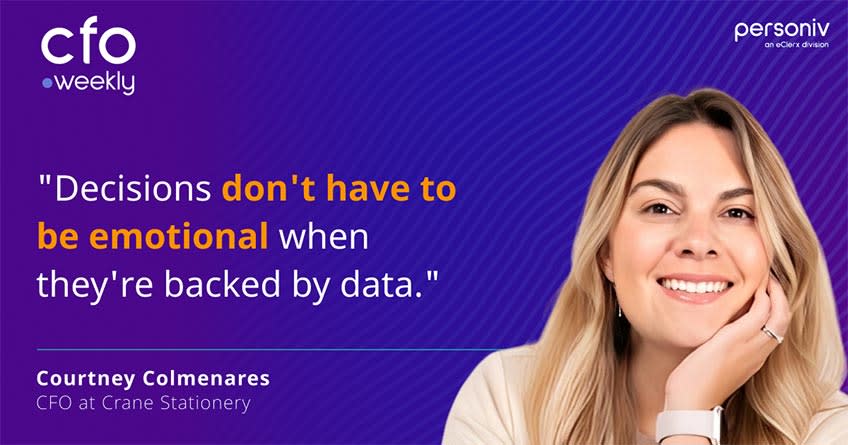
"Decisions don't have to be emotional when they're backed by data." Colmenares revealed. - 00:02:00 – 00:03:57
Building a Lakehouse from Scratch: Why the CFO Becomes Chief Data Officer
When Courtney joined a $10M startup with a lean team and no data infrastructure, she didn't wait for the right ERP or the perfect system. She built a small data lakehouse herself, pulling data from QuickBooks and every business system into one source, spinning up daily dashboards, and giving the team the visibility they needed to move fast. That experience made one thing clear: in organizations between $10M and $100M in revenue, there is almost never a chief data officer. That role, Courtney argues, belongs to the CFO by default because finance sees everything, from the first transaction to the final report.
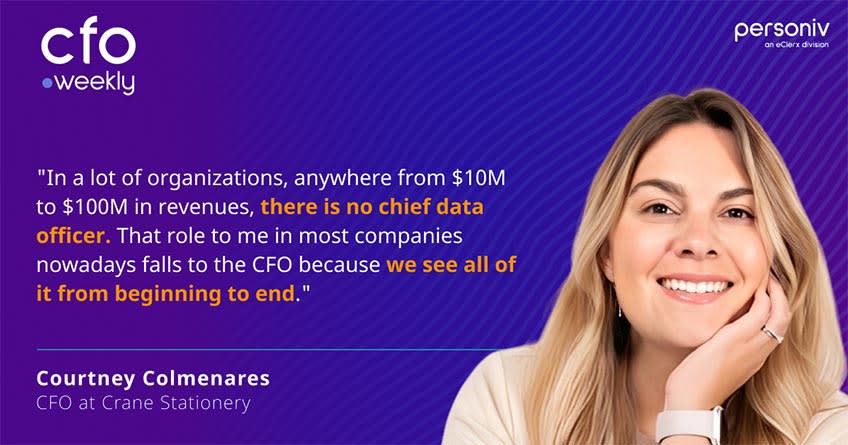
"In a lot of organizations, anywhere from $10M to $100M in revenues, there is no chief data officer. That role to me in most companies nowadays falls to the CFO because we see all of it from beginning to end." Colmenares highlighted. - 00:05:08 – 00:07:35
The Three Pillars of Owning the Data Stack
For Courtney, owning the data stack is not about writing code or building dashboards. It means three things. First, understanding the architecture: knowing where data lives, how it flows through systems, and where it could break. Second, being the source of truth: ensuring the general ledger is complete, accurate, and trusted across the organization at all times. Third, owning the decision layer: knowing which KPIs to surface, which red flags to flag early, and which trailing and leading indicators to bring to the leadership table on time, not two months after the quarter closes.
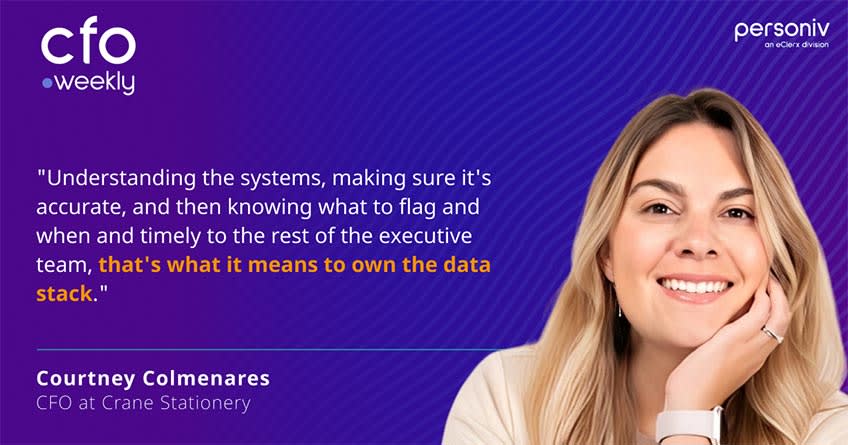
"Understanding the systems, making sure it's accurate, and then knowing what to flag and when and timely to the rest of the executive team, that's what it means to own the data stack." Colmenares explained. - 00:07:35 – 00:09:15
Don't Let Perfect Be the Enemy of Visible
The most common roadblock Courtney sees is companies holding themselves hostage waiting for a perfect ERP or perfectly clean data before they start making decisions. Her answer is simple: don't wait. She works in layers. Bronze, raw, messy data first. And standardizes just enough to join datasets and surface insights. At Crane Stationery, joining two separate sales reports into a single view unlocked pricing changes, staffing decisions, and cross-channel insights almost immediately. None of that would have happened if they'd waited two years for a new system.
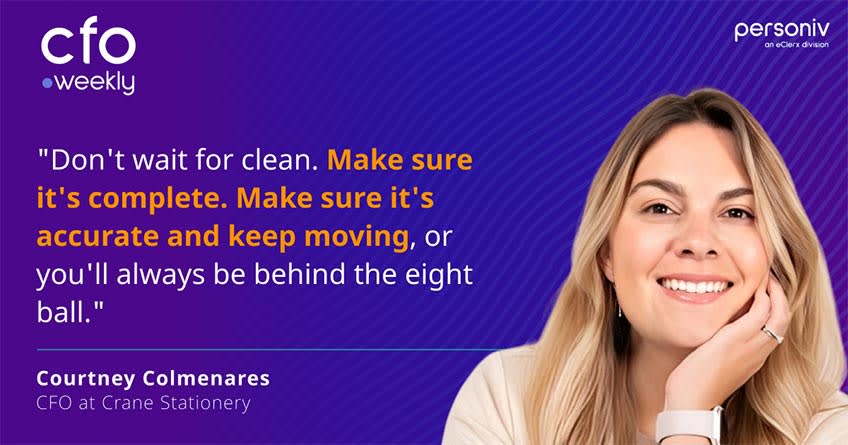
As Colmenares said, "Don't wait for clean. Make sure it's complete. Make sure it's accurate and keep moving, or you'll always be behind the eight ball." - 00:11:32 – 00:14:35
Trust Is Built One Report at a Time
For Courtney, the accuracy of every report is non-negotiable. Every daily report her team publishes includes a reconciliation file that ties back to the general ledger before it goes out even if that means it lands at 10AM instead of 8AM. The worst thing a finance team can do is send out a report that turns out to be wrong. Regaining that trust is hard. On the useful side, Courtney is equally disciplined: she kills reports that no one is using, constantly checks in with department heads, and iterates reporting packages in real time. The goal is not volume, it's that someone somewhere says that helped me make a decision.

"Nothing's more valuable than when someone says, that helped me make a decision or that helped me spot an issue." Colmenares remarked. - 00:19:04 – 00:21:39
The CFO as Chief Data Officer
Courtney sees the CFO role evolving dramatically over the next five to ten years. AI literacy will be essential not just knowing which tools exist, but understanding what to automate, what to keep human, and how all of it fits within the organization's security posture. The transactional and reporting work won't disappear, but it will be increasingly automated. What remains for the CFO is the strategic, high-touch work: capital allocation, scenario planning, organizational design, and serving as the spoke in the middle of the wheel that integrates every function in the business.

"The CFO role is really going to continue to lean more into that operator role and what's going to be left is the strategic high-level work: capital allocation, scenario planning, organizational design." Colmenares noted. - 00:24:02 – 00:25:40
Want more insights? Explore our full library of podcast blogs here.
To listen to the full conversations, check us out on Apple Podcasts, Spotify, and our RSS or your favorite podcast player!
Instructions on how to follow, rate, and review CFO-Weekly are here.
Transitioning to a model with the CFO as chief data officer requires serious bandwidth. We provide scalable, dedicated finance teams to handle the day-to-day operations, freeing you up to lead your data strategy. Drop us a line today to learn more.


