


Does your organization’s finance function feel stuck in the past, bogged down by manual processes and siloed data? If so, it’s time for a major shift in your organizational structure and operating procedures. Finance transformation isn’t as easy as upgrading your IT or adding another finance team member. It involves changing your fundamental strategy and approach in your finance function. In this article, we’ll break down a finance transformation roadmap for CFOs, including a seven-step process you can follow, how to prepare your team, and ways to avoid common challenges.
Key Takeaways
-
A successful finance transformation roadmap for CFOs moves beyond simple IT upgrades, fundamentally overhauling the operating model to maximize value creation rather than just cutting costs.
-
Transformation requires a comprehensive seven-phase approach, starting with a thorough assessment of current inefficiencies and extending through continuous post-implementation optimization.
-
CFOs must champion the initiative by clearly communicating the vision, bridging the gap between high-level strategy and execution, and mitigating cultural resistance.
-
Leveraging finance and accounting outsourcing alongside new technologies like AI and automation is a proven strategy for filling talent gaps and keeping transformation budgets lean.
Table of Contents
- What is Finance Transformation?
- What Finance Transformation Means Today
- Why Finance Transformation Initiatives Fail
- The Finance Transformation Roadmap for CFOs (+ Infographic)
- How CFOs Can Prepare for a Successful Implementation
- How to Prepare Your Finance Team
- Technologies For Finance Transformation
- Common Finance Transformation Challenges
- Choosing the Right Finance Transformation Partner
- How to Measure the Success of Finance Transformation
- Frequently Asked Questions
What is Finance Transformation?

Finance transformation involves overhauling your company’s finance function strategy. It combines process, system, and organizational changes across the business by selecting strategic technologies, engaging in staff training, and completing thorough analysis.
Finance transformation initiatives are not simple IT projects, digital upgrades, routine accounting changes, or cost-cutting initiatives. Instead, they take on a broader role and change your core operating model.
What Finance Transformation Really Means Today for CFOs

CFOs play a direct role in the success of finance transformation initiatives. In fact, 79% of CFO respondents in a recent Gartner survey agreed that leading transformation was a top priority. CFOs bridge the gap between high-level management strategy and execution in business units. Here are four main roles of Chief Financial Officers in the finance transformation roadmap:
-
Developing Frameworks and Milestones – CFOs refine the structure, focus, and milestones of finance transformation. They keep teams engaged, milestones achievable, and visions clear.
-
Selecting Tools and Resources – The success of finance transformation relies on integrating the right tools and resources into finance operations, such as process automation with machine learning and AI.
-
Solidifying Leadership Teams – Finance transformation can identify new deficiencies in the finance function. CFOs focus on finding and correcting these problems to keep the transformation moving forward.
-
Creating Accurate Budgets – Finance transformation can be expensive. CFOs maximize tight budgets by carefully allocating resources.
Want to hear how industry leaders are tackling these exact initiatives? Check out the key takeaways from our recent Tech + Talent Webinar on Finance Transformation.
The Evolution of Finance Transformation: Creating a Practical Roadmap for CFOs
The definition and scope of finance transformation have evolved over the past few decades. In the early days of automation, finance transformation focused on implementing ERP systems, eliminating manual and mundane tasks, and developing digital workflows. Today, many organizations have already integrated these items into their finance function strategy. Now, finance leaders are tasked with integrating the latest tools, like GenAI, and creating a cross-functional strategy that maximizes value creation, not cost-cutting.
Why Most Finance Transformation Initiatives Fail

Not all finance transformation initiatives are successful. In fact, 70% of CFO respondents in a recent survey described their transformation as “less impactful.” Take a look at Lidl, a discount grocery chain. Lidl spent seven years integrating a new ERP system into over 10,000 stores. After spending $580 million, Lidl abandoned the project in 2018 and went back to its existing system.
What went wrong? For one, Lidl was unwilling to change other business processes that clashed with the ERP system's best practices. Lidl recorded inventory based on purchase prices, while the ERP platform used retail prices. Second, the transformation timeframe extended well beyond the intended timeframe, racking up costs and testing management's patience.
Lidl isn’t a one-off case. Revlon’s 2018 ERP update resulted in nearly $64 million of shipment disruptions. Without a clear roadmap, achieving a successful finance transformation can be difficult.
The Finance Transformation Roadmap for CFOs
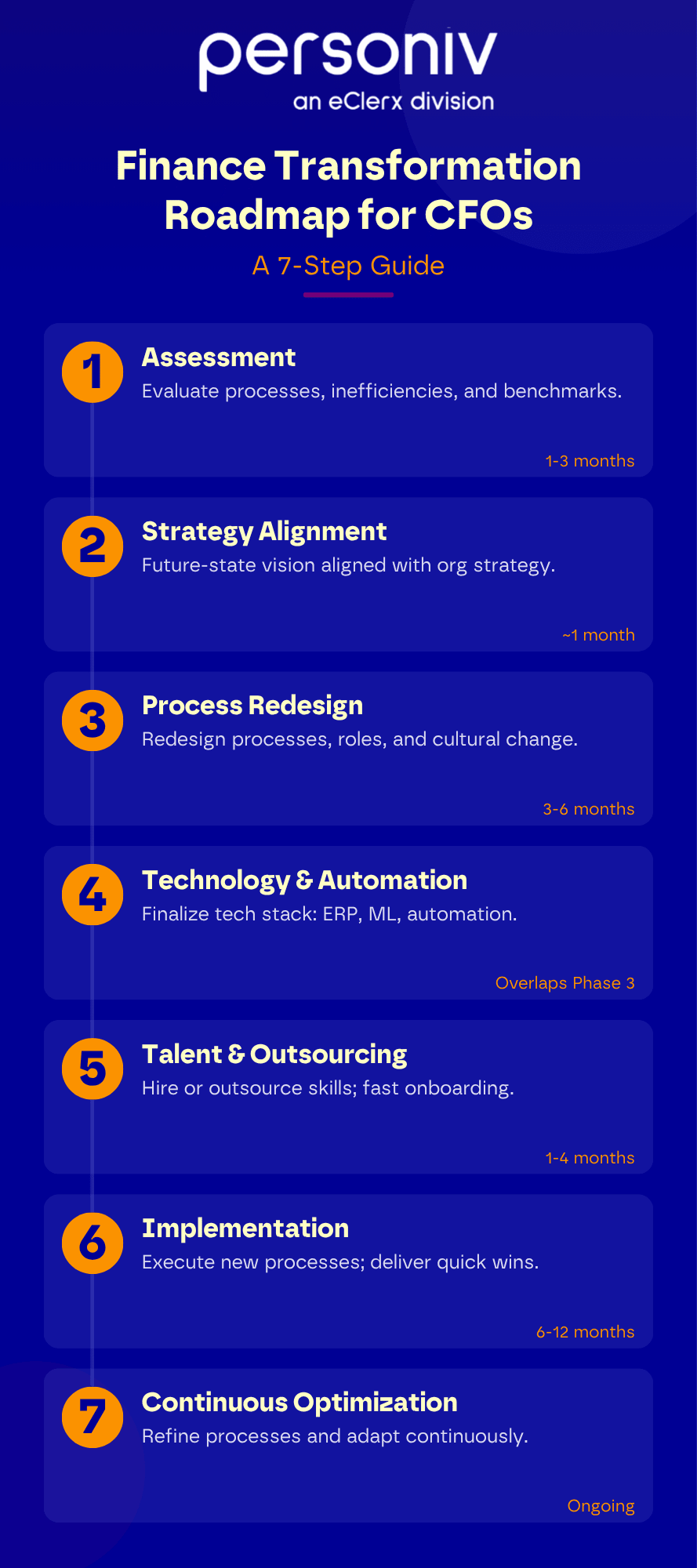
The steps for successful finance transformation will look slightly different for every organization. Nevertheless, let’s explore a typical finance transformation roadmap for CFOs.
Phase 1: Assessment
The first phase in finance transformation is assessment. What are your current processes? What are the pain points and inefficiencies in your organization? How does your organization compare to others in your industry? In this phase, you are taking the time to complete a comprehensive assessment of your finance function. Evaluate the following areas:
-
Closing cycles
-
Mundane and manual tasks
-
Reporting and analytics
-
Operational silos
-
Regulatory compliance
-
Data standardization
-
Cost optimization
-
Risk management
Timeline: Your assessment shouldn’t happen in one day. Instead, you should keep track of pain points and inefficiencies over the course of one to three months to get a full picture.
Phase 2: Strategy Alignment
After you’ve completed your initial assessment, it’s time to develop a vision. Where do you see your business in the next year? How about in the next five to ten years? What type of transformation is needed to reach that vision? Aligning pain points with your strategy will help you solidify finance transformation initiatives.
Let’s say modernizing the finance function is one of your CFO priorities. Your finance function strategy might include expanding process automation with GenAI, adjusting your management strategy, or acquiring team members or finance leaders with a new skill set. Back into the finance transformation that’s needed now to achieve your vision in the future.
Timeline: The strategy alignment phase timeline will take around a month. During this time, you will conduct basic research on potential solutions. A deep dive into practical finance transformation steps will happen in the next phase.
Phase 3: Process Redesign
Finance transformation doesn’t focus on one area. Instead, it overhauls every aspect of finance organizations. What technology is needed for effective finance transformation? What is your budget? Who is involved in the finance transformation? How will you handle cultural resistance? What is the most effective allocation of your resources? Every detail of the finance transformation will need to be defined.
When redesigning processes, it’s important to keep regulatory compliance in mind. Ensure your implementation complies with applicable laws and regulations, keep clear documentation for audit purposes, integrate controls directly into your processes, and establish process ownership to improve consistency.
Timeline: Process redesign can be one of the longest phases in the process, especially if you need to get different levels of approval, such as from a board of directors. Three to six months of finding the right processes is common.
Phase 4: Technology & Automation
In the process redesign phase, we touched on finding the right technology. Phase four will solidify your new tech stack. Finance technology can get expensive, which is why prioritizing is important. Let’s say that your finance function strategy is to consolidate business units with machine learning. While your operating model could benefit from specialized forecasting software, that’s not the main goal. Instead, you might invest in a new ERP system.
Timeline: Phase four is often completed in conjunction with or during the process redesign phase. Getting a full picture of your process redesign relies on identifying the applicable technology and automation needed.
Phase 5: Talent & Outsourcing
If part of your finance transformation involves adding new talent, Phase 5 is when you will start the hiring or outsourcing process. What skill set are you looking for? Do you need to rework your leadership team or hire support staff? Is outsourcing a cost-effective solution for tight budgets?
Just like selecting the right technology is crucial to finance operations, so is onboarding the right talent. As a result, many companies enlist the help of a recruiter. The role of a finance recruiter is to source the right candidate based on your needs.
In some cases, hiring an employee is the opposite of what your finance function needs. Instead, it makes more sense to outsource. Phase 5 also involves finding the right outsourced provider.
Need a deeper dive into filling talent gaps? Read our guide on leveraging outsourcing for finance transformation.
Timeline: Finding the right talent can take time. If you are onboarding a specialized employee, expect the process to take two to four months. Outsourcing is a much quicker process, with the onboarding process taking less than a month once you select your provider.
Phase 6: Implementation
Phase 6 is where all of your research and due diligence gets put into action. The implementation phase is the most critical and is bound to come with challenges, like cultural resistance. Part of being a transformational CFO is identifying these issues quickly and finding viable solutions.
At the same time, celebrating quick wins can also help your team overcome hurdles in both the short-term and long-term. For example, if leveraging technologies is part of your finance transformation roadmap, maybe you start with one segment, like AR or AP. Once your team masters this, you add another segment. Use quick wins as a way to motivate your team and take the implementation process slowly.
Timeline: The implementation phase will be one of the longest phases, taking anywhere from six to twelve months, depending on your finance transformation goals.
Phase 7: Continuous Optimization
Successful finance transformation requires continuous adjustments. For example, after leveraging technologies to eliminate silos, you might uncover new shortcomings, like a lack of staff. As Chief Financial Officer, it’s your job to continuously optimize your finance transformation framework. Modernizing the finance function can take years of adjustments and innovation before it’s operating at peak performance.
Timeline: Operating model improvements are ongoing, with no set timeline.
How CFOs Can Prepare for a Successful Finance Transformation Implementation

Finance transformation best practices for CFOs vary based on your strategic goals and objectives. However, all finance transformations require strong leadership, clear communication, risk assessments, and organization. Set clear goals and expectations and celebrate quick wins throughout the implementation process.
Preparation might also involve working with a finance transformation partner. While you might have decades of experience as a CFO, you might not know the ins and outs of certain finance transformations, like new technology implementation. Partnering with an expert from the start can give you the leverage needed for a successful implementation.
How to Prepare Your Finance Team

All team members in finance organizations need to be prepared for finance transformation. Here are four ways to prepare your finance team to increase your odds of a successful finance transformation:
-
Clearly Communicate Vision – Your vision should be shared with your finance team. Sharing your “why” gets them excited and on board for finance transformation.
-
Identify Gaps – If your finance team is already spread thin, you may face pushback on finance transformation. Identifying these gaps early will help you bring on the right support.
-
Offer Training – Finance transformation brings new skill requirements. Address these learning curves by offering training.
-
Assign Tasks – Assigning tasks and responsibilities to team members can improve adoption and success. These leaders also serve as great resources to guide team members who may be struggling with the new finance function strategy.
Technologies For Finance Transformation

Finance transformation best practices almost always include adopting new technology. There are countless types of technology that your operating model can benefit from, such as risk management software or performance management software. These programs include fundamental technologies, including:
-
Artificial Intelligence – Often used for predictive analytics and automated reporting
-
Cloud Computing – A scalable option for growing finance teams
-
Blockchain – A secure way to initiate smart contracts and transactions
-
Big Data Analytics – An option for finance teams to break down large datasets into meaningful planning and forecasting tools
-
Generative AI – A way to generate real-time reporting and insights
-
Regulatory Technology – A strategy for automating compliance and reporting
The role of finance technology is to aid your finance team with the day-to-day tasks. Finance transformation in your organization might include some or all of the above technology options.
Common Finance Transformation Challenges (And How to Avoid Them)

Challenges are common in finance transformation. In fact, it’s almost always guaranteed that you will hit some type of roadblock as a transformational CFO. Let’s explore four of the top challenges and how you can avoid them.
Cultural Resistance
Team members might be hesitant to change, especially if they’ve been using old processes and tools for years. Assigning ownership and responsibility of different tasks, keeping everyone informed, and clearly sharing your vision and “why” are great ways to overcome cultural resistance.
Poor Finance Transformation Strategy vs. A Real Roadmap for CFOs
A poor and unclear strategy can lead to a less-than-successful implementation. Take the time during the assessment and strategy alignment phase to work out all of the granular details of your finance transformation.
Talent Gaps
Talent gaps can lead to cultural resistance and an unsuccessful implementation. During the assessment phase, thoroughly evaluate your existing team to find gaps that need to be filled.
Tech Issues
Technology isn’t perfect. Tech issues, such as a break in communication between systems or poor team training, can cause your finance transformation to fail. Taking feedback from your team and constantly adjusting your processes are great ways to minimize tech issues.
Choosing the Right Finance Transformation Partner Checklist

As a CFO, you don’t have to handle finance transformation on your own. In fact, working with a trusted expert can improve your chances of a successful transformation. Here are ten questions to ask a finance transformation vendor:
-
What is your experience related to finance transformation?
-
Have you worked with organizations in my industry and of my size?
-
Can you describe the typical transformation process?
-
How do you ensure a successful finance transformation?
-
How will you handle change management across the entire organization?
-
What are the tangible benefits you offer?
-
How do you ensure collaboration between business units?
-
How have you handled conflicting priorities in previous projects?
-
Do you provide ongoing support for continuous improvement?
-
How do you measure success?
Want a more comprehensive guide on vetting providers? Read: Choosing the Right Finance Outsourcing Partners: A CFO’s Checklist.
How CFOs Can Measure the Success of Finance Transformation

Measuring the success of finance transformation generally involves tracking specific KPIs and financial function benchmarking related to efficiency, value, accuracy, and costs. For example, if your goal was to reduce the timeframe for month-end close, you would measure the time it took prior to the transformation and compare it to the time after the transformation.
To effectively benchmark your transformation, tracking the right metrics is critical. Discover which numbers matter most in our guide to finance KPIs.
Where Personiv Fits into Finance Transformation

Finance transformation is a monumental undertaking, but you don't have to navigate it alone. Transitioning your operating model requires balancing new technology with the right talent.
We can help facilitate effective finance transformation in your organization. Our team of outsourced professionals can help you move through each phase of the finance transformation roadmap, from the initial assessment to making adjustments post-implementation. If you’re ready to unlock finance transformation, reach out to our team members for a consultation today.
Frequently Asked Questions


