


In this episode of CFO Weekly, Jared Shulman, Co-Founder and CEO of Daylit, joins Megan Weis to explore how AI agents are fundamentally transforming accounts receivable and how leaders can navigate the complexities of triple spend AI adoption without getting stuck in a costly trap. Jared brings a unique perspective shaped by his background in credit and hedge funds as a CFA charterholder, his entrepreneurial journey into fintech, and his role teaching the next generation of finance leaders at Babson College.
With deep experience underwriting accounts receivable portfolios and building AI-powered financial platforms, Jared shares how Daylit has evolved from an AI factoring and credit company into the leading AI agents platform for accounts receivable, having recently raised $110M in equity and debt funding. He unpacks why finance teams are currently caught in a "triple spend" trap, why the future belongs to teams that move from operators to architects, and how headless finance is no longer a distant concept.
Show/Hide Transcript
Megan Weis - 00:50
Welcome back to CFO Weekly. Today, I'm joined by Jared Shulman, cofounder and CEO of Daylit, a fast-growing fintech platform bringing AI agents to accounts receivable and working capital management. Daylit helps businesses automate collections, resolve disputes, predict cash flow, and unlock financing through a smarter, more connected receivables platform. The company recently secured $110,000,000 in equity and debt funding to accelerate its growth and expand its AI capabilities. In this episode, we'll unpack the SaaS reckoning in finance, why finance leaders should consider pausing certain SaaS purchases and invest in building their team's AI fluency. Welcome to the show, Jared.
Jared - 01:39
Thanks so much for having me.
Megan Weis - 01:40
So when you look back at the beginning of your career, was there a specific experience that first showed you how much inefficiency in receivables and cash flow can hold a business back?
Jared - 01:52
Yes. There was. But with your permission, I'll tell a different story that I think will help lead into our main discussion around this AI wave, and we'll pick up some of the inefficiencies in cash flow and receivables along the way. Because we're at this turning point, at least this is the way that we see the world and our customers that we talk to see the world where this AI wave is really changing the way that people are working.
You talked about the beginning of my career, and the question I go back to is my first job out of school. My background is I grew up in the hedge fund space. I'm a CFA charterholder and worked at various hedge funds, much of them in the credit space, underwriting accounts receivable portfolios. But my first job out of college, I was an equity trader, and I'll never forget, it was this turning point in my career. I went to this prime broker. He brought us up to his office. He was trying to show off how impressive his firm was. It was a top floor, huge building in Manhattan, and we got there. And it was a football field full of empty desks, Bloomberg terminals. There were basically two people there, and everyone had been laid off and replaced with algorithmic traders. It was the turning point in the equity space where the markets were starting to get way more efficient.
I bring that up not to scare anyone, but we see there's this big turning point that's happening today. It's happening really quickly where work that used to be done on a manual or management basis is now happening through technology. We can talk about today what's happening in cash flow receivables, accounts receivable teams, but it was, for better or worse, very early in my career that I saw just how quickly technology can change. In my case, I went on to YouTube and taught myself how to write Python scripts, and that's what brought me here today. But there's a lot of ways to keep up with what's happening and prepare for it. It's a really fascinating and interesting time to be in the market in the seat of any finance professional.
Megan Weis - 04:05
It really is. I think it's very exciting what's ahead for finance and accounting. Maybe a little scary too, but mostly exciting.
Jared - 04:12
It can be scary. I think it's natural. I was just at this conference last week, and I'm overhearing the murmurs of the crowd and talking to people. Some people are like, "Hey. I got five years left to retirement. Do I really have to learn this AI thing?" And the consensus was, "Hey. In five years, so much can change." Talk about five months. I think people are really, at this point in their career, weighing where they are and if they should learn it. The consensus is it's really time to lean in, really time to learn. By the way, learning how to become fluent in AI, which is something that we spend a lot of time talking about, is a lot more accessible than I think a lot of people realize.
Megan Weis - 04:56
So let's talk about that. How would you go about becoming fluent in AI?
Jared - 05:03
Yeah. If only back in the day, at least for me, maybe I'm dating myself a bit, but there was a Rosetta Stone. I don't know if Rosetta Stone is putting out an AI course. They probably should. That'd be another company pivoting to AI.
Maybe for starters, we can talk a little bit about how we see the world in terms of AI purchasing today for the suite of the CFO. Again, we're here to talk about this transformation that's happening in the CFO suite from the CFO all the way down to administrative workers, staff accountants, people that are handling the day-to-day. When we look at what's happening in the market, we think that there's this what we call triple spend or three x spend on AI right now.
What we mean by that is today, finance teams have their existing stack of legacy software. They have their ERP. They have all of these add-ons on top of it. They have workflow-specific tools that are bespoke to them or have been installed on top of the ERP through an implementation team. What's happening is they're feeling this big urge to go out and purchase AI to keep up with the trend or get ahead of the trend. We consider that the second purchase. You have your spend on legacy software, and then you're bolting on this AI.
But there's this hidden third cost, which is this idea of implementation and deployment. What I mean by that is if you look at where a lot of these big AI labs are spending their time, it's working with companies like Deloitte, like Accenture, as professional services to come in and basically install the software and upskill the workforce on how to use the software. You have this triple spend that's happening. Many of the times when people go and buy AI software, they're getting hit three times. They're paying for the legacy software, they're bolting on AI, and they have to go and train their staff on how to use it.
Our vision or where we see the world heading is to reduce two of those three spends by really spending that time and encouraging your team to become fluent in AI. We can talk a little bit more about what fluency means, but our belief is that by becoming fluent in AI, you can start to implement these agents. Most importantly, you can start to reduce the spend on your legacy software, replacing that with some natural AI skills using things like Claude Cowork or Claude Code. You start building some of these bespoke legacy softwares yourself and going directly to what we call the good stuff—going directly to these AI agents so you're not building on top of this old school legacy software. That's really what we think about when we talk about AI fluency: reducing that triple spend and going directly to the good stuff, directly to the AI agents.
Megan Weis - 08:20
So talk to me a little bit about Daylit. What is it that you guys do, and how did it come to be?
Jared - 08:27
Daylit's been around for about five years now. We've helped a thousand plus customers with their accounts receivable. The business got started as an AI factoring and credit company, so our customers would come to us looking for liquidity on their accounts receivable or looking for help on credit—understanding the risks of their buyers—and we ran that business successfully for a few years.
About twenty-four months ago, our customers started to come to us with some pain around collections. This was large manufacturers, distributors, professional services companies, and even tech platforms that are selling B2B and need to staff up a really big team just to get paid on time. Something like 50% of invoices are paid late. We built them a small AI tool about a year and a half ago just to help them get a little bit more scale out of their collections team, and they really liked it. We spent a little bit more time on it. A small little beta group grew into real paying customers.
About twelve months ago, we announced we raised $110,000,000 from some of the top fintech and AI VCs in the country.
Megan Weis - 10:14
Congratulations.
Jared - 10:15
Thank you. Today, we're considered the leading AI agents for accounts receivable platform. Our AI agents have been trained and looked at over $100,000,000,000 worth of AR, and we believe they're the preeminent specialized agents to help customers manage their accounts receivable. When we talk about going directly to the good stuff, directly to the agents, we believe the future will be in the finance stack, becoming fluent in AI and being able to coordinate your systems around these specialized agents like Daylit for AR as an example.
Megan Weis - 10:24
If you had to design a financial stack today for a mid-market company with AI fluency as the goal, what kind of tools would you keep in that stack, and what wouldn't be there?
Jared - 10:37
For starters, we need to start with our system of record. This is a space that we're watching really carefully. There are the new AI-forward or AI-native ERPs, like Rilla and Campfire. I would say that if you're a business that has limited complexity, such as a SaaS-based business or professional services, this is a really great place to start because this is the future of ERP.
As you become a little bit more complex, of course, these SaaS-based leader ERPs like NetSuite, QuickBooks Enterprise, Sage, and Acumatica are good examples, but you want to start with your system of record. Then, on top of that, what we typically see customers begin with when they think about automation is AP and AR. It's not too uncommon for us to see a customer use Ramp on their accounts payable side, and then we're always delighted when we see Daylit as the selection on the accounts receivable side. Of course, in both buckets, there are a few other vendors.
That's what we see as a typical first step. If you're a mid-market business, you're thinking about your ERP, your system of record, and then you're going to automate things in accounts payable and accounts receivable. Those are two really good cost centers that you want to address first and foremost. Then you can start to think about things around the FP&A function and higher-order items.
Megan Weis - 12:18
With all the technology that's available, when you're interacting with your customers, how much of a typical finance team's workflow is still manual despite all of these tools being available, and why is that?
Jared - 12:36
The why is a really interesting part of the answer. I would say 9.9 out of 10 times, there are still many of these workflows that are manual. There's automation built within, but the real promise of these AI agents—and again, we go back to reducing this triple cost and going directly to the agents—is that legacy software, even with automation, still requires a lot of human management.
There are a lot of workflows that require things like monitoring, tagging, or approvals. Of course, those are all important, but with the use of AI agents, our goal and where we see the market heading, especially for the finance team, is they upscale or elevate from operators to architects. Instead of going through and approving every invoice or tagging every account as a "promise to pay" or "dispute," you spend the time as an architect and think about the policies that you want to administer for your organization. If these invoices look like this, auto-approve. If these accounts behave in a certain manner, let's auto-tag and execute a plan against that.
When I say "legacy SaaS," I mean the old school traditional software businesses where much of the workflow is around helping a human operator do some automation, but they still spend time actually clicking around the "last mile." What's exciting about these AI agents is they're promising to deliver an outcome. We really like to see customers who are thinking about not spending their time on that last mile, but rather spending their time architecting the system that can go and deliver there.
Megan Weis - 14:33
When you're talking to finance leaders, what's the biggest misconception you find that they have about AI?
Jared - 14:41
The first thing that always comes up is this idea of hallucination. I don't want to discredit hallucination because it still exists to a certain extent, but I feel like a lot of the customers I talk to who start off as naysayers and eventually convert to customers are anchoring to Chat GPT 1.0 or 2.0.
The gray meme is Will Smith eating spaghetti—this was the litmus test for the quality of AI. When you see the first version of the spaghetti meme, it's very low quality; I wouldn't want something of that caliber to go anywhere near my customers. But today, it's straight out of a movie. That's the first big bucket: there's this anchor to a much earlier version of the models that was a real concern then, but today, it's no longer a concern.
The second thing is security, which is rightfully so. People, especially finance teams, sell to customers in the legal profession, healthcare, and banks. Customer data is so valuable. On the accounts receivable side where we're looking at details around your customers, security is the most important thing. Those are the two checkmarks any company needs to focus on: providing evidence that we've thought about guardrails for quality so agents don't run wild, and guardrails for security.
Megan Weis - 16:40
That's a term I hear a lot from CFOs: "guardrails." What are you going to do if it jumps out of the box and decides to do what it wants to do? So, this idea of "headless finance"—what exactly is it?
Jared - 16:58
It stems from the team over at Salesforce a couple of weeks ago coming out with this idea of a "headless CRM." They asked a really powerful question: "What if you never had to log in to your CRM ever again?" The obvious response is to dismiss it. I always want to see what's happening with my customers and track my dashboards.
But when you start to peel back the onion, you realize that so much of what we do with the CRM is ingesting, posting, or tagging data. How much of that can just happen in a headless manner? Anytime we send an email, it goes into the CRM, but it requires some review, layered judgment, or rules that are architected by a revenue operations team. When it comes to the output, ultimately, our goal is just to drive more revenue and find more customers.
When you peel back what it means to really be headless, you recognize that a lot of that "dashboardification" of legacy software is really just there so that we, the operator, can follow up on an SOP or some sort book. When we think about this idea of headless finance specific to the accounts receivable team, you can apply that same level of logic. What if my accounts receivables team never had to log in to legacy SaaS? What if they were managing the AI agents for accounts receivable the same way they were managing someone who is doing the day-to-day collections against a rulebook, and the rulebook is the source of truth as opposed to the dashboard? We believe the future of purchasing in the CFO suite is trying to get as close to the AI agents to deliver the outcome as possible. It's managing not just humans, but the actual AI agents, and that doesn't necessarily require a dashboard.
Megan Weis - 19:37
And you've said that you can reduce AR cost by up to 75%. Where is that efficiency actually coming from? Is it 75% fewer heads needed, or where does that come from?
Jared - 19:51
The costs per accounts receivable are really threefold. The first and biggest is just the cost of borrowing or the cost of your DSO. Anytime you have money outstanding, there's a cost against your own WACC. For many companies, it's between 10% and 15%. Just by being able to reduce your DSO—in many cases, we reduce it by fifteen or twenty days—you're pulling in cash faster, and it's money that can be reinvested back into the business.
The second piece is around the cost of bad debt. Most people are writing off between twenty and fifty basis points of their revenue every year. A lot of that is just in the long tail. You have maybe a thousand customers, but you're only able to focus on the top 20%. Every year, you know those 800 customers in the long tail slip through the cracks. We help make sure that doesn't happen.
The last piece is the CFO hierarchy. We believe that the future with AI turns the suite of the CFO from a cost center to a value creator or revenue driver. Much of the cost in final mile collections is often overseas or involves people who want to and can be doing more valuable work. Those resources can be redeployed towards higher-value items like supporting an FP&A function or staff accountants. This frees up budget and takes away a really burdensome cost in accounts receivable.
Megan Weis - 22:01
And you teach the next generation of finance leaders at Babson College, correct?
Jared - 22:06
Let's hope so. These Babson kids are incredibly smart, so that's been a lot of fun.
Megan Weis - 22:14
How are you preparing them for the future?
Jared - 22:17
I've been teaching for the last five or six years. I do it for them, but I also do it for me because I love doing it. When AI was first coming out, there was naturally a lot of concern. Today, at Babson—which is known for entrepreneurship—I let the students know this is maybe the greatest time in history to graduate college, especially if you have an entrepreneurial mindset.
I teach a course called Intro to Vibe Coding with Lovable as the backdrop. The barrier to build a business or to create something is lower than it ever has been. I really encourage students to always do two things: one, embrace AI and have a builder mentality because companies will hire for that. Two—and this is free advice to anyone listening—if you're in college, spend your spring break in San Francisco. Go to all the events and parties and soak in what is effectively the center of the universe for AI. The Caribbean will always be there, but right now is a critical time to get deep into what is happening.
Megan Weis - 24:12
Great advice. I hear people wondering if AI is taking away those entry-level jobs from the younger generation and where they're ever going to start if those entry-level jobs are gone. Do you worry about that at all?
Jared - 24:37
I'm a firm believer that AI is just going to be good for society. We're actively hiring right now for specific skill sets. We want people who are hungry to build. I think it was Patrick from BlackLine on one of your previous podcasts talking about the idea of the "generalist." That is the power of what AI is creating: people can come in as a generalist and, even with only a couple of finance courses, they can enter these finance orgs and start building reporting tools or analyzing data in a much more advanced way than exists in their day-to-day software. It's a very exciting time to be a recent grad if you have that mindset.
Megan Weis - 26:07
Last question: how do you see the role of the CFO or the finance organization in general evolving over the next three to five years?
Jared - 26:19
I'd love to see the suite of the CFO start to look a little bit more like a trading floor. Right now, most CFOs would admit it looks more like a cost center. We see AI as a chance to transition to a value driver.
If the CFO and their team's time is spent less on basic reporting, chasing invoices, paying bills, and budgeting, they can start to think more strategically. They can look at access to capital and the landscape for acquisition or expansion. Many businesses have opportunities to hedge. People are already using tools like polymarket.com and Kalshi to hedge inflation prices for inflation-linked wages.
If you are spending all of your time on administrative work, you won't have the resources to be strategic. Our mission statement is to eliminate the mundane. Put these AI agents in charge, architect the system, and then spend your time driving value for the organization. If we can be helpful taking care of that AR headache, we've done our part.
Megan Weis - 28:23
Thank you, Jared, very much for being here today. This has been a great conversation.
Jared - 28:28
Thanks so much for having me. It was a lot of fun, Megan.
Megan Weis - 28:31
I think it's a very exciting time to be in finance and accounting, so I can't wait to see what we're talking about three years from now. Let's check in then and see if we were right. To all of our listeners, please tune in next week. Until then, take care.
What You’ll Learn:
-
Why finance teams are stuck in a triple spend trap when adopting AI
-
How AI agents are elevating finance professionals from operators to architects
-
The concept of headless finance and what it means for the CFO suite
-
Why becoming fluent in AI matters more than buying the latest enterprise tool
-
How Daylit reduces accounts receivable costs by up to 75%
-
What the CFO function could look like in three to five years
Key Takeaways:
The Trading Floor That Changed Everything
Early in his career, Jared witnessed firsthand how quickly technology can displace entire workforces when he visited a prime broker’s office and found a football field of empty desks, cleared out by algorithmic traders. That moment became the lens through which he views today’s AI wave, and it drives his conviction that finance professionals must lean into AI fluency now, not later. The lesson he took was not fear, but urgency and adaptability.
“There’s this big turning point that’s happening today, work that used to be done sort of on a manual or management basis is now happening through technology.” Shulman noted. - 00:01:52 – 00:04:05
The Triple Spend Trap in AI Adoption
Finance teams today are unknowingly paying three times when they adopt AI: once for their existing legacy software stack, again when they bolt on new AI tools, and a third time for the implementation, training, and professional services required to deploy it. Jared argues that the smarter path is building AI fluency so teams can bypass the legacy layer entirely and go directly to purpose-built AI agents, reducing two of those three costs and accelerating time to value.
“Our belief is that by becoming fluent in AI, you can start to reduce the spend on your legacy software. Going directly to what we call the good stuff, going directly to these AI agents.” Shulman pointed out. - 00:05:03 – 00:08:20
From Operators to Architects
Despite the abundance of automation tools available, the vast majority of finance workflows still require significant human management. Legacy SaaS platforms were designed around helping human operators execute automation, not replace it. AI agents change this dynamic entirely by delivering outcomes rather than facilitating clicks. The future of finance teams is not managing dashboards but architecting the policies, rules, and decision logic that allow AI agents to execute with minimal human intervention.
In Shulman's words, “The real promise of these AI agents is, the finance team, they upscale or they elevate from operators to architects.” - 00:12:36 – 00:14:33
Where the 75% Cost Reduction Actually Comes From (Escaping the Triple Spend Trap in AI)
Daylit’s up to 75% reduction in AR costs comes from three distinct sources. First, reducing days sales outstanding by 15 to 20 days directly lowers the weighted average cost of capital on outstanding receivables. Second, AI agents address the long tail of customers that human teams can’t realistically focus on, cutting the 20 to 50 basis points of annual bad debt write-offs. Third, by automating final-mile collections work, finance teams can redeploy headcount toward higher-value activities like FP&A support and strategic analysis, transforming the CFO function from cost center to value driver.
“We believe that the future with AI turns the suite of the CFO from what’s traditionally been a cost center to, like, value creation, like a revenue or value driver.” Shulman remarked. - 00:19:51 – 00:22:01
Preparing the Next Generation at Babson College
As a lecturer at Babson College, Jared teaches an introductory vibe coding course using Lovable as the backdrop, emphasizing that barriers to building a business have never been lower. He encourages students to embrace AI with a builder mentality, spend time in the center of the AI universe in San Francisco, and recognize that the generalist skillset AI enables is increasingly what employers are hiring for. Rather than worrying that AI is eliminating entry-level roles, Jared sees it as creating more accessible paths into finance and entrepreneurship for adaptable, hungry graduates.
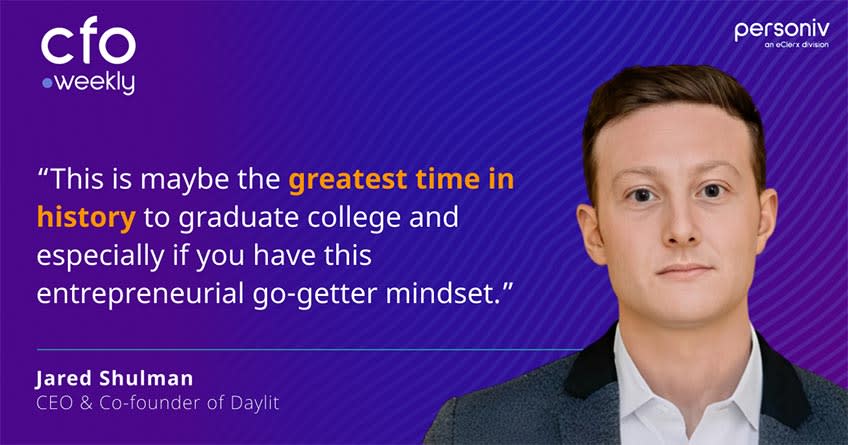
“This is maybe the greatest time in history to graduate college and especially if you have this entrepreneurial go-getter mindset.” Shulman commented. - 00:22:06 – 00:25:40
The CFO Suite as a Trading Floor: Breaking the Triple Spend Trap
Jared’s vision for the CFO function three to five years from now looks less like a traditional cost center and more like a trading floor, where the team’s time is freed from reporting, invoice chasing, and budgeting cycle management and redirected toward capital allocation strategy, hedging, acquisition evaluation, and investment decisions. AI makes this possible by eliminating the mundane, architecting the agents to handle routine execution, and empowering finance leaders to become genuine value drivers for their organizations.
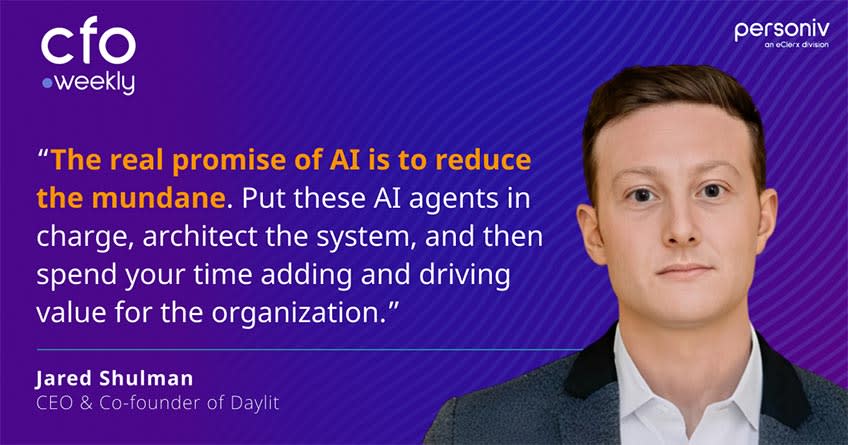
“The real promise of AI is to reduce the mundane. Put these AI agents in charge, architect the system, and then spend your time adding and driving value for the organization.” Shulman highlighted. - 00:26:07 – 00:28:23
Want more insights? Explore our full library of podcast blogs here.
To listen to the full conversations, check us out on Apple Podcasts, Spotify, and our RSS or your favorite podcast player!
Instructions on how to follow, rate, and review CFO-Weekly are here.
Ready to modernize your accounts receivable without falling into the trap of triple-spend AI adoption? We provide the scalable talent and expertise to help you transition to an AI-driven architectural model effectively. Contact us today to learn how we can support your transformation.


