


In this episode of CFO Weekly, Hari Sankar, Senior Vice President of Applications Development at Oracle, joins Megan Weis to explore how cloud technology, automation, and AI embedded in financial systems of record are fundamentally transforming the office of the CFO. Hari brings over thirty years of experience driving enterprise transformation and is at the forefront of integrating AI into finance functions, having led Oracle’s journey with AI-powered finance tools, including their autonomous database and cloud infrastructure.
With a career shaped by a pivotal insight from an MBA classmate over dinner, that finance had a substantial unmet need for analytics and planning software, Hari has spent fifteen years championing the cause of CFOs burdened by manual processes and disconnected systems. Now at Oracle, he oversees AI-powered solutions embedded directly into core finance platforms, helping organizations move from reactive scorekeeping to predictive, agentic operations.
Show/Hide Transcript
Megan - 0:49: Welcome back to CFO Weekly. Today, I'm joined by Hari Sankar, senior vice president of applications development at Oracle, a leader in cloud technology and AI driven solutions. Hari has over thirty years of experience in driving enterprise transformation and is at the forefront of integrating AI into finance functions. He's led Oracle's journey with AI powered finance tools, including their autonomous database and cloud infrastructure. Welcome, Hari. Thank you so much for being here today.
Hari - 1:20: Thank you, Megan. It's great to be here with you.
Megan - 1:23: So your career spans several roles at Oracle and beyond. How is it that you first got interested in the intersection of finance and technology, first question? And second part of that question is, was there a particular moment or project that really piqued your interest in transforming business operations? So we'll start with the first question of how you first got interested in technology and finance.
Hari - 1:49: Sure. As you mentioned, I've had a number of different roles, all of them in the software industry. Many years ago, I was with a company that developed analytics and planning software for the marketing function. As you probably know, we're early adopters of analytics software and planning software, and they're pretty sophisticated in their use of software for doing these things. Over dinner one day, an MBA classmate of mine suggested that the finance function had a substantial unmet need for similar software to do planning and analytics. So this is what sort of got me first interested at the intersection of finance and specifically analytics and planning technology. So to the second part of the question, what I did was I thought through this for a while, and then I started having conversations with people in finance, some people in FP&A, some CFOs, some senior finance people on the accounting side, just to understand how analytics software and planning software was used in finance and how these functions were being performed back then. This was over fifteen years ago. I won't go into a lot of gory detail, but the simple answer was that back then it was done mostly with what I would call blood, sweat and Excel. That told me that there is a lot of opportunity here for helping people in finance with analytics and planning software. So that was really the moment which set me on a path to focus on the needs of the finance function. I've been enjoying my ride through the finance function for a good part of fifteen years now.
Megan - 3:16: Curious to know, do you think that finance is late to adopt these sorts of technologies or just that providers are slow to give good solutions?
Hari - 3:27: Good point. It's probably a little bit of both. Finance tends to be conservative. For example, we'll talk more about this in the context of AI and predictive models and so on. Finance tends to be skeptical. I mean, marketing is willing to live with a lot more uncertainty. In finance, a number that's 99% right is still 1% wrong, and 1% wrong is unacceptable to finance. So there are reasons like that as to why finance was a little slower in adopting some of these technologies. To be honest with you, the bar for finance is very, very high. So software makers would go after other functions before they would come to finance because finance are sticklers for prediction, for precision, and repeatability, and auditability, and all of those things.
Megan - 4:09: Very true. And you've seen Oracle evolve from traditional business software to an industry leader in cloud technology. So how have these technological changes impacted the finance function over the years, especially when it comes to automation and predictive capabilities?
Hari - 4:26: I like the way you framed your question. Automation and prediction, as you correctly call out, are the two major areas with a ton of potential, both in the recent past and especially looking ahead. So I'm going to really answer this question, sort of framing those two opportunities. So if you look at the accounting function or more broadly the finance operations part of finance, which includes the controllers team, there are huge opportunities to automate labor intensive processes. Some of these processes are also heavily backend loaded, like closing the books, reporting the results, doing account reconciliations. These are all happening today as chaotic fire drill processes that happen at the end of each month or each quarter. So continuous automation today and going forward, much of this automation will be AI powered. So continuous AI powered automation of these labor intensive processes is the big opportunity number one. The big opportunity number two is really in the use of predictive models, AI powered predictive models, to project forward and provide timely warnings to the business, timely forecasts to the business. I mean, today people struggle with forecasts. I think there is a big opportunity to apply predictive models to improve this process. Hindsight is useful. Looking back and reporting on results as they have happened is useful. But in order to really achieve predictable business performance, you need forward visibility. And that's easier said than done, but that's the promise of AI driven prediction models. These AI driven prediction models will leverage not just financial data, but a combination of financial and operational data from both internal and external sources to provide that forward visibility. So automation and prediction, I think in broad strokes, are the two big opportunities for technology enabling the finance function today and into the future.
Megan - 6:20: And given what can be automated in the function of finance and accounting, how much do you think that businesses have automated? Do you have any guess?
Hari - 6:33: I think there is a lot that remains to be done. There are some organizations that have taken some steps using what people used to call robotic process automation to automate certain tasks or to automate certain pieces of repetitive labor intensive tasks. But there is a lot of manual labor in every part of finance, whether it's accounting or whether it's in the controller's team for closing the books or whether it's for doing reconciliations at the end of the month, or whether it's for gathering data and cleaning data and looking for interesting insights in that data by the FP&A function, or to make plan revisions or do scenario analysis. There's a ton of manual work in all of these kinds of processes that I touched on. So I think it's fair to say that we've barely scratched the surface in terms of the potential for automation within finance.
Megan - 7:24: And how do you see the role of CFOs evolving as automation and AI take on more operational responsibilities?
Hari - 7:32: I think the traditional CFO role, it's fair to say, has centered on governance and compliance. CFOs have historically been the scorekeepers for the official numbers. They've been the owners of the financial systems of record, as well as the reports of record, both for internal and external stakeholders. That role over the past few years has been expanding to include a very important strategic advisory component. So this is where CFOs and their team, they facilitate and influence most of the important operational decisions, which impact revenues, costs, and resource allocation. And not only the operational decisions, also key strategic decisions that shape the organization's future. So the CFOs are taking a much more active role in collaborating across functions and providing strategic advice on decisions, both operational and strategic decisions. So I think AI is going to enable this and extend this even further because AI powered decision analytics and collaboration across the business functions will become a very, very important element of the CFO's job description going forward.
Megan - 8:42: And as you just mentioned, AI has been a game changer in many industries, and finance is, of course, no exception. So can you share how AI is being integrated into Oracle's finance applications and how it's improving financial planning, reporting, and most importantly, decision making?
Hari - 9:01: Sure. At Oracle, for some years, we believe that AI driven finance is the future of finance. This is why we took the decision to embed predictive, generative, and agentic AI capabilities right into the core finance platform. This is the harder way to introduce AI to our customers. The easier thing to do would have been to deliver it as an adjacent layer or as an additional layer. We believe embedding AI right into the core finance platform is the right approach because it will address not only the prediction and automation opportunities that we talked about earlier, but it will deliver them in a way that's right for finance. So let me sort of expand on what I mean by right for finance. As we all know, finance correctly places a lot of emphasis and value on things like security, governance, transparency, and auditability. And finance folks, I mentioned before, are by nature very skeptical. If I give them the world's best AI prediction model that's a black box, they'll never use it. Models need to be transparent. They need to be explainable. So at Oracle, we worked with CFOs for a very long time to address their needs. So we understand these requirements really well. And that's why if you look at it, that understanding more than just the technological prowess is why CFOs trusted Oracle with their systems of record for many, many years. And that's why we believe they will trust us with these AI driven systems of action or systems of automation, whatever you want to call them. So these systems of the future that are AI powered that help with not just keeping data, the systems of record, but also taking action and driving decisions. That's why we believe our customers will trust us with these systems going forward.
Megan - 10:39: And can you maybe share some examples where AI driven insights have helped Oracle's clients transform their financial operations?
Hari - 10:47: As you know well, AI is fast becoming very real for many of our customers. And for many more customers, 2026 is the year for really operationalizing AI in finance. So there are starting to be a lot of customer examples, success stories, case studies that we can share with you. I'm going to share just a handful. The first one is a large defense contractor based in the US. This organization uses AI powered insights to substantially automate the monitoring of business performance metrics. They have a number of different business units. Some are steady state operations, with less variability. So what this customer is doing is managing the monitoring of business performance at these business units, largely using AI powered signals and human intervention is used occasionally for course correction. Otherwise, the monitoring and exception management is all done through AI and pattern recognition. They do have a small number of business units that are much more volatile by nature, because these are more complex business units in certain cases. And this customer focuses their FP&A staff primarily on these more complex, less predictable units with the expectation that over time, AI will drive further automation and stabilize these businesses as they become more predictable in the future. So what they're doing in terms of applying human resources selectively towards more complex operations is a classic example of doing more with less with a lot of help from AI. So that's case study number one. Case study number two, again, a US customer, this customer is in the transportation business. So you'll see that people may think that AI is for heavily digital businesses or these heavily technology centric businesses. We're not seeing that to be the case. We are seeing the application and adoption of AI to be very broad across every industry type. So the second customer is in the transportation business. They make extensive use of AI prediction models, not just for financial KPIs, but also for a broad range of operational metrics. For example, parts failure rates are a key driver of maintenance costs for the business. And that's a major line item in their expense budget. What they're doing is with AI powered prediction models, they're able to project these part failure rates and associated replacement costs with much better precision. So this is improving their overall forecast accuracy. They used to have traditional forecasting methods that were very human centric previously. Now these AI powered prediction models are providing much better prediction accuracy, improving their ability to forecast this big item on their expense budget. And then there are several other customers who use our predictive cash forecasting module to take cash forecasting to a whole different level. What they do is they use granular data on receivables and payables on a continuous basis. Transactional data, if you will, drives prediction models that project cash inflows and cash outflows with a lot of precision. So these customers are starting to see potential improvements in their ability to manage cash and their overall ability to manage working capital as a result. So I just gave you a few examples, but as you can see, the use of AI in finance isn't just about the automation of manual processes. It's really about empowering staff. It's about improving the quality and timeliness of decisions and actions. That's what really excites us, and we'll talk more about this.
Megan - 14:10: Yeah. Such a powerful tool. And you've mentioned the shift from reactive finance to predictive finance. Can you explain what that shift looks like in practice, or how can finance teams start to make this transition, and what tools or technologies are necessary to facilitate this change?
Hari - 14:27: Let's take a step back and quickly summarize the role of financial planning analysis, which is a very key function inside of corporate finance. So the FP&A function as it is called, it's really at a high level about answering two questions that are seemingly simple, but actually very complex. The first question is, where do we stand today in terms of performance against our key performance indicators or KPIs? Where do we stand today is the first question. The second question, which is even harder to answer, is where are we likely to end up at the end of the reporting period, the quarter or fiscal year? So where do we stand today and where are we likely to end up are the two hard questions that FP&A answers on an ongoing basis, and that's really a key part of their job. Today, if you look at it, most FP&A teams spend all their time looking backwards. They collect data from disconnected source systems, they curate that data, often using a lot of manual work. They dump this data into custom crafted Excel spreadsheets that have been developed over many years. They apply Excel magic to put together a reliable picture of current performance. This is a very labor intensive process. This is a very difficult task. And FP&A on a daily basis crunches numbers to answer that first question. Where do we stand today? With AI driven finance, I think, there's the opportunity for us to get curated data from financial as well as operational systems on a continuous basis. And using that data, applying that data to pattern recognition algorithms, we're able to provide continuous visibility into the current performance with much less manual labor. For example, we can set tolerances and limits and exception conditions, and these can be refined by AI over time. So the AI algorithms will pick up issues such as variances, exceptions, anomalies, biases, and they will give you insights automatically. So you don't need to do this daily process of gathering data, cleaning data, crunching that data, looking through the reports to find interesting bits of information. Those interesting bits of insights come to you directly from AI. So as a result of this, FP&A teams will have a lot more bandwidth to focus on forward looking analysis, identify the need for plan revisions, associated actions and decisions to get the business performance back on track. That's a big change in the role of FP&A because they are kind of running to stay in the same place today. AI can free them up from all of that number crunching manual work and give them the insights and help them focus on doing the analysis and making the decisions that really move the needle in terms of business performance.
Megan - 17:03: And so important given how quickly the world is changing these days.
Hari - 17:07: And to the second part of your question, as to what tools and technologies are required, we thought long and hard about this and we finally decided to keep things simple. And that's the advice that we give our customers. Look, AI embedded in your systems of record is the way to go. There are many options, because people will say, build an AI layer, leave your systems alone, we can provide insights through that layer. But we think AI embedded in the systems of record is the right way to go because AI at the end of the day is not just about data. So much of getting AI to work for finance is about the context, the process context, the business context, and the user's role context. These are all vitally important for finance. So you can take data from finance systems and other systems and replicate them into a data lake, or you can layer AI on top of legacy systems. But that would require the recreation of all of this context that I've talked about, the process context, the finance context, the company context, and so on. You need to replicate that elsewhere. And that is super complex and that is error prone. And we believe that's simply not worth the effort. So which is why we advise our customers to keep things simple, use AI embedded within your finance systems. And as your usage gets very sophisticated, there may be opportunities to do things outside of the system of record. But I think for the foreseeable future, many of their needs are going to be addressed well by what we build inside the finance systems of record.
Megan - 18:33: And as we look towards the future, what do you believe will be the key drivers in transformation of the finance function? And how do you see technology shaping the future of financial leadership and organizations?
Hari - 18:45: So I think I want to focus on three key elements in what will be the key drivers of transformation of finance. The first one, and we touched on all of these already, but I'm going to expand on them a little bit. The first one is pervasive automation within finance. As we discussed before, I think automation, we've just barely scratched the surface within the finance function. So there is going to be pervasive automation. That's number one. Number two is insights powered by AI. The third one is cross functional collaboration. So finance is going to become a much more connected function. So automated, insightful, and connected are the words I would use to describe the finance function of the future. Let's elaborate on each of these elements quickly. We talked about this a couple of times already. There's too much manual labor in every aspect of finance, from accounting to finance operations to FP&A, and all the way to statutory reporting. There's far too much manual labor. Agentic AI, we believe, will drive substantial automation of these processes and process flows. That's number one. Number two, prediction models will elevate insights. They will provide a whole different level of analysis, and they will elevate decision making using data powered insights. So these prediction models will make use of financial data as well as operational data from internal systems as well as external systems. So in this process, as you can see, if you're a customer on a connected SaaS platform like Oracle's Fusion Suite, you'll have a huge competitive advantage because you can pull together financial and operational data much more quickly in a much more aligned fashion because the suite is built on a common technology platform and uses a common data model. So it's easy for you to bring the data together and align the data. But if you're on disconnected systems, that process of bringing the data together and aligning the data is a lot of work and a lot of people will give up partway through that effort because it's not a simple task. So that's number two. Number two is about prediction and AI powered insights. And the third one is really about the changing role of finance. The changing role of finance will heavily emphasize cross functional collaboration. It's not just about expertise in accounting rules or financial ratios. Finance will transform truly into a team sport. So this will call for a broadening of skills, roles, and job definitions in the finance context. So I think those are the three key drivers of the transformation of the finance function as we look ahead.
Megan - 21:08: And Oracle's autonomous database is revolutionizing data management. How do you see the relationship between data automation and finance automation? And how can CFOs use these technologies to gain more insights and drive better business outcomes?
Hari - 21:25: I don't think this is a surprise to anyone. Data is probably the most important asset that the company has in many cases, or at least one of the most important assets that a company has. But that's easy to say, but to gather data, clean the data, connect the data, interpret the data correctly, align the data across finance and other functions has been a real challenge for most organizations because systems are disconnected, processes are disconnected. And a simple thing like revenue, if I look at a report that's produced by sales and another report that's produced by finance, they don't line up. Not because there are errors, but there are definitions that are not aligned. Finance may book revenue only when it's recognized, whereas sales may show revenue in the reports as soon as it's booked. So booked revenue versus recognized revenue is the difference, but both are called revenue in that report. So it's not just about the data, it's also about the master data that contains these sorts of definitions. So alignment is a very difficult problem. Cleaning and curation is a very difficult problem. Timeliness of data is a very difficult problem. These are all the problems that Oracle has been solving, as you rightly said, with our database technologies for a long time. But in the finance context, what we are doing is to bring it together in a way that makes sense for finance. Because financial forecasting is not just about looking at financial data, but oftentimes operational data is a leading indicator of financial performance. For instance, in my software business, if I want to understand renewal rates, I shouldn't be looking at my financial data on revenue and bookings and things like that. I should be looking at usage on my fleet. If the usage is high for a certain customer, they will renew. If the usage is low at 50% of what they subscribed for, I know for sure at renewal time, they're not going to renew at the original rate. They're going to renew at a lower rate. So in order to reasonably predict renewal performance, I need to be looking at usage metrics, which are operational metrics. So operational data is a key predictor of financial performance in many cases. So these are all concepts that we understand really well, and we have the expertise in managing data at scale, reliably for a long time. So we bring our infrastructure capabilities and marry it with our expertise in addressing the needs of the finance function, our understanding of the requirements of the finance function. And that's why we think we are in a very good position to solve this problem with finance.
Megan - 23:54: And for many organizations, moving from a manual legacy financial system to an automated system powered by AI can be daunting. So what advice would you give to CFOs who are navigating this transition, and what are some of the common pitfalls to avoid?
Hari - 24:10: You're absolutely correct. I mean, this is a substantial undertaking and CFOs need to be thoughtful in their approach to navigating this transition. A lot depends on the organizational context. Some companies are in a fortunate position where they already have AI expertise or experience and skills within their teams. Many others are just getting started with AI. So the first piece of advice, I'm going to give the CFO listeners a few pieces of advice, so bear with me. The first piece of advice is to pay attention to your organizational readiness. Level up your teams on AI. Bring in AI savvy new hires if needed. Get your teams bought into the potential of AI as a technology that can enrich their jobs and enable them to do better things, higher value added things. So they may have legitimate fears and concerns. Address these fears and concerns head on. If necessary, set up centers of excellence or special interest groups to encourage the organic spread of AI awareness and expertise within your organization. So the first piece of advice really is to pay attention to your organization, specifically your teams, and bring them up on AI skills, AI experience, and AI awareness. The second piece of advice really is to sit down and chart a phased roadmap for AI adoption in finance. You don't have to do big things to start with. Starting small is just fine. Build a few pilots, say in the FP&A function, forecast a few line items on your P&L using AI models and showcase that success and build confidence. It's very important to create early success stories and build on these early success stories to engage more people. And then through that process, drive projects with a larger impact. That's advice number two, chart a phased roadmap for AI adoption. The third piece of advice really is about data. Data is really, really important. Everybody will tell you that. Clean data is really important. But don't get stuck trying to solve the data problem on a wholesale basis because you can spend the next five or ten years doing that. So don't get stuck trying to solve the data problem in the large. Find pockets of opportunity where there is either good data or find AI models or agentic use cases that can handle less than perfect data. Those exist. And if you talk to us or if you talk to your consultants, they will tell you what those use cases are. So over time, establish data discipline, data alignment across systems, and things like that, to improve the quality of your data. But don't try to solve the entire data problem all at once because that's a daunting task for anybody. One more piece of advice that I can give. I would say embrace the agentic mindset. So let me explain what I mean by that. Recognize the potential of AI agents. These are not just about automating point processes. These are not just about providing assistance to your team. It can certainly start with those things like assistance and automation. But I think the potential of AI agents is really in helping your organization reimagine the finance function. Big parts of the finance function, FP&A, finance operations, accounting, things like that. So embrace that mindset in terms of here's the potential and then begin a continuous journey of innovation and reimagination with targeted deployments of agents. You can start small, but increase the scope and impact of these agents as you go forward. So those are some of the elements of advice that we'll give to CFOs. The CFOs come to us and finance leaders come to us to talk about these topics in a lot of detail. So don't hesitate to reach out. We're not just a software vendor, we are also, in many cases, a strategic partner to our customers. So we are happy to discuss these topics, not just technology topics.
Megan - 27:50: Some great pieces of advice. And building on the idea of continuous journey, how do you think the role of the CFO is going to evolve in a world where AI handles more and more tasks? And what new skills should the future CFO focus on to stay ahead of this shift?
Hari - 28:08: I think we touched on this earlier a couple of times, so I'll keep my response here relatively short. As we said before, CFOs will take on a much more strategic advisory role in a world where agentic operations take over. So in that world, CFOs should have a really good understanding of their business. What CFOs do today, but I think they should take it to the next level and really understand the competitive advantages of a given organization. And they should have a much greater level of comfort around operational aspects. If you're a manufacturing company, understand how your manufacturing works. What do you do differently? Where are the costs? And what is your strategic advantage? Is it on time delivery to your customers? Is it superior quality compared to your competitors? Understand those operational aspects really well because your role going forward is not just about number crunching or compliance or governance. It's about really developing a true understanding of your business. And they should also develop really good instincts for the market and the competitive picture in that market. Because the goal is, as a strategic advisor, CFOs have to be very comfortable working across the C-suite to drive, as I said before, not only operational decisions, but also strategic decisions in a highly collaborative manner. So I would say those are the skills: business instincts, a truly deep understanding of the business, the competition, the marketplace, so that you can sit across the table with your peers and be an equal partner in driving operational and strategic decisions.
Megan - 29:39: And as you continue to lead Oracle's financial technology initiatives, what excites you the most about the future of finance automation?
Hari - 29:48: Most organizations will start with thinking of agents as assistants, and then they'll think about automation of processes that are narrow in scope. I think there is a potential for what I would call agentic operations in finance. So a lot of processes will be driven by agentic technology. So that will open up the door to reinvent the finance function. I mean, that's what really excites me the most because we truly believe at Oracle that this is a once in a lifetime opportunity for CFOs to rethink core finance processes, to reimagine functions within finance like accounting and FP&A, and redefine jobs and roles. So it's not just about automating how things are done today. You may do a little bit of that, but that's not the big picture. That's not where the big payoff is. It's really about reimagining these processes. And through that reimagination process, CFOs will find a way to deliver compelling value to the organization and all its stakeholders. This is what excites us the most, and we really look forward to partnering with our customers in this journey of reimagination and reinvention of the finance function.
Megan - 30:56: And to wrap up, what key piece of advice would you like to leave listeners with to make the most of the opportunities that lie ahead?
Hari - 31:04: I think I'm going to stick to one piece of advice. The biggest piece of advice of all: don't sit on the sidelines. AI is real now, it's real today, and 2026 is the year to operationalize AI within your finance function. So my advice is take the first steps to get there. If you've already started with AI, then accelerate AI adoption because the opportunity is real. The value proposition of AI in finance is very compelling, and those CFOs who take decisive action today will truly shape the future of their organizations. So my advice is don't sit on the sidelines.
Megan - 31:38: Hari, thank you for sharing your perspective and experience at the forefront of finance transformation.
Hari - 31:44: Thank you, Megan, for this opportunity. It was a pleasure talking to you.
Megan - 31:47: And to our listeners, the future of finance is already here. Hari, as you mentioned, the question is no longer if you'll adopt automation and AI, but how boldly you lead with it. So until next time, this is CFO Weekly.
What You'll Learn:
-
Why finance has historically lagged in technology adoption and what is changing now
-
The two biggest automation and prediction opportunities in finance today
-
How AI is shifting the CFO role from governance and compliance to strategic advisory
-
Why embedding AI inside systems of record matters more than layering it on top
-
Real-world customer examples of AI-driven finance transformation across industries
-
How CFOs should approach the transition to AI with a phased roadmap and agentic mindset
Key Takeaways:
Automation and Prediction: The Opportunities of AI Embedded in Financial Systems of Record
Oracle’s evolution from traditional software to cloud and AI has revealed two transformative opportunities for finance: pervasive automation of labor-intensive, back-end-loaded processes like closing the books and account reconciliations, and AI-powered predictive models that provide forward-looking visibility. Most organizations have barely scratched the surface of what can be automated, and the promise of prediction lies in leveraging both financial and operational data to enable truly predictable business performance.
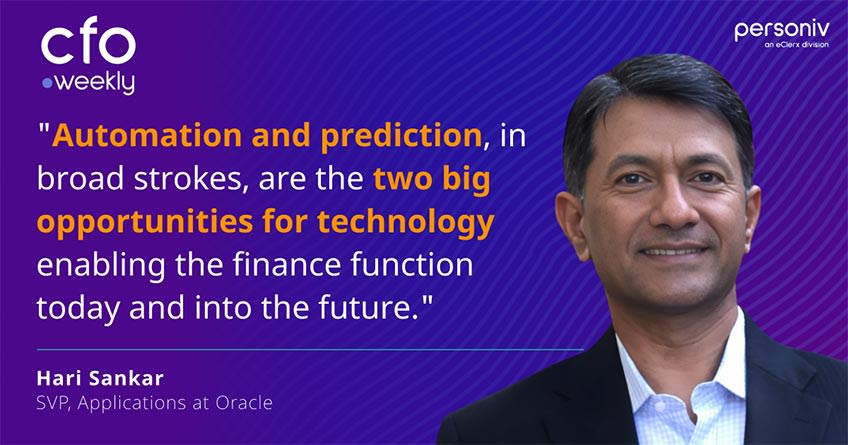
"Automation and prediction, in broad strokes, are the two big opportunities for technology enabling the finance function today and into the future." Sankar commented. - 00:04:28 – 00:07:30
Why AI Must Be Embedded in Financial Systems of Record
Oracle made the harder decision to embed predictive, generative, and agentic AI directly into their core finance platform rather than adding it as an adjacent layer. This approach matters because finance demands security, governance, transparency, and auditability, and AI models that function as black boxes will never earn the trust of CFOs. By understanding finance’s requirements deeply, Oracle is building AI-powered systems of action that CFOs will actually trust and use.
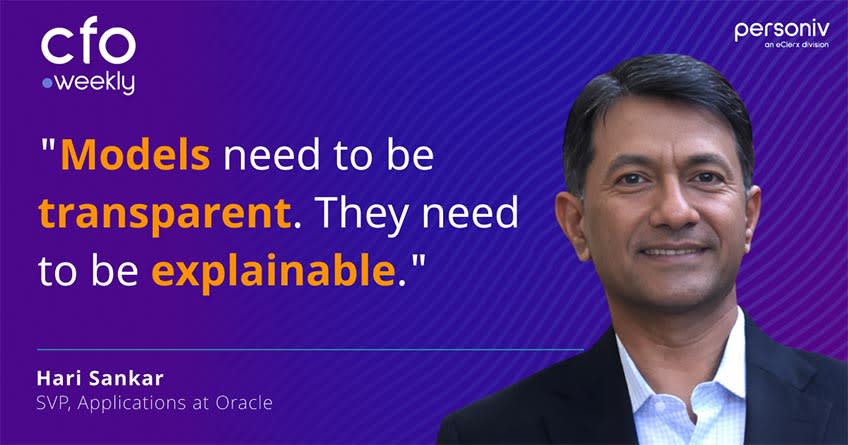
As Sankar said, "Models need to be transparent. They need to be explainable." - 00:09:10 – 00:10:51
From Reactive to Predictive: The FP&A Transformation
Today, most FP&A teams spend all their time looking backwards, manually gathering, cleaning, and crunching data to answer one question: where do we stand today? With AI-driven finance, continuous data feeds from financial and operational systems, paired with pattern recognition algorithms, can deliver real-time performance insights automatically. This frees FP&A teams to focus on forward-looking analysis, plan revisions, and the decisions that actually move the needle on business performance. The advice for tools: keep it simple and embed AI in existing systems of record to preserve the critical context that makes it work for finance.
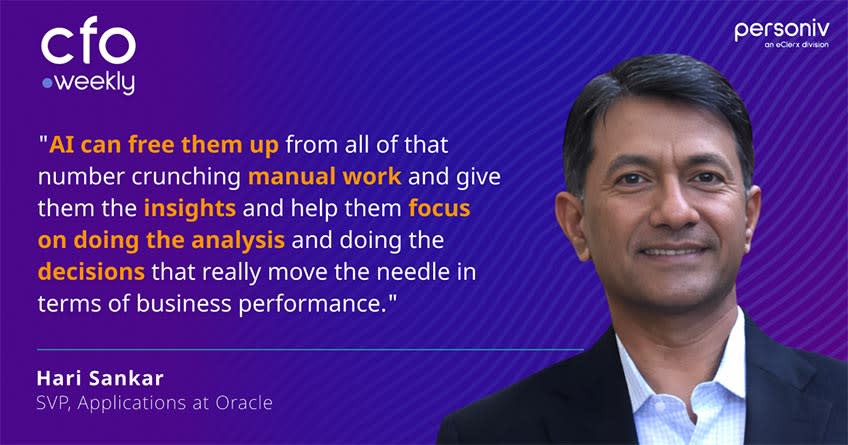
"AI can free them up from all of that number crunching manual work and give them the insights and help them focus on doing the analysis and doing the decisions that really move the needle in terms of business performance." - 00:14:46 – 00:18:55
Advice for CFOs Navigating the AI Transition
CFOs approaching AI transformation should focus on four areas: first, organizational readiness, upskilling teams, addressing fears, and building AI awareness through centers of excellence. Second, a phased adoption roadmap, starting small with pilots, creating early success stories, and scaling from there. Third, pragmatic data management, finding pockets of good data or AI use cases that handle imperfect data rather than trying to solve the entire data problem at once. Fourth, embracing the agentic mindset, recognizing that AI agents are not just about automation and assistance, but about reimagining core finance processes entirely.
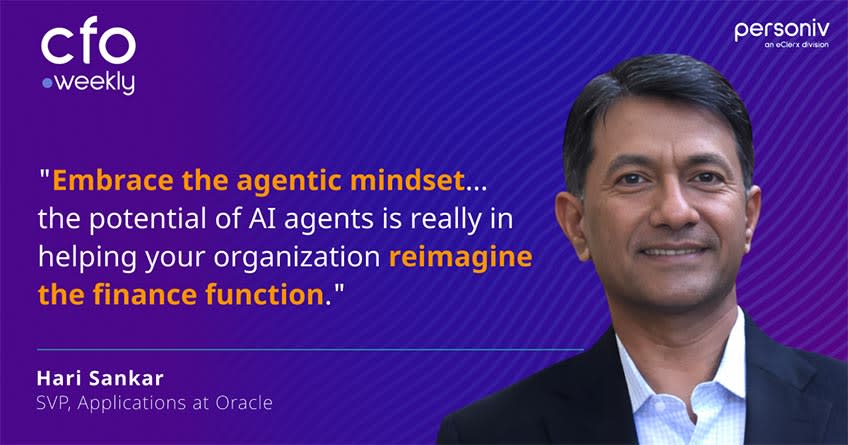
"Embrace the agentic mindset...the potential of AI agents is really in helping your organization reimagine the finance function." Sankar highlighted - 00:24:41 – 00:28:28
The Future CFO: Business Instinct Over Number Crunching
As agentic operations take over, CFOs must develop a truly deep understanding of their business, its competitive advantages, operational realities, and market dynamics. The future CFO will be a strategic peer across the C-suite, equally comfortable discussing manufacturing efficiency, renewal rates, or competitive positioning as they are reviewing financial statements. The three words that will define the finance function of the future: automated, insightful, and connected.
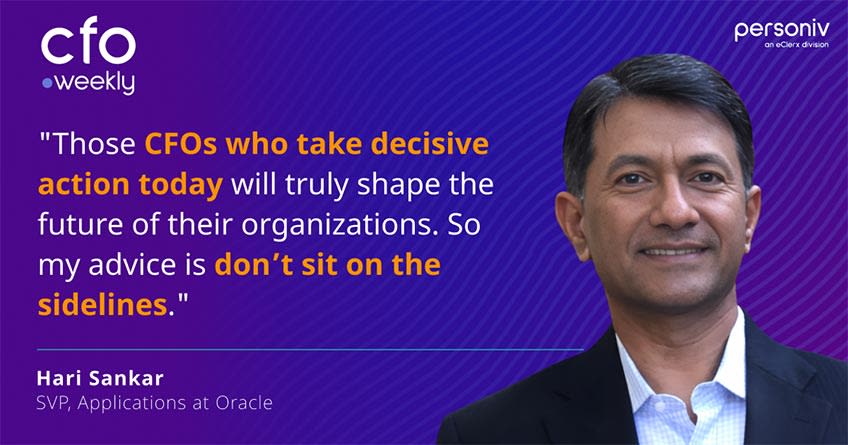
"Those CFOs who take decisive action today will truly shape the future of their organizations. So my advice is don’t sit on the sidelines." Sankar noted. - 00:28:46 – 00:31:36
Want more insights? Explore our full library of podcast blogs here.
To listen to the full conversations, check us out on Apple Podcasts, Spotify, and our RSS or your favorite podcast player!
Instructions on how to follow, rate, and review CFO-Weekly are here.
Ready to leverage the latest technology? We deliver premier financial and accounting solutions tailored to help you maximize the value of AI embedded in systems of record and drive strategic growth. Drop us a line today to learn more.


