


In this episode of CFO Weekly, Mark Dempster, Founder & Chief People Officer at Founder Circle Capital, joins Megan Weis to explore how peer community has become essential infrastructure for addressing CFO isolation and vulnerability while navigating the intense pressure of pre-IPO growth. Mark brings a rare perspective shaped by decades at the intersection of leadership, brand, and venture capital, having previously served as the marketing partner at Sequoia Capital where he was among the first to create this role at a venture capital firm.
With his deep background in brand strategy and relationship management, Mark shares how The Circle, a private leadership community for CXOs, has evolved from accidental dinner conversations into a structured peer-to-peer environment where finance leaders can be vulnerable, process uncertainty, and build the confidence needed to scale themselves and their companies. Currently serving as Founder & Chief People Officer at Founder Circle Capital, Mark oversees leadership services for the firm's CEO/CXO community, driving vision and culture internally while supporting CFOs through one of the most scrutinized phases of their careers.
Show/Hide Transcript
Megan - 0:50: Welcome back to CFO Weekly. Today, I'm chatting with Mark Dempster. Mark is the Chief People Officer of Founder Circle Capital where he oversees the leadership services for its CEO/CXO community, otherwise known as The Circle. He also drives the firm's vision and culture internally and the firm's brand marketing and sourcing channels externally. He was previously the marketing partner at Sequoia Capital, where he was among the first to create this role at a venture capital firm. There, his responsibility centered on brand marketing and sourcing channel development, as well as providing portfolio companies with marketing counsel and business development opportunities. He had the good fortune to assist every company of consequence that the firm invested in since the turn of the century. Mark came into the venture industry by way of the marketing services industry, having held brand strategy and relationship management roles at CKS Partners and Landor Associates. Mark brings a rare perspective shaped by decades at the intersection of leadership, brand, and venture capital. Today, we'll explore how community has become a cornerstone of leadership growth and resilience, why peer relationships sharpen judgment in ways data alone cannot, and how CFOs are using live benchmarking to stress test strategy as they scale toward IPO and beyond. Our guest today has had a front row seat to these dynamics and has helped redefine how leaders support one another at the highest levels. Welcome, Mark, and thank you so much for being with me here today.
Mark - 2:26: Glad to be here. Thanks for having us.
Megan - 2:29: Let's talk a minute about The Circle, what it is and how it came to be, and who is it meant for?
Mark - 2:39: We've been doing this since about 2014, and we describe it as a private leadership community. It is a place for CXOs. Most of it'll be the people who report to the CEO to have a peer to peer environment to sort through all kinds of daily operational, managerial, leadership kinds of issues. We have a bunch of different formats of how people interact with one another. The commonality between the companies are that they are private venture backed companies. They are in the growth stage very late stage of their private lives where the IPO is visible somewhere in the kind of twelve to maybe at most thirty six month time frame so there's a commonality of size, scale, speed that they all have that kind of gives them similar topics that they need to kind of get into together. I think one of your questions was a little bit around maybe the origination story. We didn't have in 2014 or 2013 this sort of divine insight of like we should create community that looks like this. Most wonderful things that we all enjoy, it happened by complete accident. We were doing dinners. Dinners are not uncommon in the venture world to host and the time if you squinted and maybe tilted your head a certain direction, maybe we had slightly differentiated dinners, like we knew enough at the time that we wanted the audience to be part of the content, not just the person up front who's the guest speaker. But the real insight, there was this one gathering we had with Lee Kirkpatrick who was the CFO that took Twilio public, and he was doing a really nice job of talking about the lessons learned about taking a company public, all the grungy stuff, all the sort of glamorous stuff, what worked, what didn't work. And that was interesting, and it was useful. But the real insight was we had a couple of breaks during the agenda, and we started noticing well, wait. There's two CFOs over there kind of leaning in talking to each other, and there's three over there and four over there in their own sort of little pods. I started kind of like eavesdropping, and they were talking about, okay. Hey. I have this issue. Have you ever seen it? How did you deal with it? Or another would be, hey. We're trying to solve X and we need to find a vendor for that. Do you have any recommendations? So these little micro conversations were going on and that was the light bulb moment. That's when we realized, wait a second. This is how we should design this whole offering and little by little it became the private leadership community that it is today and we've been doing it with CFOs for over a decade and we now do it for heads of revenue, heads of marketing, heads of product as well.
Megan - 5:22: And are people invited to join, or do they seek you out?
Mark - 5:26: It's all the above. People find out about us. They find their way to the circle.founderscircle.com, and it describes more about what it is and who it's for and how they consume it, and then there's an application process that can do that, nominated by current members. Oftentimes, an individual has formed their own little community of two, three, four, or five people, and they find their way into The Circle, and then they tell their CFO friends, hey, join too. And then through our own process as a venture firm, we identify companies that kind of fit this profile, and we invite the CFOs.
Megan - 6:02: And as you look back on your own journey, was there a moment that you personally felt the weight of being a lonely leader and realized that even the most capable executives need peers and not just advisors?
Mark - 6:15: Wow, Megan. You're trying to get me to cry right up here. So thanks.
Megan - 6:20: Is that working?
Mark - 6:22: Let me get a tissue here. Hang on. The answer is yes, and I'll give you sort of my little vignette, but I didn't know I was going through it at the time it's only in hindsight that I have the quote wisdom but in the venture world I was something of patient zero of being the first person in a venture firm that was not an investor and that was at Sequoia Capital, awesome place to be involved with this business and at the time there was no playbook on how do you be an operator in a venture firm. In my case, I was running marketing And today, you have marketing and business development, you have talent related roles, you have data related roles, design related roles. So back then, I was a person of one doing marketing, business development kind of stuff for the companies for the firm, but there's no playbook for it and the partners themselves didn't have a playbook for it, so we were all making it up. And so a venture firm at times can be an intense environment. It's got a different structure than typical corporate structure, it's flatter. So I sometimes liken it to being a goalie on a soccer team, an important role but looks different than the others, plays different than the others, and so there's differences and having all of that other talent kind of constantly coming at you all the while you're trying to figure things out at the same time, day after day, week after week, month after month, the pressure builds trying to figure things out on your own, that's where, you develop that lonely experience. And at the time, there was no one like me to reach out to to say, hey, how did you do this? Did you ever make this mistake, and how did you ever correct that mistake, or did you ever have this particular initiative, and how did you go about solving that initiative? Like I said, I didn't know I was developing some empathy muscles in this regard. And then a decade later, we were able to form The Circle, and I was able to draw upon that experience.
Megan - 8:18: And you've worked with founders and CFOs across multiple generations of high growth companies. So what patterns have you seen in the leaders who scale sustainably versus those who burn out or stall, and how does community factor into that difference?
Mark - 8:33: I guess I'm biased. I'm going to give you a short answer and then a long answer. The short answer is those who sustainably grow and do so with their sanity in check are intact, they have others to turn to. It turns out this dirty little secret we're all human and there's lots of smart people in this business, lots of driven people in this business, a lot of accomplished people and there's also a lot of youth in this business and we're figuring this stuff out in real time. So the kind of companies that we cater to in The Circle, they're in that IPO tractor beam, and guess what? Their board knows it, and their board is comprised of VCs. And the VCs are kind of saying to themselves, oh, this company is working. It's probably going to return some or all of my fund. And they start getting really discerning, really scrutinizing each and every board meeting. Lots of questions, lots of challenges, lots of encouragement to push on the product front, on the sales front, on the marketing front, lots of mandate to grow the organization to make it scalable to make it repeatable what the board's really thinking about is the future that can this company be in a beat and raise modality consistently as a public company. So what's happening is unbeknownst really to the management team because they're not informed of this, is they're being reinterviewed for their jobs each and every board meeting. A CFO, for example, thinks they're going in and delivering a report as they normally do, but what's really going on is the board is kind of sizing them up of, hey, is this the person in the finance function to take us into our public life? Yes or no? And sure, they listen to that report but then they're really kind of scrutinizing that report what's underneath that report what are the issues that are driving why certain metrics in that report are working or not working And interestingly, usually, the board member already knows the answer to the question they're asking. They're just waiting to see if the CFO has the answer. Or if they're willing to say, I don't have the answer, but I know how to get it, and I'll get right back to you on it. Otherwise, they'll be thinking maybe we need to replace them for someone who's been there done that.
Megan - 10:46: I was actually going to ask the question, is it okay to say that you don't know the answer in that kind of environment?
Mark - 10:53: Oh, it's highly advised. It is a big credibility, big trust builder, and big credibility builder, but for sure, do it. We've heard plenty of stories of, oh, I don't know that answer. I'll get right back to you, and then they don't, and that will erode trust and confidence every bit as much as BSing your way through an answer.
Megan - 11:14: And CFOs, they often carry a unique form of isolation given the sensitivity of their role. How does a trusted peer community change the way that finance leaders process uncertainty and make high stakes decisions?
Mark - 11:28: The main thing I've really grown to admire about the CFO role that I didn't know when we first got into this, They are the ultimate UN ambassador inside the company. And if you think about that sort of metaphor, they have to influence everybody, but no one reports to them. So they have to simultaneously get alignment with the CEO on all kinds of strategic and operational issues as well as the board, no easy task there. And then they're the ones tasked with working with all of the functional CXO leaders to affect those objectives all the way throughout the organization and because the CFO has access to all the data, they see every square inch of the entire organization, they know how it works and so they got to work with the CRO on sales numbers and headcount and budget every annual planning session, every OKR session. They've got to work with the marketing person on marketing spend and ROI for customer acquisition and how that flows into inside sales and how that flows into enterprise sales, they see the entire system at work. They have to artfully affect everybody going in the right direction, and sometimes everybody making a change, and yet no one reports to them. That's a sort of an amazing role, an amazing dynamic to have to sort through throughout that whole system. You're interacting with your CEO, you're interacting with your board, you're interacting with your CRO peers, you're interacting with your own team who's got to be sort of a service provider out to the organization. Oh, by the way, this company is moving so fast, track is being laid in front of the moving train. You're seeing problems all day, every day you've never seen before. You don't even know how to define them and describe them, let alone what to do about them. And so that's kind of the cauldron of uncertainty that a CFO can find themselves in, particularly if a venture backed company. So having a community where they can go be kind of vulnerable, like, hey. I've never seen this before. Like, what is this? Because guess what? Their CEO doesn't want to hear that from their CFO. A CEO wants solutions. And if you don't know the solution, they might be thinking, well, maybe I need to find someone who does know the solution. So give me a place I can go to to say, I don't know what this is. Can someone tell me what this is? And then help me think through how to deal with it. So it's a place for them to be messy, a place for them to be imperfect, a place for them to be inarticulate. Sort it all out there, then go back to your CEO, then go back to your CXO peers, be buttoned up, and really lead a conversation internally about that topic.
Megan - 14:15: So within The Circle, are people like, how would you find someone that has had the same problems that you're facing? Is it like a chat room or, like, how do you seek out people that have had the same issues you're facing?
Mark - 14:30: It just happens, and here's how it just happens. There are, in round numbers, 350 CFOs in the CFO Circle, and they all kind of fit that definition we talked about a little bit earlier. And then there's different modalities of how we help them interact. We have quarterly Circle calls, and these topics that define a Circle call are developed by the community themselves. We're really good listeners figuring out what's current right now. What does the majority of the group need to talk about? So by definition, you got commonality coming to one of those calls. In between, all day, every day, we have Circle chats, which is essentially an email group, and you put out your question and those who know something about that topic respond. We have Circle cohorts where it's a smaller subset of the community who's aligned really to where you are, the sector of your company, the stage of your company, the revenue of your company, the growth rate of your company, there's commonality there. So by definition of these different modalities you're going to run into people peers who either have recently gone through your issue or they're also going through your issue at the same time.
Megan - 15:38: And what are the most common questions that you're hearing from CFOs as they're bringing them to their peers today, and what does that reveal about where the pressure points really are within this phase of business's life cycle?
Mark - 15:52: I'm kind of chuckling most common questions. The answer is yes. D, all the above. You name it, Megan. Any operational topic you could imagine. I mean, you're a general manager of a business unit. Yep. Let your brain go down to all the most finite, crungiest, tactical topic you can imagine, and then multiply that times a hundred. Elevate a little bit to some core functional topics that you do in your group and in your adjacent groups every one of those gets talked about all the way up to strategy. What does strategy really mean? Who do you do that with? How do you do it? I could give you a couple examples. The reality is even though every single conversation starts with an operational flavored topic, 9.9 times out of 10 as you listen to the conversation unfold, it's really about people. It's really about relationships in the building, how to communicate well, how to collaborate well, when it's not going well, how to fix it, whether that's above you, on side of you, below you. We'll do a topic about sales forecasting, and the CFO is really deepened on that topic because it affects everything in the budget, how things are going to get spent, how things are going to get allocated, what do we think the return on investment's going to be. So sales forecast testing is key as well as for the board meeting and reporting for that. What often you kind of start hearing is, well, it's very difficult for the CFO to get alignment with the CRO on what are realistic numbers, what's a realistic headcount to get at those numbers? When do we think we're going to get a return for that kind of spend? They have challenges with their CRO peer on getting on the same side of the table. Sometimes the forecasting challenges a team member deep down in the sales organization who's got no even dotted line to the CFO, but they're materially impacting the accuracy or the timeliness of a forecast. And so how does that CFO get to them and work with them and align with them? That's the commonality across a gazillion operational topics. I could give you a couple as an example.
Megan - 17:59: And beyond data, there's something uniquely powerful about learning from someone else's lived experience. So in your experience, how does exposure to peer scar tissue change the way that CFOs think about risk timing and trade offs compared to relying solely on advisors or just historical benchmarks?
Mark - 18:22: When we come together so one of the questions I'm kind of hearing you ask is, how does this community function really well? How can a CFO get to, like, the truth of the issue they're trying to wrestle with? And it's this wonderful word that doesn't get used often enough in a corporate environment, which is vulnerability. So for example, when we come together for a Circle call, it usually takes just one CFO who's willing to give even a hint of uncertainty that they don't know something about a topic, that they're making mistakes around a topic, that they are under pressure around a topic, and you can just feel the electrons change in the room. Like, body language just shifts. And even though no one says this out loud, you can see all the bubble thoughts of, oh, thank god. I thought I was the only one going through this. And as soon as someone's willing to do that, everybody else falls in line. They're like, yeah. Me too. And here's my messy stuff. And when you can get to that tone, that kind of trust, just the truth comes out, and you get to ideas and solutions a lot faster. And there's no judgment on sorting through that in a messy way and with each other, and that's where the good stuff happens.
Megan - 19:41: When you get to the level of being a CFO, I imagine that vulnerability becomes very difficult. Admitting you don't know something or just imagine that first person, it takes a lot of being brave to be able to do that.
Mark - 19:55: It takes a ton of bravery. It should be more natural. It should be more comfortable. It should be more permissible either in yourself or amongst others because if you can get there and maybe you've experienced this in your own circle, if you can get there, it feels a whole lot better than trying to shoulder yourself, figuring it out yourself, trial and error on yourself, the stress that it builds when you just keep it all kind of to yourself. It works a whole lot better.
Megan - 20:22: I'm curious. Do you have any thoughts on for all of the CFOs out there listening who might not have access to The Circle, any thoughts on how they can form their own circles or where they can look for peers who might be going through the same thing?
Mark - 20:38: When we have a new member join, they will often say, I got two or three or four folks outside my company in my role that we try to convene or we email or we Slack when we can. And so people do that. We hear about it more often external to their company versus internal to their company. I think there's a certain anxiety about communing with those inside your company because how you might be perceived, whatever story you tell inside of your head. There's always personalities that are part of the mix. They tend to try to form it on the outside. The challenge that they constantly run into is just simply bandwidth. They've got this full time job on this fast moving locomotive and the time it takes to reach out to those peers on a topic of one that's on a short time fuse. It is not as frequent as they would like, not as fluid as they would like and that's one of the values that we're trying to bring, which is give them the environment to be able to easily step into that and get answers super quickly.
Megan - 21:39: And as companies grow faster and roles in the world are becoming more complex, feel like everything's these days is on like a hockey stick exponential change. So how are CFOs using peer networks, not just for answers, but for confidence building?
Mark - 22:00: Whether it is informal interaction or it's a formal agenda that you're a part of, It's a lot of the ingredients we've been talking about if with whomever you are communing with. If you can get to a point where, like I said, we're all humans, and part of the human condition is that we put on masks. We put on this presentation, this performative characteristic that we want others to have the perception that we know what we're talking about and that we're really buttoned up. When well, sometimes we know what we're talking about and sometimes we're buttoned up. A lot of times we're not, but we put on the mask. And if you can get yourself to a place of taking off that mask and just being real, remember when we were kids, our mothers or our grandmothers were like, honey, just be yourself. There's a lot of wisdom in that.
Megan - 22:48: There is.
Mark - 22:48: And if you can be that way, whether it's in front of five people or 50 people, whether it's informal or formal, that's the beginnings of being a great leader is being vulnerable with yourself, checking in with yourself, doing inventory on yourself, trying to find ways to improve upon those habits we keep doing over and over that we shouldn't, that's the beginnings of it. But the flip side to your question is, we do put together intentional programming around leadership specific topics. We have an annual CFO summit coming up in February, and it's titled Unplug to Upgrade, and it's all about developing your leadership muscles in different contexts. One session is all about in the context of a CEO and a board. Another session is all in the context of your own team. And in the formats we put together and the content we put together is all geared towards not the operational stuff, but you as a leader and then each other helping each other out. People aren't coming there to listen to Mark talk about leadership, they're coming there to listen to each other talk about leadership, both the highs and the lows of it.
Megan - 23:55: And looking ahead, how do you see community evolving from just being a support system into more formal strategic infrastructure?
Mark - 24:06: Double click on that for me a little bit, but help me understand what you're driving at.
Megan - 24:11: I guess I'm driving at, like, how are people moving from just, I guess, reaching out when they have a problem here or there to, like, really sewing this into the fabric of their existence?
Mark - 24:25: Got it.
Megan - 24:26: I guess maybe how can they better leverage that kind of environment so that it's not just something they reach out to when the problems arise, but I guess something they're taking more advantage of.
Mark - 24:41: I'll go off script a little bit here and talk about a fabulous organization called YPO, Young Presidents' Organization. You're probably very familiar with it. They have a format called forums, YPO forums. And it's a very admirable kind of structure and offering. You basically come together with a cohort, and that cohort is formed with bringing people of common attributes kind of together. This group is specifically for CEOs. They can meet every quarter, and it's a proactive, going to meet every quarter, this is going to be the agenda, who's going to be there, this is what we're going to talk about, and it's pretty strict. It's you're allowed to miss one, it's understandable. You miss two and you're out. It sounds a little draconian, but the point of it is that it isn't so much that, yes, you have missed out by not being there, but more importantly, the group has missed out because you weren't there to contribute. So if you can't make it on a consistent basis, then, maybe come back another time. In that sort of model, it's much more proactive. It's much more structured, and you have more sort of there are definitely current topics, but there's also more forward looking topics. And, typically, in the way that those conversations get organized, at least one CEO is kind of on the hot seat in a given time frame, and they're just laying it all out there, and then they conclude with a set of action items. And your cohort, your peers hold you accountable that when you come back in a quarter, you should be reporting on how you have made change against those issues and against those action items, and if you haven't, you're going to get a bent ear from your peers about that. I think that's a great example of we're striving to get there. We have a cohort offering, it's not as structured as what I just described. That's a great way to have, quote, unquote, infrastructure around this where you're using it more proactively.
Megan - 26:27: And last question, but just as you look ahead, what defines a future ready CFO, both in terms of critical new skills as well as mindset for the future?
Mark - 26:41: When a CFO gets involved with the community, generally speaking, what's happening is they're in this shift from being an individual contributor to being a manager at the very least, but more particularly a leader of individual contributors. And so and we could be talking about any function truthfully in that transition. It's challenging from going from the person who is really quite competent at a given domain, accounting, FP&A, biz ops, and get their hands off the home row and to be recruiting and developing and managing others to do that because you need leverage to do higher value initiatives, to be doing strategy, to be interacting with the CEO, to be interacting with the board, to be interacting with your CXO peers on direction, on operations, on achieving goals. You can't be mired even though you're accountable for the numbers and the accuracy of those numbers and the timeliness of those numbers. You can't be mired in the muck of producing those numbers. That's kind of one phase to your question. Another phase is particularly as they're heading towards the IPO and after the IPO, it's now becoming a storyteller inside the building, outside the building. And a CFO is the wonderful source of truth when it comes to the operations and it comes to the numbers, and they're very comfortable in that numeric worlds. But that's fairly dry and unmotivating when you're trying to move the rest of the executive suite or you're trying to influence institutional investors about this business, its vision, where it's going, and then, of course, how the numbers support that. And so learning how to be that storyteller, learning how to be that relationship builder with a different kind of customer called the shareholder is a critical competency for the CFO. And, again, that's a new level that they need to elevate themselves to that they then in turn need to be able to hire and manage others to do a variety of operational and functional tasks that they couldn't or shouldn't be doing themselves.
Megan - 28:48: And this is more of me being curious than anything, but, like, what percentage of CFOs leading up to an IPO are the right CFOs for after an IPO? Is that common that the CFO pre IPO stays on, and is the CFO post IPO?
Mark - 29:10: Oh, by the way, I don't know the answer to that. I'll get right back to you on that. What I do know anecdotally from talking to a number of veteran CFOs, it is by far the largest open rack at a company from a recruiting standpoint. So there are more unfilled CFO jobs in venture than in any other role, and there are two reasons for that. One of which is it's a pretty common role to get replaced on the eve of, or when a IPO is kind of visible. For the reasons I talked about at the beginning of our conversation, all that scrutiny that's happening with the board and they're trying to figure out are you the person or you're not the person, it is fairly common that a board is going to want to sort of a been there done that type of person. It's a pretty critical every quarter you got to be on or your stock is going to get really punished. Okay. There's a whole community, a whole pool of public company CFOs, but if it's really a small subset that is willing to come out of that environment, come into a private environment, yeah, the company's working. Great product, customers, incredible revenue, but usually what's happening there is the organization is not at all scaled to be a repeatable business. The go to market typically is not fully dialed in on how to make it repeatable and scalable and so there aren't a lot of CFOs who want to come into a private environment and fix all that. And on the flip side, there isn't much of an apprentice structure, philosophy, or structure in venture. If you're the director of FP&A, if you're the VP of finance, you're getting experiences and skills in some functional areas, but there isn't a lot of teaching on how to be the next level up. So you have this big gap in between, and it's a long winded way of trying to get it to your answer. A sort of tongue in cheek. We don't really say it publicly or on the website, but jokingly, we say The Circle. We're here to help you not get fired. But the truth in that is what The Circle is really about is help you scale yourselves so you can scale your company. And if the CEO and the board and your peers can witness, have you keep coming back time and time again, elevating a given discussion, bringing solutions to a given discussion, they see you as someone who is scaling, someone who's helping the business, and they don't want to replace you. We're trying to address that.
Megan - 31:36: All of this points to how important community really is, especially within this kind of environment. Mark, thank you so much for being here today and sharing your perspective and for the work you're doing to redefine what leadership looks like at the highest levels.
Mark - 31:51: Well, it's a pleasure to be here, and it's fun to talk about it. And, too bad this wasn't a three hour conversation because something tells me we could nerd out about this for quite a while.
Megan - 31:58: Well, thank you very much again. And, to all of our listeners, please tune in next week. And until then, take care.
What You'll Learn:
-
Why CFOs in the IPO tractor beam face constant reinterviewing by their boards
-
How vulnerability and peer support combat the isolation inherent in the CFO role
-
The critical shift from individual contributor to leader and storyteller
-
Why the CFO role has the highest unfilled recruiting rate in venture capital
-
How community infrastructure helps CFOs avoid replacement at the IPO threshold
-
The power of lived experience over data alone in high-stakes decision-making
Key Takeaways:
The Accidental Birth of Peer Community
The Circle began with a simple observation during CFO dinners: the most valuable conversations were happening in the breaks, not during the formal presentations. CFOs were naturally forming small pods to share real-time challenges, vendor recommendations, and tactical problem-solving. This insight sparked the creation of a private leadership community now serving 350 CFOs across venture-backed companies.
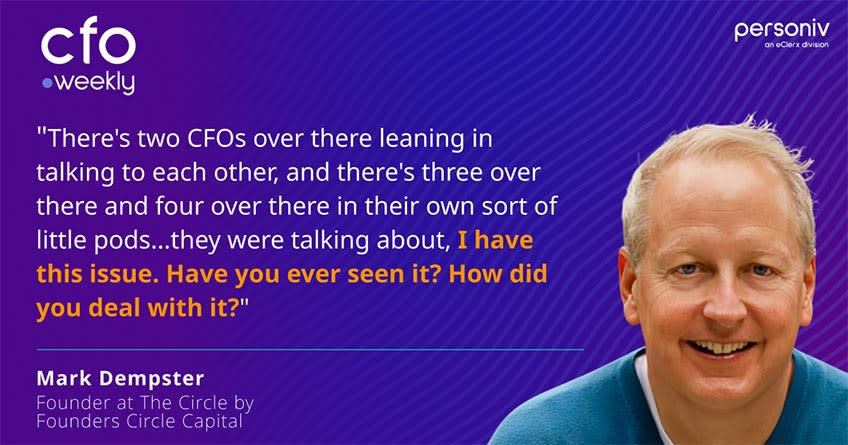
"There's two CFOs over there leaning in talking to each other, and there's three over there and four over there in their own sort of little pods...they were talking about, I have this issue. Have you ever seen it? How did you deal with it?" Dempster shared. - 00:02:29 - 00:06:02
The Silent Reinterview
Venture-backed CFOs in the IPO tractor beam face a hidden reality: they're being reinterviewed for their jobs at every board meeting. Boards scrutinize whether the current CFO can lead the company through its public life, often already knowing the answers to their questions and simply testing whether the CFO demonstrates the same knowledge and self-awareness.
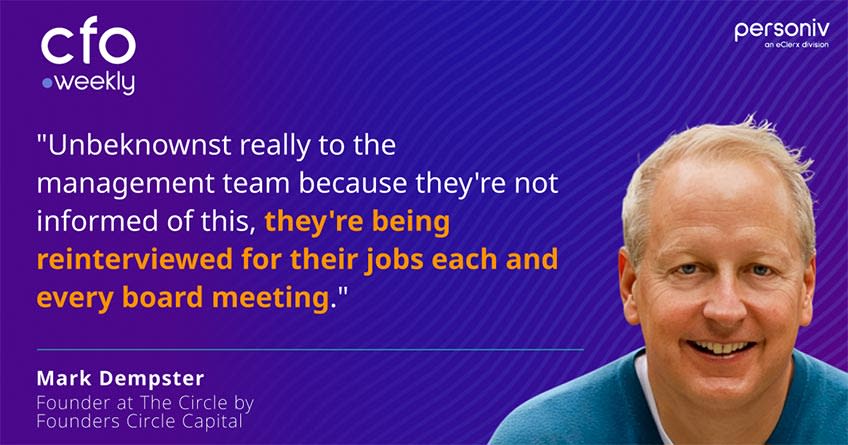
"Unbeknownst really to the management team because they're not informed of this, they're being reinterviewed for their jobs each and every board meeting." Dempster pointed out. - 00:08:18 - 00:11:14
The UN Ambassador Role
CFOs serve as the ultimate UN ambassadors inside their companies, they must influence everyone while no one reports to them. They see every square inch of the organization through data access, align with CEOs and boards on strategy, and work with every functional leader on execution, all while moving at venture speed where problems emerge faster than solutions.
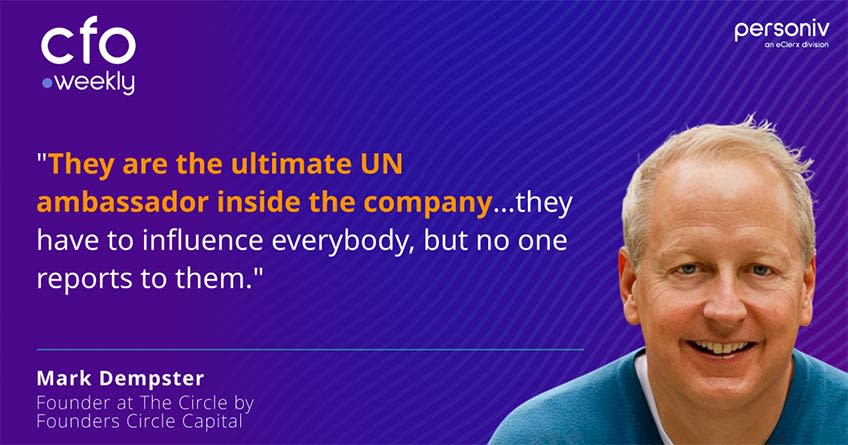
Dempster reflected on this, saying, "They are the ultimate UN ambassador inside the company...they have to influence everybody, but no one reports to them." - 00:11:14 - 00:14:15
The Power of Vulnerability: Addressing CFO Isolation
High-performing peer communities function through vulnerability. When just one CFO admits uncertainty or mistakes, the entire room shifts, body language changes, and others immediately follow with their own messy truths. This environment enables faster problem-solving, better ideas, and relief from the stress of shouldering challenges alone.
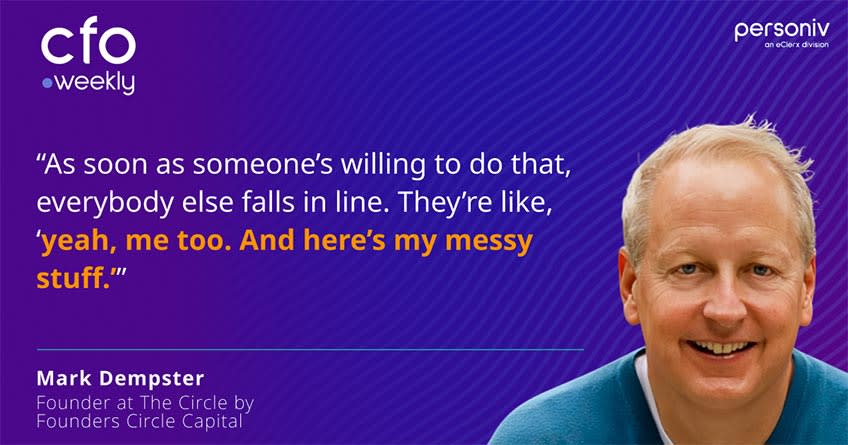
“As soon as someone’s willing to do that, everybody else falls in line. They’re like, ‘yeah, me too. And here’s my messy stuff.’” Dempster remarked. - 00:18:22 - 00:20:22
Scaling Yourself to Scale Your Company: Overcoming Isolation & Vulnerability
Future-ready CFOs master two critical transitions: from individual contributor to leader of others, and from numbers producer to storyteller. The most significant gap in venture capital is the lack of CFOs who can scale into public company leadership, creating the highest unfilled recruiting rate of any executive role. Community helps CFOs develop these competencies and avoid replacement.
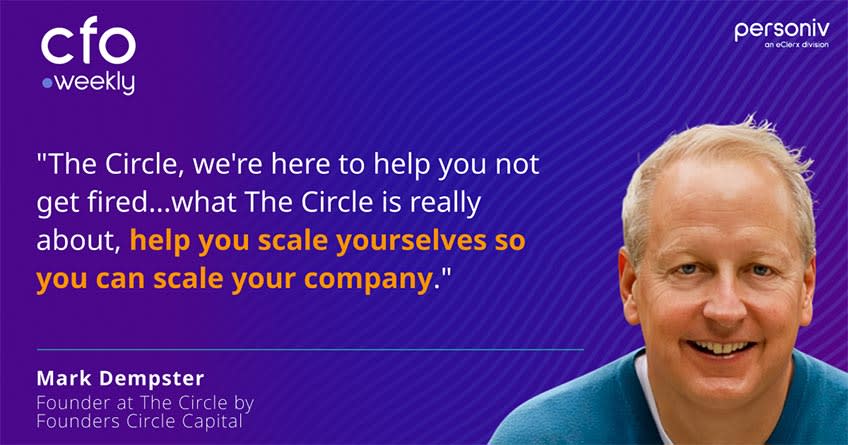
"The Circle, we're here to help you not get fired...what The Circle is really about, help you scale yourselves so you can scale your company." Dempster said. - 00:26:41 - 00:31:36
Want more insights? Explore our full library of podcast blogs here.
To listen to the full conversations, check us out on Apple Podcasts, Spotify, and our RSS or your favorite podcast player!
Instructions on how to follow, rate, and review CFO-Weekly are here.
Ready to build a stronger foundation? We deliver premier financial and accounting solutions tailored to help you manage the workload, overcome isolation and vulnerability, and drive strategic growth. Drop us a line today to learn more.


