

In this episode of CFO Weekly, John Wise, Director of Finance and Accounting at The Armstrong Company, joins Megan Weis to unpack how the CPA designation can become a launchpad for strategic business leadership, transforming finance from a back-office function to a key driver in navigating the cultural and operational growing pains middle-market companies face as they scale. John brings a career built across Fortune 500 rotational programs, regional public accounting, and FP&A leadership before landing at The Armstrong Company, a family-held, fourth-generation moving and storage business with roots stretching back to 1957.
With hands-on experience in lease accounting, financial reporting, M&A due diligence, and finance modernization, John shares how he approaches transforming a decentralized, founder-led finance function into a scalable, data-driven operation. He unpacks the warning signs that a process has been outgrown, and why he believes the traditional linear path from accountant to controller to CFO is being disrupted by FP&A and cross-functional business partnership.
Show/Hide Transcript
00:18 - Megan: Today I'm joined by John Wise, Director of Finance and Accounting at the Armstrong Company. John is a CPA and finance leader whose career has centered on helping privately held and middle market businesses grow through stronger financial leadership, operational transformation and strategic planning. His experience spans M and A, due diligence, finance modernization, debt management, and building scalable finance processes that enable long term growth. In his current role at the Armstrong Company, John is helping transform the finance function across a growing portfolio of businesses, demonstrating how finance can evolve from a back office function into a strategic partner. In this episode we'll explore the versatility of the CPA designation, the opportunities it creates beyond traditional accounting, and how finance leaders can drive transformation in privately held and middle market companies. Welcome to today's episode John, and thank you so much for taking the time to be here.
01:53 - John: Thanks Megan. I'm really excited to be here.
01:55 - Megan: So to start, can you maybe walk us through your career journey and what initially attracted you to accounting in the CPA profession?
02:05 - John: Yeah, be glad to. In terms of the attraction to the profession, it's really kind of a lackluster story. My dad was a salesperson his whole career and when I got into late high school and was thinking about school I was initially thinking something chemistry related, maybe anesthesiology or pharmacy. And you kind of talked me out of that with how much school was involved and just mentioned that in all the companies I've worked for the accountants are always the ones that have all the information, make a lot of the decisions and seems like their jobs are the most secure. So you should go major in accounting. Being a 17 year old not really knowing a whole lot about the world, I kind of took his word as the truth. At that point. So went to school, majored in accounting. I think maybe just the fear of failure kept me from changing majors at any point, but it all just kind of clicked for me. So I went through with that and started my career at that time. Coming out of college. Really a big thing at the time was these Fortune 500 rotational programs where you go in usually for a three to four year window, you do six month rotations across different areas of the business. And it really just felt like a really kind of a fast track to seeing a lot versus going into maybe a more traditional auditor tax role. So it was really appealing to me. So I went to work for Pfizer here at a shared services location in Memphis, Tennessee. Worked heavily with lease accounting which was about a year or so after the newer lease standard came out, ASC842. So I got some really good experience there. Worked in financial reporting for some of the pharmaceutical carve outs that Pfizer was working on at the time. Credit and collections, customer management really kind of touched a little bit of different technical accounting and more I would say business finance processes. And it was a great kind of introduction to the corporate world in a really, I would say control heavy environment. So really enjoyed that. And then from there during COVID the pharmaceutical industry was heavily impacted by that. As we all know, with the search for a vaccine kind of going to the forefront at that time, Pfizer went through a restructuring to kind of slim down their shared services model and centralize My job wasn't, wasn't eliminated, but it gave me a time to rethink about do I want to move and stay with Pfizer long term or are there certain skills, parts of my suitcase of expertise that I want to build out? I think I'd always kind of wondered should I have gone into public accounting first because that is the more traditional path. So at that point I actually after about two and a half years of professional experience at Pfizer, jumped into a what I would call like a regional accounting firm. So HHM, CPAs, I believe they're a top 100 firm now, but mostly in the southeast. So Chattanooga headquarter with operations down into Florida, Gulf Coast, Alabama, Tennessee. So but it was a great experience. I mean I really, that was, I feel like for me that was a really eye opening experience into what accounting could really lead to. I was working with founder led businesses, nonprofits, construction companies, manufacturers, really all types of businesses in the privately held space, from small businesses to middle market businesses. And I really just love that environment. I love how entrepreneurial it felt. I love the client interaction and I learned so much from a nuts and bolts of accounting perspective. But I definitely didn't love the hours in public accounting and I didn't love pay. I thought those two were a little bit misaligned, so. So I had my first child and decided it was time to get something a little bit more. I felt like aligned with my skill set from a time perspective and a pay perspective. So I went back to Fortune 500 to work for Autozone, another Memphis based company. And I think that my time at AutoZone probably fast tracked my career more than anything. I was definitely still doing accounting, helping with month end, but really got involved in FP&A for Autozone's commercial business. So weekly P and L forecasting and balance sheet forecasting that was going up to the executive committee, the annual planning process, long range planning, really just business partnership altogether. I was a accounting and FPA manager for the commercial business. So every week I was sitting down with our SVPs of commercial and retail operations and talking through sales forecasts, changes that were happening operationally. I think for me that's when I really realized that there was more to my career than just being, I guess, the chief accountant, if you will. That traditional path of accountant, controller, CFO started seeming like it was maybe not as linear as I thought it was. So that's when I really started thinking about more holistic kind of finance roles and had a really great opportunity to step into a director level position here at the Armstrong Company which is a family held fourth generation business, been open for about 75 years in the moving and storage industry. And like many other businesses, Coke completely changed. This business moved away from being, I would say a primarily household goods moving business to more of a full service commercial, moving and storage business. It's just been really cool to be a part of that transition that's led to changes in process and people in the way we do business and changes every day in the middle market. Just I feel like you have so much such a unique opportunity to see a lot and do a lot. It's been awesome. So that's where that brings me up to where I am today.
06:49 - Megan: Yeah, what an amazing career. And those rotational programs that you mentioned having done right out of college, I always feel like those are so valuable and attractive and I'm always surprised that every company doesn't do something like that.
07:03 - John: I wasn't at the Pfizer headquarters in New York City. If I could have gone back and done my career may have looked different. But otherwise, it was awesome.
07:10 - Megan: And like you, I've always loved accounting in that it leads to all sorts of opportunities, including being a podcast host, if that's what you want to do. And I'm curious, so if you knew someone who was 17 or 18 now going into college, would you still recommend accounting with AI and everything else that's out there?
07:32 - John: I think that, you know, a lot of schools, and this is probably changing. I'm not very in tune with academia these days, but a lot of schools definitely still push the traditional path of, you know, go to public accounting, do audit, do finance, or do audit, do tax. But really the degree itself is so valuable because you've heard this saying before, you really do speak the language of business. You can step into any business, whether It's a Fortune 500 business or a small business, nonprofit, whatever, and you can very quickly get up to speed with how money and data moves through the business. That's the language of what we do as accountants. And I think it's just extremely invaluable to all businesses. So I would still recommend it. I think the avenues are there to go into investment banking, private equity. I think that the world has shifted away from being more. I don't even know what you want to call it, right. But the Fortune 500 public offering, SEC governed world, it feels like private equity is really kind of tapped into that space and so many fresh minds and graduates are starting to do that. And I think accounting is a great pathway to doing that as well.
08:28 - Megan: And many people still think of CPAs primarily as accountants or auditors. But at what point did you realize that the designation could become a foundation for broader business leadership?
08:39 - John: I think during my time at autozone, also in public accounting, but at autozone in particular, I just saw so many leaders across the executive team. The CEO at the time, while I was there, he was a former Big four auditor who stepped into an accounting role at autozone and then worked his way up to being the CEO. So getting to see that at the highest level of the organization, it even spread throughout the lower level managers, just people that had started out in accounting and had gone into, whether it was go to market strategy or vendor management, product management, just so many different avenues. And at just that point, I really realized that the accounting opens up so many doors. If you start as an auditor or an accountant, you're typically going to be partnering with someone who is not on that side of the business. So you get to learn a lot. I feel like it's a naturally cross functional domain accounting if you're an accountant and you don't interact with your peers in HR marketing technology, you probably aren't doing your job extremely well. And I think when I realized that, that the job could be so much more than just the debits and credits, it really started encouraging me to seek out cross functional relationships to truly understand what was going on in the business. And that makes the job so much easier as an accountant to. So I think it's a great platform.
09:47 - Megan: I agree. And like as an auditor, when you're auditing company's financials, you literally are digging into every component of the business. The middle market is often described as the engine of the economy, but it's also where companies face some of their biggest growing pains. So from a finance perspective, what challenges come up most?
10:09 - John: I'm sure it's unique for each business. I can speak to the ones I've experienced. I think especially in the Armstrong company, the biggest changes are typically cultural changes. Maybe it's 1980 and we have five locations around the US and business is great, we're doing well. And then you fast forward 20 years, you're not really giving kind of active thought, leadership and vision around how are we scaling our back office and our processes to meet a growing demand of our business? You know, we're acquiring businesses, we're growing organically, we're just getting bigger. You don't really realize you've outgrown processes until you've already outgrown them. So I think for us it's been cultural shifts. Maybe an owner has had one report that he uses every month to analyze the business and after a certain amount of time that report just doesn't work the way it used to or you're not seeing the business the way it used to be. As you know, many founders and small businesses start off on a cash basis accounting and sometimes that transition to accrual is not clean. That's one of the things we kind of had to walk through with our management team when I stepped into this role a few years ago was we couldn't really just look at the P and L anymore. To be the only indicator of financial success. That as we had moved away from a household goods moving company where we essentially collected all money at the time of delivery or every week, our van line relationship, we were doing business to business work, we were invoicing customers on 30 day terms. Having to do collections changes the way the cash moves through the business and therefore that changes the way you need to look at the way money moves through the business. And the way that profit is recorded. So just things like that, you know, I think the cultural shifts are the biggest ones and any change to process or tools or you know, systems, those aren't going to be successful if there isn't a cultural buy in as well and a cultural understanding of why the change is happening. So that'll be my biggest. I guess the growing pains have been on the cultural side.
11:56 - Megan: When you're going through these growing pains, what are some of the signs that you have outgrown a certain process?
12:03 - John: I think information, the timeliness of information is the biggest thing. You know, I think that if you're three weeks into a month and you still haven't closed the books, that's probably a sign that your close process is broken. If you are cash flow is running a little bit tight and you have no real answer for well, what deposits do I have coming in, what liabilities do I have coming up? That may mean that your cash basis accounting is not working anymore because your cash flow isn't sufficient. And you need to understand more about how to time your cash inflows and outflows. To me, those are some of the things that we went through initially here was more on the cash flow side of things, having better visibility into cash flow and then timeliness of information. And I think that another thing too is that people don't really realize in the middle market is it's really easy to grow without a system that's built for growth. You know, I think QuickBooks is, I don't want to not putting into it on blaster, but QuickBooks is for a long time been the gold standard for small businesses. And it's a great tool, it works well. But there does come a time where managing maybe 30 plus entities out of QuickBooks is not efficient. So another big project we went through here was migrating some of our more ancillary businesses, you know, property holding companies, things of that nature, out of QuickBooks into our ERP platform where our operating companies were housed. So you could have a holistic picture of our business. Because our business isn't just our moving companies. We have a real estate component to our business and a few other components. And when you're managing really your different business lines and different systems, getting that holistic picture could take a lot of time. You're downloading reports into Excel, you're using formulas or copying and pasting to splice together reports for quarterly board meetings, things of that nature. So I think time slippage is a big one. As you kind of see how long it takes you to pull information together sufficiently. Another thing sometimes too is just having that conversation with your operational leaders and ask them, do you feel that you're getting the information you need? Is it coming timely? Are you getting metrics that are helpful to you in evaluating your business? I've had some of the most candid and I would say transformational feedback from just talking to some of our operators that are out in the field and living it every day and just asking them what would help you. So I think those are the big things.
14:14 - Megan: That's great advice and just kind of proof that it's so important to be talking to the rest of the organization and not just working within a silo.
14:22 - John: Absolutely.
14:24 - Megan: So throughout your career, you've helped centralize finance processes and modernize operations. Where do you typically begin when transforming a finance function?
14:33 - John: I think for me, I always start by trying to understand a process as it is understanding the current state. So whether that's sitting down with someone that's been doing it for a long time or going back through old work papers. But I typically try to understand what is the process right now. And then as I've kind of gotten maybe a month or so under my belt of understanding it, doing it, there's obviously a prioritization that has to take place. For me, it's always kind of this ROI of where am I going to get the biggest return on my time that I'm going to invest into fixing a process. And so one example that I could give here from the Armstrong company was when I got here, we had really no automation or no functionality to pay our vendors. It was all someone was doing a payment run and printing checks and having to go and chase down signatures, put it in the mail, mail it, and then your bank recs could be messy for months because some checks never get cashed. And if you wanted to send electronic payment, it was keying information from one system into another. And so knowing the technology of today, I knew that there was no way that was the most efficient way. And it was really taking a lot of time because you've got multi levels, right? You've got a preparer level that's maybe printing the check, and you've got a reviewer level that's reviewing the bills, signing off on the checks, and then you've got another side that may be mailing them, and then someone reconciling them on the back end so it can touch a lot of people. Took a lot of time. And that was one of the first things I started with, was building out A functionality to send payments directly from our ERP system to our online banking treasury platform to initiate ACH payments. And like anything that's worth having, it took a little time to build. You know, there was some collaboration with our IT team, our banking partner and others to make sure that we had the files built correctly, that we had controls in place, approvals, things of that nature. But what used to take maybe a half a day to do a full payment run for our vendors now can take maybe an hour, two hours. And it's usually a preparer going in, doing a few clicks in our system that automatically routes to the approver who can click the link to view the open payables, approve it, and then that feeds to our bank. And so that's just a practical example. And that's really, I wouldn't even say cutting edge technology. That's technology that's been around. But I think we definitely underestimate at times in the middle market just how antiquated some processes can be. And so I guess in summary, I always start with wanting to understand, where are we right now? How does the process work? Why have we done it this way? Are there any reasons or blockers as to why we haven't changed? And once I can kind of answer those questions, I just try to look and see where can I spend the least amount of time to get the biggest return. That's typically how I approach that. And in terms of centralization, I think from that on that side, it's really about pain points. Where are we getting inconsistent output from? Maybe in our decentralized nature. At Armstrong, we have traditionally been a decentralized finance function. So each of our operating companies has a controller and maybe their own billing and AP team, which can be good at times. But at other times, when you think about we want to implement one technology for accounts table processing or we want to move to one banking partner. When you want to do these big corporate or enterprise shifts, the shift turns really slowly whenever you're a decentralized function. And so we've learned that. And so as the business has been kind of going through this transformational phase away from a household gets moving company to more of a commercially focused business. The finance function has been a big part of that. And we tried to rethink the way we think about headcount. So instead of having a controller at each location, now we think about, you know, when we do have natural turnover from retirements or just voluntary separations, is that an opportunity for us to look at regionalizing a location? And it Creates awesome opportunities for our controllers to see how other locations are doing it, to take on more, to kind of have career growth outside of their, the location that they're physically present at. And we've had great success with that. We've had I think upwards of eight locations that we've been able to regionalize over the last two years. Those controllers have stepped into those roles and grown a lot professionally, personally, and it also has synergies for the business. So I think there's certainly technology aspects of centralization as well. And I could go into those details later, but I think that kind of summarizes what we're trying to do is trying to get faster. If we can do it leaner, we do, but really it's about getting information into the hands of the right people quicker and in more reliable ways.
18:49 - Megan: Yeah. I'm just curious, so when you're looking at a process, how do you know when it might be ready for automation? I'm sure it's like so tempting these days. Throw technology at all sorts of things, but how do you know you have a good clean process that's ready to be automated?
19:08 - John: I had to learn the hard way a little bit. I had an experience where coming into this, this role at Armstrong, I was fresh off of a heavy FP and a role at AutoZone where weekly forecasting was a big part of my job. And so I immediately was thinking about how can I get an FP and a tool put in place, how can I get a rolling forecast going, you know, long range plan and things of that nature. And kind of like we talked about earlier with cultural changes, those aren't sometimes just as quick as the flip of a switch. Right. It takes helping people understand why they need things they've never had. It takes getting, I guess, the respect and the trust of your business partners to understand why you're doing what you're doing and how what you're doing is going to help. I think I definitely moved too fast early on in my time at Armstrong on an FPA tool trying to get that technology rolled out and just didn't see the buy in or the benefit from doing that as soon as I did. And that really kind of opened my eyes a little bit to understanding that what you just said. Megan, you can't just throw technology at a problem and expect it to fix it. You really need a good underlying process, even if it's a manual one. But it needs to be understandable, consistent and repeatable and have good data, be able to go and then build on Top of that with a software. And I think that's the big thing here, is I always want us to think first about do we have a good underlying process, because just throwing more people at it or more automation to what might be a bad process or bad data is not a great solution. So we've recently had our new Chief Information Officer to come in and really help us think more strategically around our automation efforts, how we're championing AI. And a big part of what he's doing is trying to centralize our data, trying to get all of our systems to have data going to a central repository where we can query it and get meaningful insights from it. So we're really excited about what's ahead for Armstrong, for our business, and for making everybody's life that's out there in the field. Our business partners and our operators and our truck drivers. We want to make their life easier. They want to make it more profitable and easier. So that's what we're shooting for.
21:03 - Megan: And your experience includes M and A, due diligence and strategic planning. How does having a CPA background help you see opportunities and risks that others might miss during an acquisition?
21:15 - John: Yeah, that's a great question, Megan. I think it offers you a lot of unique opportunities to see risks that, that your peers may not. So I think that from an operator perspective, when, when an M and A opportunity comes up, maybe a potential. A potential to acquire a new business in a new market. Right. It's really exciting. You think about the opportunities to expand your brand, your footprint into a new market, to capture new revenue streams, to bring on new accounts. But the accountant is always usually the one that has to come to the room and bring up, hey, guys, these are the things we might should watch out for. These are things don't look good. And I think that really it all starts with a really strong understanding of the three statements. The three financial statements, the balance sheet, income statement, and the cash flow statement. And there are very few users in a business outside of the accounting and finance team that truly understand the three statements in a deep, meaningful way. So I think one of the clear things that I saw very early on was that a lot of users and especially operators in a lot of the businesses are not very keyed in on their balance sheets. They have a very strong understanding of their P and L, their revenues, their customer base, their people costs. They're very, very. They understand their P and L. But sometimes the balance sheet can really slip away from people and understanding how it works and how it kind of intertwines with the P and L. When it comes to M and A due diligence, I always start with the balance sheet. I always want to understand the cash flow. So I want to see bank statements, I want to see bank reconciliations, I want to see balance sheet reconciliations, I want to understand what is on this balance sheet before we consider purchasing this business. And more times than not, when we're getting involved with potentially acquiring a small business or a founder led business, those balance sheets have things that need to be considered, that need to be looked at when you're thinking about a purchase price evaluation. And I just think that the CPAs of the world that are working in the middle market or working really in any sort of M and A just have a really unique ability to see those things that other people don't see.
23:07 - Megan: And many finance leaders, they struggle to find balance when it comes to financial controls and giving flexibility to the business to grow. So how have you approached that balancing act throughout your career?
23:21 - John: Yes, that's a great question. I think for me it all starts with relationships. I tried to, I think coming from more of a Fortune 500 background with my time at Pfizer and Autozone, those were very control forward organizations, SEC and SOX compliant organizations. And I wouldn't say that there was. I never had to really go and talk to our operators, our operations teams about and try to sell them on why we're doing things the way we're doing it. Right. It was almost just a cultural expectation that we're going to have a control environment, it's going to be followed, it's going to be done this way in the middle market. That's just not the case. Right. Some of these businesses have grown from being founder led to being 3,400 million in top line revenue. And that doesn't always mean that the control environments and the financial processes follow. So for me, I tried to take not as much of a telling them what to do approach that hey, we're doing this now because this is the way it is, but try to talk to them in a way that they will understand about why we have a need for things like this, like dual approvals on banking transactions, for things like access reviews on our financial systems. So our ERP systems, our banking systems, because at the end of the day we want to have business continuity. Right. I think that's a big thing that gets missed in the middle market often is that so much knowledge lives in a handful of people's heads and it's not documented. There aren't SOPs so I always try to approach really my work in general. Anything I'm doing, anything my team is doing in a way to make it repeatable. I want someone to understand my job, how I do it, why I do it, and I want to be transparent. I don't want secrets, I don't want gray areas. I want, if I have a child that gets sick and I'm out of work for three weeks, I want the team to be able to survive without me. So when I think about control environments, I think business continuity is a really big piece of that in the middle market. And so I just try to approach it from that perspective when I'm trying to onboard operators into the conversation about understanding why we are asking them to change the way they do their processes out in the field in our operating companies.
25:11 - Megan: So looking back, what's one lesson about leadership or business transformation that you wish you'd learned much earlier in your career?
25:19 - John: If I could go back and tell myself, John, what? Know this before you go into this, it would have been to just realize that things never move as fast as you want them to. There's certainly a value in kind of working from a sense of urgency, knowing that people's jobs matter, that the way that you approach helping them do their job matters, that time is money, all those things matter. But then when you are working through transformation, especially in the middle market where relationships can run so deeply, there's family involvement in the business, change isn't overnight. Change isn't just a matter of coming up with a good solution and then rolling it out the next day. It's a process of getting, I would say sponsorship from your executive team, getting sponsorship from the board of directors, from any of our family members that are still active in the business, and then from there making sure that you've got a way to then take that solution and take it out to the operating companies and roll it out in a meaningful way and where people are going to be held accountable. And I'd say unfortunately, but just the reality of that is that it's not always fast and sometimes you don't get the things done that you want to get to in the year. But you do have to take the time to meaningfully look back over whether it's a 3 month, 6 month or 12 month window and see the wins that you've had along the way. Because if you're a type a person or you're a person that's very goal oriented and you have your list of things you want to do, you can look at that Very easily every morning and see like, wow, we're just not where we need to be. We're not getting there. But if you take the time to look back, you've probably made more progress than you think. And that's been the case for me here at Armstrong. I feel like at times we're still so far from where we want to be. But I can look back over the last three years I've been here and I also see so much meaningful change that's been made. It's all about perspective.
26:54 - Megan: That's awesome. It's important to recognize the progress.
26:58 - John: Yes, absolutely.
27:00 - Megan: So looking ahead, how do you see the role of the CFO or maybe the CAO evolving over the next three to five years?
27:09 - John: Yeah, I wouldn't call myself a career professional and I feel like just since I've come into the kind of the accounting finance world, I've seen so much change in both of those roles. What seemed like we talked about earlier, the linear path, the CFO of maybe a decade ago, where you spend your time in big four or public accounting, you go into the privately held Space or Fortune 500 and you work your way up from being a manager or a senior accountant to a control controller and then director and then eventually a cfo. It seems like that those days aren't maybe behind us, but they're certainly being disrupted by what I would call FPA and business partnership and more finance, heavier business forecasting focused professions. And when I think about the CFO role in particular, I really think less and less about accounting than what I would have maybe a few years ago. Accounting is certainly the foundation for everything that every decision that's going to be made financially, but it needs to become more and more of a not an active thought for the cfo in my opinion. I think we need to think about how do we leverage AI, process automation and people to make accounting so repeatable, consistent and accurate that the CFO can really spend their time focusing on what is coming next for the business acquisitions, real estate people, processes and less about the month end close. And I think that's where the world maybe is right now. I think a lot of organizations that are on the forefront of a AI are probably already there now. I think for a lot of my peers in the middle market, it's where we aspire to be that our financial leaders are less involved in the accounting and maybe the treasury aspects of the job in the day to day and more about what's happening tomorrow, how do we forecast for the rest of the year, for the rest of the month. I think we have all the tools around us. Megan. It's just a matter of getting there. It's a matter of making it a priority and leveraging our resources to get there. That look I would say for three to five years is that I think we see less and less of the linear path of accountants to cfo and I think we see a lot more accountants bouncing into FP and A operations, maybe even IT transformation and then leveraging that broad cross functional expertise to then become a more well rounded cfo.
29:17 - Megan: John, thank you so much for taking the time to be here today to share your experience and knowledge. It's been a great conversation.
29:24 - John: Megan, thank you for the invite. I love the podcast. I'm a huge fan and I look forward to hearing your episodes in the future.
29:29 - Megan: Yep, and to all of our listeners, please tune in next week. And until then, take care.
What You'll Learn:
-
Why the CPA designation opens doors far beyond traditional accounting and auditing
-
The biggest cultural and operational growing pains middle-market companies face as they scale
-
How to know when a finance process has been outgrown and needs to change
-
Where to start when transforming or centralizing a finance function
-
How a CPA background helps uncover risks that others miss during M&A due diligence
-
How to balance strong financial controls with the flexibility middle-market businesses need to grow
-
How the CFO and CAO roles will evolve over the next three to five years
Key Takeaways:
From Fortune 500 Rotations to Regional CPA Firms: Building a Well-Rounded Finance Career
John's path into accounting started almost by accident, a nudge from his father toward a stable, information-rich profession. A Fortune 500 rotational program at Pfizer gave him early exposure to lease accounting, financial reporting, and credit and collections in a highly controlled environment. Wanting to test whether public accounting was the more traditional path he'd skipped, John moved to a regional CPA firm, HHM CPAs, where he worked with founder-led businesses, nonprofits, and manufacturers across the privately held space. That experience, entrepreneurial and client-facing, shaped how he thinks about finance in the middle market today, even though the hours and pay eventually pulled him back to corporate finance at AutoZone.
“The accounting degree itself is so valuable because you really do speak the language of business. You can step into any business and very quickly get up to speed with how money and data moves through the business.” According to Wise. - 00:02:05 – 00:07:10
The CPA Designation as a Launchpad for Cross-Functional Leadership
Watching AutoZone's CEO rise from a Big Four auditor to the top of the organization, John realized the CPA designation is a springboard, not a ceiling. Accounting is a naturally cross-functional discipline: accountants who don't partner with HR, marketing, and technology probably aren't doing the job well. Recognizing that the role could be so much more than debits and credits pushed John to actively seek out cross-functional relationships, a habit that has defined his approach to finance leadership ever since.
As Wise explained, “When I realized that the job could be so much more than just the debits and credits, it really started encouraging me to seek out cross-functional relationships, to truly understand what was going on in the business.” - 00:08:28 – 00:09:47
Where to Start When Transforming a Finance Function
John's transformation playbook starts with understanding the current state before touching anything, then prioritizing by return on time invested. At The Armstrong Company, that meant replacing a manual, multi-step check-printing and mailing process for vendor payments with an ACH payment workflow built directly into the ERP system, cutting a half-day payment run down to one or two hours. On centralization, the driver is consistency: a historically decentralized, location-by-location finance function made enterprise-wide shifts, like standardizing on one AP platform or one banking partner, move painfully slowly, so Armstrong has been regionalizing controller roles as natural turnover creates the opportunity. John also learned the hard way that automation only works on top of a good, consistent, and repeatable process; throwing technology at a broken or under-documented process just amplifies the problem.
“You can't just throw technology at a problem and expect it to fix it. You really need a good underlying process, even if it's a manual one, but it needs to be understandable, consistent, and repeatable.” Wise remarked. - 00:14:24 – 00:19:08
Cultural and Operational Growing Pains Middle-Market Companies Face
John sees the traditional, linear path to CFO, from staff accountant to controller to director to CFO, being disrupted by FP&A, business partnership, and broader operational experience. Over the next three to five years, he expects AI, process automation, and disciplined people and process design to make accounting so repeatable and accurate that it becomes a background function rather than the CFO's primary focus. What remains, and grows, is forward-looking work: acquisitions, real estate, people, and process, freeing finance leaders to spend less time on the close and more time on what is coming next for the business.
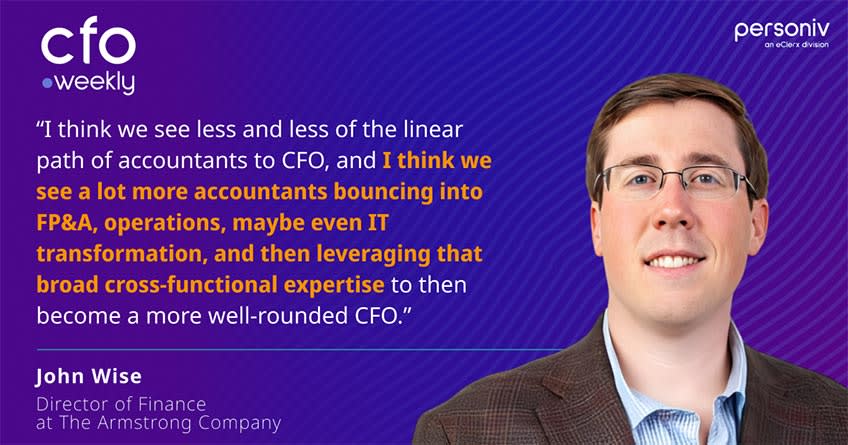
“I think we see less and less of the linear path of accountants to CFO, and I think we see a lot more accountants bouncing into FP&A, operations, maybe even IT transformation, and then leveraging that broad cross-functional expertise to then become a more well-rounded CFO.” Wise commented. - 00:27:03 – 00:29:33
Want more insights? Explore our full library of podcast blogs here.
To listen to the full conversations, check us out on Apple Podcasts, Spotify, and our RSS or your favorite podcast player!
Instructions on how to follow, rate, and review CFO-Weekly are here.
Overcoming the cultural and operational growing pains middle-market companies face requires bandwidth and strategic clarity. We provide scalable, dedicated finance and accounting teams to manage your daily workload so you can focus on leading transformation. Drop us a line today to learn more.


