


In this episode of CFO Weekly, Shirley Shu-Hurley, Chief Financial Officer at Hillsborough Transit Authority (HART), joins Megan Weis to explore why the CFO role is evolving from scorekeeper and controller into what Shirley calls the “decision architect” of the organization. Shirley is a finance leader with two decades of experience helping organizations navigate complexity, transformation, and growth. With credentials as a CPA, CFA, and MBA, she has built her career at the intersection of finance, operations, governance, and strategy, partnering with executive teams and boards to build scalable financial infrastructure, strengthen decision making, and create long-term value.
Drawing on a career that spans the energy sector, an entrepreneurship-focused MBA at Durham University Business School, a fractional CFO and strategy consulting practice, and finance leadership at a global donor-advised fund foundation, Shirley shares how she now applies that experience to public finance at HART. She unpacks her framework for evaluating organizational capacity, why she reframes finance's role from gatekeeper to system thinker, how governance can accelerate rather than slow decision making, and what mindset the CFO of the future will need.
Show/Hide Transcript
00:55 Megan: Today I'm joined by Shirley Shu-Hurley, Chief Financial Officer at Hillsborough Transit Authority. Shirley is a finance leader with two decades of experience helping organizations navigate complexity, transformation, and growth. With credentials as a CPA, CFA, and MBA, she has built her career at the intersection of finance, operations, governance, and strategy, partnering with executive teams and boards to build scalable financial infrastructure, strengthen decision making, and create long-term value. In this episode we'll explore how today's finance leaders are shaping strategy, strengthening governance, and building the organizational capacity businesses need to grow and adapt in an increasingly complex world. Welcome to the show today, Shirley, and thank you so much for taking the time to be here.
01:49 Shirley: Thank you, Megan. I'm glad to be here. Thanks for having me.
01:52 Megan: I'm looking forward to this conversation. You've had a really interesting career. So to start, can you walk us through that career journey and how your experiences across finance, operations, and transformation have shaped your leadership philosophy?
02:09 Shirley: Sure. I started my career as a financial analyst in the energy sector, primarily oil and gas, and that was the first chapter of my career. I worked in a similar role for 10 years, and then I moved to the UK to get my MBA from Durham University Business School. The concentration path was entrepreneurship. Then I moved to the US and started a consulting business, more like a fractional CFO plus strategy, in the mid-market. Later on I got into a finance role at a global donor-advised fund foundation. It's like a marketplace for donors and charities, operating in multiple jurisdictions and delivering the tax benefit for giving, while developing giving strategy and managing charitable assets. I grew into the head and leader of the finance function. When I first started it was a very, very small company, and we built a financial infrastructure together and grew into a larger footprint globally. My most recent role, which I started six months ago, is at HART, Hillsborough Transit Authority. We're serving Hillsborough County. This is my first time in public finance as a CFO. And where exactly is Hillsborough? The Tampa Bay area.
03:43 Megan: Okay. You mentioned having done an MBA in an entrepreneurial program. When you left work to do that, did you think you'd be starting your own business, or why the entrepreneurial focus?
03:56 Shirley: I think I'm most interested in solving problems and creating value. Even in my last role, we had plenty of spin-off opportunities. We called them entrepreneurship. We created the solutions, even SaaS companies or marketing arms in different jurisdictions. It all became spin-offs, almost like a portfolio of companies. That actually served my last role very well.
04:23 Megan: Throughout your career, you've worked in complex, imperfect environments across many different organizations. When you step into a new finance leadership role, what's the first thing you look at to understand the organization's true capacity to execute on its strategy?
04:40 Shirley: Very good question. Consider my recent role as CFO at HART. In my first leadership meeting, I asked every C-suite colleague one question based on first-principles thinking: for us to succeed, what is one thing that has to be true? I listened around the room, and most people were talking about the culture and all the people there. That gave me the first understanding, from a high level, of what it looks like for us to be able to execute the strategy in place. Then I talked to my teams and learned more. I think capacity is a very interesting concept here. One critique I hear here is that people often say, "Oh, we don't have the capacity." People become complacent a lot of times, they may resist change, and it takes on a negative light. On the other hand, we all know a lot of times constraints are not inherently a bad thing. Sometimes constraints promote innovation. So when we look at capacity, we probably don't only look at the number of people working here, but also the competency, capability, process, procedures, and all the systems in place, to see if they are able to unleash the capacity we truly have here.
06:10 Megan: That's really interesting. I feel like capacity is often used as an excuse when, like you said, many times it's just an opportunity for innovation.
06:20 Shirley: Correct.
06:21 Megan: I'm curious to know, stepping into a nonprofit, what has been the most challenging or surprising thing about working in a nonprofit?
06:33 Shirley: In nonprofit, I think the drive is a little bit different, because a lot of times if you put KPIs in place, you can't solely look at the bottom line. That's a completely different picture. Another thing is that the public sector is also non-profit driven. Meanwhile, we also face budgetary constraints and compliance constraints. Normally, if you work in the private sector or a for-profit company, $1 is $1 and you can use it for whatever gives the best yield. Basically your job is to invest your time and your dollar sensibly and get the best return. However, a lot of times in the public sector, $1 doesn't equal $1. There are more flexible dollars you can use for certain things, and there are certain grants you get from different governments or funding partners where there is a string attached. They say, "We're only funding you for this program or this project. You can only use this money for this kind of thing." So you face a lot of constraints and not a lot of flexibility. Then you have to work out, within those constraints, what's the best choice or decision going forward.
07:54 Megan: You've described your work as building financial architecture from the ground up. What does a strong financial foundation look like in an organization that's preparing for growth?
08:06 Shirley: From a financial architecture perspective, what I mean is even the ERP system you're using, the process, procedure, and system you're using, and how you set up your chart of accounts. Those are part of financial architecture. My recent thinking on my management philosophy is that the CFO role is more like a decision architecture. A decision architect does not make every decision, but designs the structure that allows the right person to make the sound call. That means converting an ambiguous request into a clearly defined decision: a desired organizational outcome, real constraints, viable alternatives, and quantified financial and operational consequences, then a recommended path or defined ownership, triggers, and follow-ups. So that's my thinking. In the finance role, you basically have the scorekeeper, the controller, the analyst, and the business partner, the concept we hear most of the time in operational conversations. What I would elevate it to is a level higher than that. I call it decision architect. It designs the choices, the trade-offs, the authority, and the feedback mechanism needed to act.
09:33 Megan: Strategy often looks great on paper but struggles when it's being executed. How can finance leaders help bridge the gap between strategic ambition and operational reality?
09:46 Shirley: That's another great question. I think the first thing we need to do is articulate the decision. Most requests are framed too narrowly, or framed as the wrong question entirely. So the first move is to restate the question at the level where it can actually be answered, which usually widens it from a transaction into a structure. The quality of the answer depends heavily on the quality of the question. The second part, I would say, is to recognize the desired outcome. Start with what the organization is really trying to accomplish rather than what has been asked for. Naming the outcome changes the options worth evaluating, and it moves finance from processing a request to helping with what operations needs. The third one, I would say, is to classify constraints. We can separate the constraints into different categories. Sometimes it's a hard constraint, a law or contractual obligation. Then there are policy constraints, our internal rules, which leadership has the authority to change. The last one is a preference: existing practice, convenience, or risk appetite, and assumptions that the current arrangement was right, but for a reason, and could be re-examined. Later on we can construct viable choices, and then we have to illuminate the trade-offs. A lot of times we cannot carry through the strategy because it has hidden, embedded trade-offs instead of highlighted ones, including financial, operational, compliance, risk, or people trade-offs. Another very important part is whether it's reversible or not. There's a concept called one-way doors and two-way doors that people talk about. A lot of times you have to act on it, let the outcome be data, and then reevaluate your action, instead of just sitting here saying, "Let's think about this, let's talk about this." I often share this with my team: I am a highly action-biased person. I do believe action produces information. Instead of analysts evaluating, you sometimes just need to take that step and let the data tell you, and you can self-correct. Of course.
12:20 Megan: How do you take that first step, like jumping off a cliff? How do you know when it's time to jump?
12:27 Shirley: Often we will evaluate whether the decision is reversible or not, and the magnitude and scale of the impact. If it is considered low risk, for example an internal memo to draft, then take that step, have that conversation, bring the right people into the conversation, and let's just pull the trigger. Do it now. If something is considered irreversible, then we would treat it with greater caution.
12:58 Megan: Governance is sometimes viewed as slowing an organization down. In your experience, how does good governance actually enable better and faster decision making?
13:09 Shirley: Another great question. We recently discussed the AI policy within our organization. When we were trying to understand current usage and encourage employees to use the tool, we often faced people thinking, "Well, what about data transparency? What about other security issues?" It can be hard sometimes when you overweight the risk but undervalue the opportunity cost and the potential upside you're not able to capture. If it is an AI-immature company and it's over-indexing on the risks without understanding them, without trying it a little bit within guardrails, as baby steps, then you don't know enough about what risk you are mitigating. I often say of knowledge, you have this four-quadrant: you know what you know, you don't know what you know, and you don't know what you don't know. If you never develop that AI literacy and you are just standing afar talking about the risk, then we probably do not have enough literacy to articulate what the risk is, and do not have enough knowledge to even mitigate those risks.
14:37 Megan: Just curious, how are you and your team developing literacy when it comes to AI? What resources are you using?
14:45 Shirley: I had a similar experience in my last role, and I was the champion of that. Basically what I started with was X and YouTube. At that time I felt like I was an AI news junkie and I just couldn't stop following the newest developments. What we started was to encourage AI usage instead of hiding it. A lot of times people may be ashamed of saying, "Hey, did the AI produce this work?" You don't really have to shy away from that. Actually it's very encouraged. It's the most recent tool, and it becomes a cool thing to share with your peers: "Hey, guess what, I can do this." Another way is small task groups with people working in different departments and different roles, who come up with initiatives to say, "Guess what? AI can do this for me." Then during town halls or other internal meetings, you just start to share these tips, tricks, and techniques. We started encouraging usage at the individual level instead of an organizational-level investment overhaul. I think that's a better way to adopt AI.
15:55 Megan: You've partnered closely with CEOs and boards throughout your career. What distinguishes finance leaders who become trusted strategic advisors from those who remain primarily financial operators?
16:10 Shirley: I call it system thinkers. A system is a set of interdependent parts sharing a company's purpose, with dynamics. Socioeconomic systems are dynamic and tightly coupled, governed by feedback, nonlinear, and characterized by delays and incomplete information. A lot of times we need to make things interconnected and visible, overcome the institutional silos, understand the nonlinear behavior, and address the wider consequences of the interventions. A CFO who can be a system thinker will be a better partner and advisor as opposed to working in institutional silos.
17:00 Megan: A question along those lines: how do you develop relationships throughout the organization so that you're not working in those silos and you're being collaborative with other departments?
17:14 Shirley: Actually, the CFO is positioned very advantageously in those roles, because nearly all decisions eventually pass through or touch on resources, risk, performance, and accountability. The CFO naturally can see the connections that remain hidden inside individual departments. People sometimes joke that the CFO is the "CF-No," the department of saying no to most people, almost like a gatekeeper. Instead of behaving like a gatekeeper, we should act more like a partner and a decision architect. I often say, "We will find a way to say yes in a responsible way instead of saying no. Let me understand your business objectives first, so I know what you want to achieve, and let's evaluate it together. Maybe we're not able to do it the way you presented, but we can figure out another way to achieve this." I often say, find a way to say yes in a responsible way. I think through that you build credibility and trust.
18:27 Megan: We've talked about capacity, but organizational capacity isn't just about financial resources. How do you evaluate whether an organization has the people, systems, and operating discipline to successfully execute its strategy?
18:43 Shirley: I think that's also aligned with system thinking. A lot of times people pursue the local maximum instead of the global maximum because they work in operational and institutional silos. When we evaluate an organization's current capacity in people and systems, those are also very dynamic questions, because people change, and come and go. Maybe there are the right people in the wrong seat. Maybe there are wrong people on the bus altogether. And in this day and age, we upgrade our systems quite regularly. Even an ERP system, maybe every five years we have to reevaluate, even with the tremendous cost of conversion and migration. If necessary, and if technology catches up, we would do that as well. All of these things are very dynamic and not set in stone. Under this systems thinking, the first thing you look at is the event. Underneath the event, you can look at the pattern. An isolated event probably isn't worth your attention. But if there is a pattern of things going wrong, that is an opportunity to look one step deeper at whether there's a structural issue. If there is a structural issue, then that is the chance for us to make some changes. Underlying that, another layer under the structure, is the thinking model, maybe a decision-thinking model. In technology, people say the map is not the territory. A lot of people use their thinking model just looking at dashboards. If you don't look deep enough at a granular level, it's just a map, and it's not truly translated into reality, so a lot of information is lost. I think the most important thing is that when you identify a thinking-model issue or structural issue, that is a chance for you to solve something. For example, one structural issue a lot of organizations have is what I call the asymmetry of decision, authority, and accountability. What I mean is that somebody with a very strong view and higher authority comes in and makes a decision, but the decision maker is not exposed to the operational consequences. Then they have no way of self-correcting in decision making, and this is a recipe for operational chaos. What we try to do in every decision is ask who the decision maker is, and point out the person who actually carries the exposure and the consequence, because that person is most likely to self-correct.
22:01 Megan: When you're going through a transformation, obviously it's a lot of change. How do you get people excited about the change rather than resistant?
22:12 Shirley: I think sometimes people get disheartened because they may have heard about this so many times. A lot of leaders come and go, and they say, "Hey, let's do something." Then a couple of months later nobody talks about it, and it becomes "what's the next shiny thing." That's one way you can dishearten people. Another is that the organization develops an immune system, and people are very comfortable with the current process and procedure out of familiarity. Those are the ways people may not buy in. On the opposite side, sometimes a new leader comes in and brings new hope. People truly crave new leadership if they have been lacking it for so long. Once you build the trust and credibility, and I also feel like I don't stay only at 5,000 miles high, sometimes I like to work closer to the ground and have this level of conversation with you. We can challenge each other's thinking, why you think the way you think, and what blind spots we each have. For all my direct reports, I encourage them to act as partners. If I don't know what I'm talking about, I do want them to tell me so that I do know. I often say I have very strong opinions, but I don't marry my opinions and I don't attach my ego to them. I very much welcome disagreement. I say it's implied that if you don't disagree with me in a meeting, you basically wasted my time. That could have been an email I sent to you. We didn't need this discussion at all.
24:01 Megan: AI and advanced analytics are giving finance teams more information than they've ever had before. How do you see technology changing strategic decision making, and where do you think leadership judgment is going to remain irreplaceable?
24:16 Shirley: I feel like a lot of ground analytical work largely can be done by AI nowadays, especially spreadsheets and financial models, which are so mature. You can even embed it in, like AI builds a model and tells you its own assumptions, and you can challenge those assumptions and have multiple rounds of interaction. So on the analytical level, it can do a lot of work. You just act as a thought partner or a sounding board, back and forth, to challenge its assumptions. At this level, what judgment is irreplaceable? It's human agency. We hear about this so much. Agency is that you can act, or you can just act without permission. I'm not saying an employee should go rogue and act without permission. It is that when you run into a wall, you can run over the wall, above the wall, underneath the wall, through the wall, and don't treat bottlenecks as an absolute stopping point. You surface constraints and work through them. So that is human agency, and you move up the judgment curve. That is more than workplace skills. I think it's the most important capability we need to continue building up.
25:41 Megan: When you're looking at a process for automation or applying AI, how do you know when that process is ready for it and you're not just speeding up a bad process?
25:53 Shirley: Basically, a recurring, similar manual process is probably a good candidate for automation, and a lot of things that are dynamic and reactive could be good candidates for an AI agent in the future. We can't just go in and demand automation or an AI agent up front, because if one person doesn't know how to do it manually and correctly, they probably can't do it very well with automation or an AI agent. We see a lot of demos saying, "Hey, we can do this," but those demos are not production-ready AI agent or automation solutions, because there are edge cases and people still in the loop. If you don't build all those constraints and trade-offs in, it just looks very good at demo level, but it's never a production-ready solution.
26:55 Megan: Last question. Looking ahead, how do you see the role of the CFO evolving in the next two to three years, and what new skills or mindsets are going to be critical for the CFO of tomorrow?
27:08 Shirley: I read an ACCA report a while back saying the CFO would evolve into the Chief Value Officer, and that's an interesting concept. Besides that, the value part, another thing I see is that CFOs are definitely not what people thought before, a number-crunching person. They are a storyteller as well. When you interact with the board in a presentation, or even the public, what those numbers mean and what kind of story they paint is a very important skill for a CFO. Even on the strategic level, I think the CFO should understand the operational level as well, and which industry you are in, and I see that would add the most value.
28:01 Megan: Shirley, thank you so much for being my guest today. This has been a wonderful and enlightening conversation.
28:07 Shirley: Thank you so much to all of our listeners.
28:10 Megan: Please tune in next week, and until then, take care.
What You'll Learn:
-
Why the CFO role is evolving from financial operator to decision architect
-
How to evaluate an organization's true capacity to execute its strategy
-
A framework for classifying constraints as hard, policy, or preference
-
Why an action-biased mindset produces better decisions under uncertainty
-
How grassroots AI literacy programs build trust and adoption across teams
-
Why system thinking will separate strategic CFOs from financial operators
-
What the CFO role will look like in the next two to three years
Key Takeaways:
Redefining Organizational Capacity
When Shirley steps into a new finance leadership role, she starts by asking every member of the C-suite one first-principles question: what has to be true for the organization to succeed? That single question reveals how leadership defines capacity long before she ever reviews a headcount report. She argues that capacity is too often reduced to the number of people on a team, when it should also account for competency, process, and systems, and that constraints, rather than being an excuse, can actually be a catalyst for innovation.
"A lot of times constraints are not inherently a bad thing. Sometimes constraints will promote innovation." Shirley said. - 00:04:40 – 00:06:10
Why the CFO Role Is Evolving Into a Decision Architect
Financial architecture, in Shirley's view, includes the ERP system, the chart of accounts, and the processes and procedures finance relies on. But she has come to see the CFO's real value in a broader concept she calls decision architecture: designing the structure that lets the right person make the right call, by turning an ambiguous request into a defined decision with a clear outcome, real constraints, viable alternatives, and quantified consequences.
As Shirley explained, "A decision architect does not make every decision, but designs the structure that allows the right person to make the sound call." - 00:07:54 – 00:09:33
Why Governance Should Accelerate, Not Slow, Decision Making
Shirley sees governance as an enabler of speed, not a brake on it, especially when it comes to AI adoption. Rather than overweighting unknown risks, she encourages teams to build AI literacy through small, guardrailed steps so they can actually understand and mitigate the risks they are worried about. At her prior organization, she championed a grassroots approach: following AI developments personally, encouraging employees to share tools and use cases openly instead of hiding them, and forming small cross-departmental task groups that surface wins during town halls.
"If you never develop that AI literacy, you do not have enough knowledge to even mitigate those risks." Shirley highlighted. - 00:13:09 – 00:15:55
From Gatekeeper to System Thinker
The finance leaders who become trusted strategic advisors, Shirley says, are system thinkers who see the interdependent, nonlinear connections across an organization rather than operating inside institutional silos. Because nearly every decision eventually touches resources, risk, performance, or accountability, finance is uniquely positioned to see what other departments cannot. Rather than acting as the department that says no, Shirley pushes her team to understand the underlying business objective first and find a responsible way to say yes.
"I often say, find a way to say yes in a responsible way. I think that's how you build credibility and trust." Shirley commented. - 00:16:10 – 00:18:27
The CFO of Tomorrow: Chief Value Officer and Storyteller
Looking ahead, Shirley points to an ACCA report suggesting the CFO role is evolving into a Chief Value Officer. Beyond delivering value, she believes the modern CFO must also be a storyteller, translating numbers into a narrative that resonates with the board and the public, while staying grounded in the operational realities of the industry they serve.
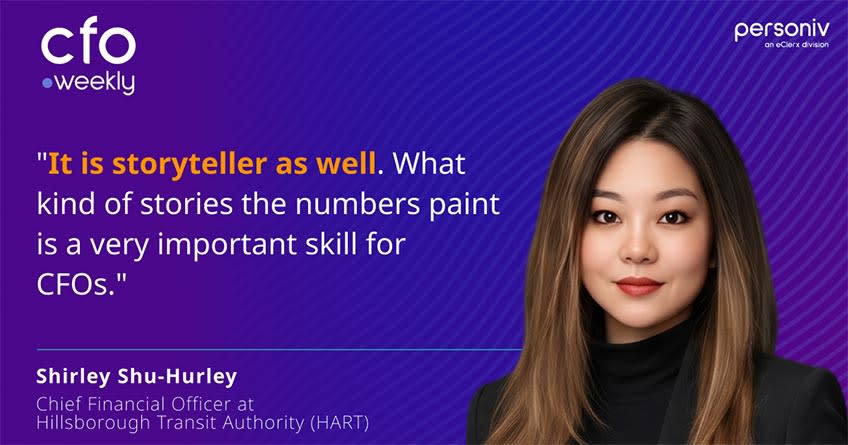
"It is storyteller as well. What kind of stories the numbers paint is a very important skill for CFOs." Shirley mentioned. - 00:27:08 – 00:28:01
Want more insights? Explore our full library of podcast blogs here.
To listen to the full conversations, check us out on Apple Podcasts, Spotify, and our RSS or your favorite podcast player!
Instructions on how to follow, rate, and review CFO-Weekly are here.
Fully embracing why the CFO role is evolving to decision architect means stepping out of the day-to-day weeds. We provide scalable, dedicated finance teams to handle the operational heavy lifting so you can focus on driving strategy and system thinking. Drop us a line today to learn more.


