


In this episode of CFO Weekly, Patrick Villanova, Chief Financial Officer at BlackLine, joins Megan Weis to discuss the shift from binary automation to agentic AI, and exactly why CFOs require deterministic AI to maintain strict governance while forecasting for the future. With over a decade at BlackLine and a background in big four accounting, Patrick explores how AI agents are moving beyond creative tasks to handle complex, transactional decision-making in highly regulated environments.
Patrick shares insights on why the "deterministic" nature of financial reporting requires a different approach to AI, one where perfection is the only allowable outcome. He explains how finance leaders can transition from "doers" to "reviewers," the evolving skill sets required for the next generation of accountants, and why embracing technology is the only way to avoid becoming a "dinosaur" in the modern era.
Show/Hide Transcript
Megan - 00:56 Welcome back to CFO Weekly. Today, I'm joined by Patrick Villanova, Chief Financial Officer at BlackLine. Patrick brings deep experience across SEC reporting, SOX readiness, IPO preparation, acquisitions, and global accounting operations. Over the past decade at BlackLine, he has played a key role in scaling the finance organization of a public SaaS company while navigating transformation, automation, and evolving regulatory demands. Welcome, Patrick. Thank you so much for being here with us today.
Patrick - 01:25 I'm happy to be here, Megan. Thank you.
Megan - 01:27 So, Patrick, you've spent a decade at BlackLine and have lived through digital transformation from the inside. When you look at finance today, what feels fundamentally different compared to even three or five years ago?
Patrick - 01:42 It might be a blinding statement of the obvious given the nature of this podcast and what we're going to talk about today. But when I joined BlackLine ten years ago, we were still in a strictly SaaS world of automation where decisions and automation were binary in nature. Whether it was through a SaaS platform, RPA, whatever technology was out there, it was yes or no. And that's where the technology had been for decades, whether it was on-premise or a SaaS space or in the cloud. In the last three to five years, we've seen the rise of AI. Now, years ago, AI was mostly used in a creative fashion—maybe more marketing, generating content, emails, artwork, logos, things of that nature. But what we've seen is AI now move more into our space: the office of the CFO, the more technical space in terms of what can AI do in the world of accounting and finance from an agentic standpoint, from a decision-making standpoint, from a transactional standpoint. We have seen the evolution of that. It's still early. There's still a lot of dialogue out there. There's an emerging narrative. We are one of those companies that are obviously leaning in heavily on our investments with AI to augment our current technology and enhance it.
Megan - 03:12 And to me, BlackLine seems like a household name. Everybody knows it, but maybe there's some listeners out there who don't. Do you want to just give us a quick overview of what BlackLine is and how it's differentiated in the marketplace?
Patrick - 03:26 Sure. Of course. BlackLine is an office of the CFO platform. What that means is we have four primary solutions that are connected through our Studio 360 platform. To keep it very succinct, we help companies close their books more efficiently, more accurately, with less human intervention. We help companies with their intercompany transactions. We help companies with their financial close, with their analytics, with their business reviews, and we also help companies with their collections. So when you look at the mandate of a CFO and what that person is responsible for, an overwhelming majority of that person's work—or the team's work—is financial reporting, closing the books, as well as accounting operations, billing, and collections. We bring automation in that area. We've been around for about twenty-five years, and we are the largest company in this space that does specifically what we do in terms of serving the office of the CFO and financial close.
Megan - 04:33 Let's start simple. When people hear the phrase Agentic AI, it sounds somewhat futuristic, although less futuristic today than it did maybe three years ago. In practical terms, what does it actually mean for the office of the CFO?
Patrick - 04:48 Maybe let's start really basic, and that will lead into the conversation. Agentic AI. Let's just take the word agentic. It's an agent. And what does an agent do in the everyday life of a person? An agent acts on your behalf. It doesn't have to be a sports agent or Hollywood agent. You can have an agent in any capacity that is acting on your behalf at your instruction. That agent is given a decision-making framework: if this happens, go do this, or these are the types of decisions I want you to make on my behalf. This is how I want you to represent me. This is what I want you to do for me. So just in the most basic terms, that is what an agent can do for a person in their professional or personal life. Then you take it one step further. You say, well, you have agentic artificial intelligence. So instead of having a person do this work for you, you have an agent. You have AI built within your platform that is out there doing work on your behalf as a finance or accounting professional.
While we have high levels of automation in the industry already, the industry does require a lot of manual intervention. You have to go in, log in, move things through workflows, click this, click that, and it still requires a lot of human intervention. It requires some basic decision-making and some very complex decision-making. So while the level of automation in this industry has moved exponentially in the twenty-five years I've been an accountant, and the ten years I've been at BlackLine, the difference now is you can now program an agent, design an agent, and release it into your financial systems ecosystem with a certain level of instructions and some variability. That agent can go out and basically do the work that you've been doing.
The more rote work, the more mundane work, the clicking, the moving through workflows—if you're a finance and accounting professional, that can be a major time commitment over the course of several weeks or the course of a year. You're removed from that. You're staring at your screen rather than clicking and constantly being interrupted by what the system is doing. Every person has their own staff finance and accounting professional working in the background, doing that work for you so that you, as a professional, can step back and say, "Okay, I'm no longer being interrupted by the mundane. I can be more analytical. I can be more value-added. I can be more strategic." You are not interrupted or distracted by this rote and mundane work happening in the background that this agent is now doing on your behalf.
Megan - 07:31 Sounds like a dream come true for most accountants. I'm curious about the BlackLine product. If someone wants to implement it, what is the process? Is it pretty much off the shelf, or is there a big implementation project that comes along with it? How do people use it?
Patrick - 07:51 We have over 4,000 customers as an organization. Our product is not shrink-wrap right off the shelf like you would see at a software shop. We serve middle-market enterprise and mega-enterprise companies. We serve almost 70% of the Fortune 500 right now. We serve companies with trillion-dollar market caps and companies that have $200,000,000 or $300,000,000 in revenue. We are not a business-to-consumer business. We serve companies that have an accounting and finance department and a big enough scale business that requires more automation within their office of the CFO ecosystem.
Yes, we do perform implementations. For some of our solutions that are a little more straightforward, you can do that in a matter of weeks with very low touch from your IT department. Sometimes you can even run it within your own finance and accounting department with a little IT savvy. Then, of course, we have more complex solutions like our intercompany solution that takes much more time. Typically, the more time something takes, the more value it delivers because it is solving a more complex problem. There is a direct correlation between the size of the problem, the complexity of the problem, and the value in solving it. The bigger the value, typically, the longer it takes to implement. But if you, as a customer, are actively engaged with us, we will get an implementation done in a couple of weeks if you buy just a couple solutions. If you buy the whole suite, you can get it done in several months. We're not talking about a traditional ERP that could take years. We sit on top of an ERP system, and we take data in and out of the ERP. We automate the data from a transactional standpoint and help companies reconcile the data so it's accurate.
Megan - 09:41 Looking back at your own journey, was there a moment where you realized that AI wasn't just another automation wave, but something that was going to materially change how finance operates?
Patrick - 09:54 I can't say there's one particular seminal moment.
Megan - 09:59 Like a lightning bolt.
Patrick - 10:00 If anybody could sit there and say, "I had my AI moment and this is when I knew it was a trillion-dollar idea," that's pretty impressive. Maybe there are a handful of people in the world that did that. But I'll give a good example. I got very deep there in terms of financial close software and what we do, but here is a basic transaction that everybody can relate to. Everybody's received a bill in their lifetime and paid a bill. The invoice goes out from whoever you bought it from, the cash comes in, and that cash has to be applied to the invoice to indicate it's been paid so that you no longer have to chase that invoice down. It's part of your books and records. The transaction is complete. That's Economics or Accounting 101. Every business that has revenue does that.
A handful of years ago—less than five—I was looking at a very early-stage agent that applied cash. It basically said, "Okay, here's cash that came into an account. Let me figure out what invoice this relates to and apply this cash." Historically, before the advent of AI and machine learning, it was binary. If you sent an automation tool out to apply that cash, if any variable changed at all, it would reject it or say, "I can't find the open invoice." Then a human being would have to go in and manually apply that cash, which takes time and costs more money. In the days of typical automation or typical RPA where it's one or zero, yes or no, you could take that transaction a million times and if one little variable changed—like the company changed their name or their legal name, or even the configuration of the invoice—it would reject it a million times out of a million times.
Then I saw this agent get released into a similar ecosystem for the same transaction. In this particular example, the company slightly changed their legal name, and the address moved off to the right side of the invoice versus being on the left. That's it. Everything else remained the same. The first three or four times, the agent did what the traditional technology did. It ran into the invoice and said, "I don't recognize this. I don't know what to do." By the third or fourth time, the agent sent a message saying, "Wait a minute. This address is the same as a current vendor. The invoice configuration changed, but it's the same banking account. And the amount on the invoice matches to the penny an amount received the other day into your banking account that is in line with the instructions that you gave this vendor." The only thing that changed was where something fell on the invoice and the legal name of the vendor. It said, "Hey, is this the same vendor?"
That was an "aha" moment for me because I had been living in a world where it was binary. Now I'm sitting there saying this technology could actually learn. It could adjust and adapt without a human being going in to perform the transaction manually or the vendor having to rewrite the code. This really has legs and potential. But this could be really dangerous in a financial and accounting environment that is highly regulated and governed by the SEC and the IRS, where perfection is the only allowable outcome. You can't be close enough. You can't be 99% right. You have to be perfect.
If you have a technology out there that can learn and adjust, you have to make sure that the adjustments it is making are correct. That's where we are today. We are designing these agents very prudently in our ecosystem to make sure that they're 100% right and that the judgment, if any, that they're exercising is consistent. That is what's most critical right now in our industry. We can't afford a typo. We can't afford something being slightly off. It has to be perfect, trusted, and accurate. That's the threshold we're crossing right now in the office of the CFO. We are leaning into this as we design these agents for our customers that trust us. We would never do anything to compromise that.
Megan - 14:47 In your role as a Chief Financial Officer, where have you seen Agentic AI create the most immediate operational impact within financial close or intercompany processes? Where do companies get the most bang for their buck?
Patrick - 15:03 Right now, AI is being used effectively within financial close in general, which intercompany is a subset of, on transactional level controls and on processing transactions. The example I just gave—applying cash, identifying accounts that are out of balance—within the accounting space, we see the most value being delivered in terms of risk management. You can use AI to review your financial statements, and it can identify irrational trends in your numbers. That typically might indicate a mistake or an error was made. It can review journal entries and identify journals that are out of sequence or break a certain pattern, which might be indicative of an error or just somebody entering something in incorrectly. It's still a mistake. It has to be corrected before it ever goes outside to the public markets.
As we sit here today, we're seeing agents being very effective at identifying risk and reviewing massive volumes of transactions that a human being in traditional software cannot do. Probably the next level is we're seeing agents doing very basic tasks that accountants used to do: preparing reconciliations, reconciling accruals, preparing journal entries, applying cash. This is stage one. It's low judgment, high volume, and task-oriented. It's demanding on people, and it is the perfect place to release agents. It's low risk, easily reviewed, and it builds trust in the technology.
The next phases will start as an industry to allow them to exercise a little bit more judgment. But right now, it's a huge value play. For a large enterprise company, people don't realize they have thousands and thousands of accountants. The amount of time spent on processing these transactions is significant. To automate that all with an agent that never sleeps, never tires, and if designed correctly, doesn't make mistakes—that is a huge value proposition for the industry right now.
Megan - 17:27 If you were speaking to someone who was thinking about studying accounting, would you steer them down that road? Or do you think accounting is going away and that AI is going to take over?
Patrick - 17:41 Accounting itself can never go away. You always need accounting, and AI will never—"never" is a strong word—it is excessively improbable that AI can replace all of accounting. You always need some type of human intervention to review from a quality control and accountability standpoint. The general public makes investments on the financial information that accountants provide. They trust that information. As long as that exists and as long as that's regulated by the SEC and IRS, a human being has to be held accountable. You will always need accountants. You will always need that specialty. You will always need accountants to help design these agents as facts, circumstances, and laws change.
Accountants aren't going away. Now, what I do see happening is the skillset of accountants changing dramatically. I'm already seeing that in my world in terms of how we hire. If I went back ten or fifteen years ago, the traditional process to recruit an accountant was to look for Big Four accounting and a CPA—somebody that's been through it, that's technical, and you want to bring that technical accounting skillset into your environment. Full stop. Now, when I'm interviewing, we're looking at accountants who still understand the tenets of the profession, but just as importantly, you have to be more than tech-savvy. You have to be data-savvy and AI-savvy. You have to know how these things work or could work. You have to lean in and embrace technology. The lines are really being blurred between accounting, finance, IT skillsets, and data scientists. We're recruiting a different type of talent because we see where the industry is going, and that kind of talent will thrive.
I can show historically that this has always been the case. Forty-some years ago, the advent of the personal computer in the early eighties started appearing in accounting offices. Shortly thereafter, Microsoft Excel came about. Believe it or not, accountants rejected it. They wanted to stick to their green ledger paper and their red pencils and the rulers. The accountants that were slow or refusing to adopt Microsoft Excel and throwing away reams of paper went the way of the dinosaur. The accountants that leaned into it accelerated their careers. Fast forward twenty years later—the turn of the century—and that's when BlackLine came about. In 2001, we said, "We can take what you do in Excel and we can automate that." Sure enough, those accountants that were living in Excel for twenty years said, "No, I have to control everything." The accountants that did not adopt the technology went the way of the dinosaur again. The accountants that leaned into BlackLine and other players succeeded.
So here we are, Generation Three. AI is bigger than the two things I just talked about, but it's no different in theory. AI is here to make our lives easier, to augment our experience, and to make us more efficient. You can either be scared of it or you can embrace it. We will not go away. We will just get better at our jobs, and our jobs will become more interesting and less rote.
Megan - 22:30 Can you share an example where AI meaningfully changed how your own team operated, whether in speed, accuracy, or decision quality?
Patrick - 22:40 I can give you quite a few examples. Let's go to the other side of the house: the finance side. As a CFO, I came up as an accountant. I was a CPA. I am accounting-minded. I've used our solution for ten years now. I'm very automation-oriented and process-oriented. But even on the finance side—the side that does budgeting and forecasting—they look into the future, whereas accountants look into the past. We have been able to use some internal tools to do forecasting. We're not "hands off the wheel" where we just let AI do it. But let's say you have four people that spend an inordinate amount of time forecasting and predicting how much we are going to grow or how profitable we are going to be. If you have AI, that's the fifth invisible person in the room. That's the person in the room that is taking all inputs, doing its own analysis, and kicking out an output.
Right now, it's a fifth opinion. We have the traditional human way of doing things, and then you have the AI way of doing things. Then you reconcile and you evaluate. Did AI misinterpret an input, or did it figure something out that we've never been thinking about? It's like bringing a new way of thinking that can consume and process data that no human being can, but it doesn't have context yet. It doesn't know the business the way human beings do. It doesn't know exactly what we're trying to achieve strategically, but it is a fifth opinion in the room that makes you smarter.
Going back to the accounting space, I'll leverage the example I gave you before. We use our own solution for that. We used to have to manually apply every single dollar of cash that came in to an invoice. Right now, about 80-plus percent of the time, it is hands off the keyboard. Invoice goes out, cash comes in, cash gets applied, and it gets pushed to your system of record. No human being ever gets involved. Think about that: 80% of your transactions are now being performed by an AI agent within your collections platform. That allows those people who were mired in that level of detail to do more fruitful things, like analyzing the tougher accounts, making the tougher phone calls, and really digging into the numbers rather than just processing data.
Megan - 26:02 Both incredible examples of just how powerful it is. You touched on this a bit, but many finance leaders worry about control, auditability, and regulatory risks. How do you balance the promise of autonomous decision support with the strict governance requirements of a public company?
Patrick - 26:22 We more than worry about that. If you release financial information to the public that's materially incorrect, that erodes investor confidence, undermines your stock price, and can cost jobs. The stakes are extremely high. You have to be perfect. That's a very high bar to clear when you're developing a technology that changes on its own.
I believe BlackLine has a distinct advantage here because we know the stakes, we're subject matter experts, and we have twenty-five years of clean, accurate data. Our customers need BlackLine to be perfect. They know the risk is asymmetric. It's not just our customers, but our auditors have to sign off on whatever we use. Regulators have to approve the technology or put rules around it. People like me know we need to lean into AI, but we're being very prudent about it. We are testing it and validating it. Once you build trust in a technology—especially in this industry—that flywheel accelerates. We might not dive in with two feet and just try anything. We're going to test it and get aligned with our auditors. Once all that happens, though, the sky's the limit. We're excited about it, but we're being very prudent in how we're approaching it because we've built trust over the last couple decades and we're not going to do anything to undermine that.
Megan - 28:38 I have a question for you, and I know you're not a developer, so I'm not sure if you'll have an answer or not. But how do you prevent it from going off the rails? How do you put guardrails into place where you know it's doing what it's supposed to be doing and not just what it wants to be doing?
Patrick - 28:55 I'm not a developer in today's age. When I graduated college, I had a brief stint with Y2K coding, but that is obviously an antiquated technology. I at least know the pain of programming and the diligence it requires. You can throw a lot of AI into buckets outside of accounting and finance. You have creative AI where the number of outcomes are literally infinite. That works really well in creative professions.
In our world, you can boil it down to two things. You give AI a ton of data and you ask it for an answer. That is what some companies are doing outside of our space that do not have the infrastructure, platform, workflows, or data moat. They're giving AI an infinite number of inputs and saying, "What do you think the answer is?" That is a probabilistic outcome, meaning the AI will come back and say, "I'm 98% sure that this is the answer." That definitely does not work when you're reporting financial information to the public. You can't have AI that says, "I'm 98% sure this is right." There is not a CFO in the world that will sign off on that. If you're not in this profession, 98% sounds great, but it's literally not good enough. If you're 5% off in your financials, you're restating and probably losing your job.
The other side of this is deterministic AI, not probabilistic AI. For AI to be deterministic, you have to release it in an ecosystem with guardrails. That ecosystem is our current SaaS platform that we're releasing AI agents into as we speak. We're very transparent about it with our customers, letting them test them for free and give feedback. We're saying, "Okay, AI agent, here's a pool of data. We know it's accurate because it's already been through our system." These workflows have been developed for twenty-five years, and they keep guardrails on the AI from just going off in an infinite number of directions. That is how we are designing agents to determine an outcome that everybody can trust because the structure is already in place. It's a safe space for AI to operate rather than just dropping it in a pool of data and hoping it comes out 100% accurate.
Megan - 32:22 As AI becomes more embedded in workflows, how should CFOs think about accountability? For example, if an AI-driven process flags or executes a transaction, who ultimately owns that decision?
Patrick - 32:37 Ultimately, there has to be a human being that signs off on all this. It's on every SEC document that goes out there. What I envision seeing happen is you might have fewer "doers" at the entry level processing transactions, and a lot more reviewers reviewing the outcomes of AI. They have to be held accountable for the outcome of AI. Instead of reviewing the work of ten staff accountants, you're reviewing the work of one agent. Those staff accountants are probably doing more work analyzing than crunching numbers. That's why the accounting profession can't completely go away. You have to keep training new accountants with new skillsets, and the nature of the work will change, but we will still need them reviewing work.
Megan - 33:40 Looking ahead to the next three to five years, what do you think is going to separate finance organizations that successfully adopt Agentic AI from those that struggle to move beyond traditional automation?
Patrick - 33:54 It's culture. I know that might not be the answer you're expecting, but it starts with tone at the top. You have to identify the right talent and change the way you're recruiting and the profile of the type of person you're hiring. You have to change the mindset. You have to create an office of the CFO that is highly enabled and highly trained. The amount of training is going to go up, not down, over the next couple years. You have to encourage people to lean into it and trust it. It's not your enemy; it's your friend. It's going to make your life better and advance your career.
The only way it's going to replace you is if you reject it. If you embrace it, it's going to make you better at your job. It's about driving home that tone at the top and developing that culture amongst your people. We have to test it, test it, and test it again. Once we get there, it's going to make our lives even better than they are today. Three to five years from now, it comes down to leadership, setting the right tone, and building the right team to open your arms to AI and not be afraid of it.
Megan - 35:41 Patrick, thank you so much for being here and for helping us understand that Agentic AI isn't just another automation wave, but a fundamental shift in how the office of the CFO operates, governs, and creates value.
Patrick - 35:54 Thank you, Megan. I appreciate the time.
Megan - 35:56 I appreciate you taking the time to share your knowledge. To our listeners, take care, and please tune in again next week.
What You'll Learn:
-
The fundamental difference between binary automation and agentic AI.
-
Why the office of the CFO requires deterministic AI rather than probabilistic models.
-
How AI agents act as the "fifth invisible person" in the room for forecasting and risk management.
-
The shifting recruitment landscape: why "data savvy" is as important as "accounting savvy."
-
Strategies for building a culture that embraces AI as a career-accelerator rather than a threat.
-
How to maintain strict governance and auditability while deploying autonomous agents.
Key Takeaways:
Defining the "Agent" in Agentic AI
An AI agent is more than just a tool; it is a digital entity designed to act on a professional's behalf within a specific decision-making framework. Unlike traditional automation, which is binary (yes/no), agentic AI can handle variability and execute rote tasks—like clicking through workflows or moving data, freeing humans to focus on high-value strategy.
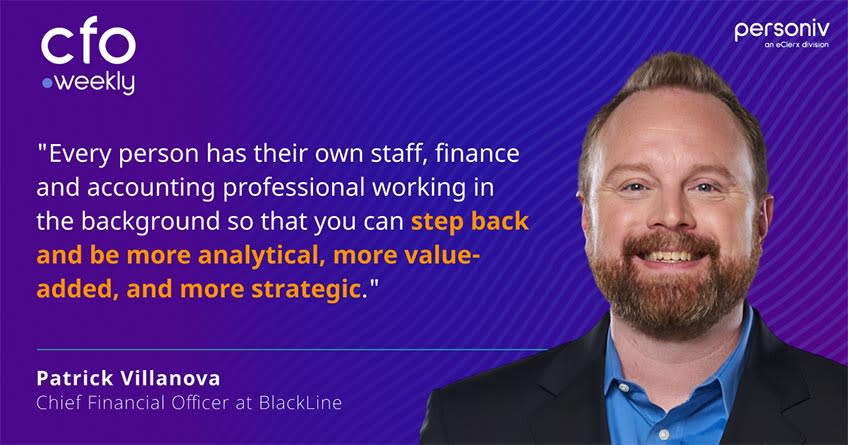
"Every person has their own staff, finance and accounting professional working in the background... so that you can step back and be more analytical, more value-added, and more strategic." Villanova remarked. - 00:04:48 - 00:07:31
Why CFOs Need the Shift from Probabilistic to Deterministic AI
In creative fields, a 98% "correct" rate is an A+; in the office of the CFO, it is a failure that leads to financial restatements. Patrick emphasizes that CFOs need deterministic AI—systems that operate within proven guardrails and workflows to ensure 100% accuracy.
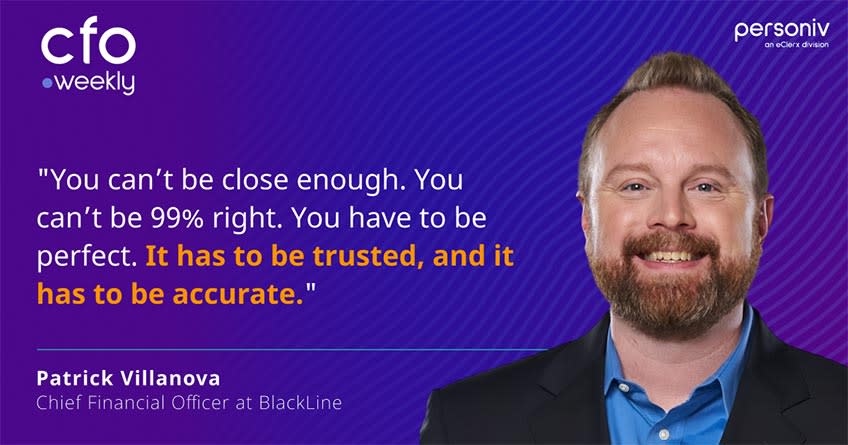
"You can’t be close enough. You can’t be 99% right. You have to be perfect. It has to be trusted, and it has to be accurate." Villanova explained. - 00:10:00 - 00:14:47
The Evolution of the "Data-Savvy" Accountant
Accounting isn't going away, but the "green ledger and red pencil" mentality is. Patrick notes that just as Excel replaced paper, AI will replace manual data processing. Future finance leaders must be a blend of technical accountants, data scientists, and IT specialists.
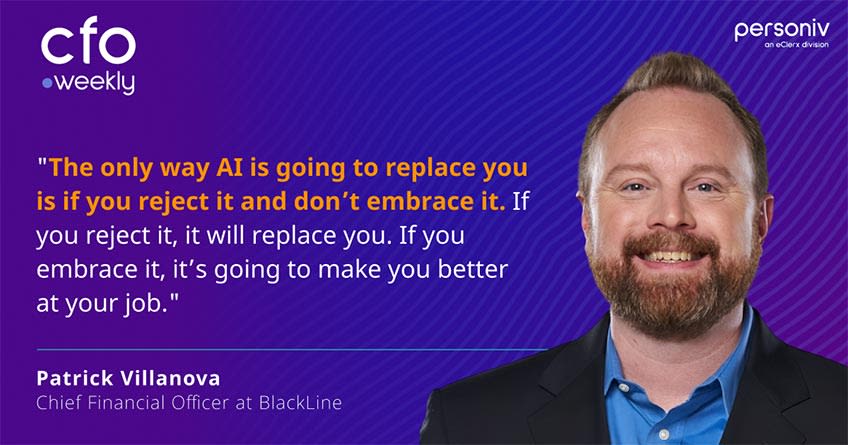
"The only way AI is going to replace you is if you reject it and don’t embrace it. If you reject it, it will replace you. If you embrace it, it’s going to make you better at your job." Villanova revealed. - 00:17:41 - 00:22:30
Why CFOs Need Deterministic AI: Culture as the Catalyst for Adoption
The successful adoption of AI depends less on the software and more on the tone at the top. Leaders must foster a culture of curiosity and constant training, moving the organization from a mindset of "fear of replacement" to "empowerment through augmentation."
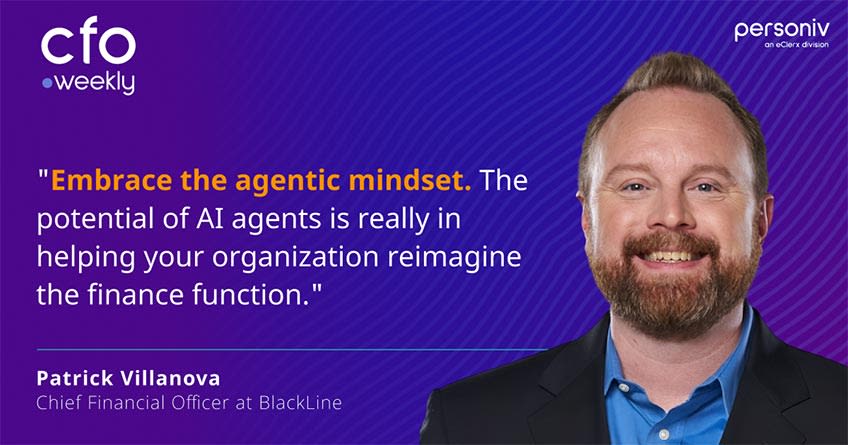
"Embrace the agentic mindset...the potential of AI agents is really in helping your organization reimagine the finance function." Villanova said. - 00:33:54 - 00:35:41
Want more insights? Explore our full library of podcast blogs here.
To listen to the full conversations, check us out on Apple Podcasts, Spotify, and our RSS or your favorite podcast player!
Instructions on how to follow, rate, and review CFO-Weekly are here.
Struggling to secure hard-to-find accounting talent? We provide scalable, data-savvy finance teams that understand exactly why the office of the CFO requires deterministic AI. Reach out today to future-proof your operations.


