


In this episode of CFO Weekly, Bojan Belejkovski, Vice President of Finance and Treasurer at Voltava, joins Megan Weis to unpack what it actually takes to build an AI-native finance operating model, why bolting AI tools onto broken processes never works, and exactly why AI failures in finance are silent. Bojan brings a rare, non-linear path into finance, starting with a law degree and a master's in international law before an operations management course at Wharton pulled him toward treasury, M&A integration, and enterprise finance transformation.
Bojan has led multibillion-dollar restructurings, post-merger integrations, and ERP transformations including SAP S/4HANA, Oracle Fusion, and Kyriba. He is the author of Treasury 2.0: Future-Proofing Finance with AI, built around his own D.A.S.H. framework: Digitize, Automate, Streamline, Harness AI. In this conversation, he explains why finance's real opportunity with AI isn't speed, it's turning finance from a backward-looking reporting function into a forward-looking decision engine, and why the failures of AI adoption are far quieter and more expensive than the failures of a bad ERP rollout.
Show/Hide Transcript
Megan - 00:48: Welcome back to CFO Weekly. Today, I'm joined by Bojan Velikowski, Vice President of Finance and Treasurer at Voltalia. Bojan is a treasury and finance transformation leader with deep experience in M&A integration, liquidity strategy, risk management, and enterprise finance modernization. Throughout his career, he has led complex initiatives ranging from multibillion-dollar restructurings and post-merger integrations to ERP transformations, while increasingly focusing on how AI can transform finance from a reporting function into a real-time decision engine. In this episode, we'll explore what it really means to build an AI-native finance operating model, how finance leaders can move beyond isolated AI use cases, and why the future of finance lies in combining intelligent automation with stronger human decision-making. Welcome, Bojan. Thank you so much for taking the time to be here with us today.
Bojan - 01:47: Thanks for having me.
Megan - 01:48: Yeah. I'm really looking forward to this conversation. So as you look back on your career and the journey you've had to date, which has taken you through treasury, M&A, and finance transformation, how has that shaped the way that you think about AI and finance today?
Bojan - 02:07: That's a great question, and I will give you a long-winded answer so you can understand what I am and why I landed there. So my path into finance, I would say, was not a standard one. I started with a law degree and actually was aiming for a career in European policy. I have a Master's of International Law, but I then started getting involved in finance-related projects like paying credit agreement negotiations and such. So what really pulled me toward finance at the end of the day was the operations management course, which I took at Wharton. And, again, it's not finance, but it rewired how I think about problems. From there, the natural path was MBA, CTP, Wharton's executive program. Then I guess I was on a mission to learn across multiple industries and advance myself. So far, to date, I've spent time in automotive, public service, renewables, renewable energy that is, gaming, sports and entertainment, food and distribution, real estate, and I don't think I'm forgetting anything. So treasury turned out to be just the perfect vantage point because it sits in the middle of liquidity, risk, capital, and you see the whole business. Then I developed a low tolerance for bad data and slow reporting, combining my legal and business degrees. That led toward AI, like three and a half years ago, I think. It's when ChatGPT became relevant, was out there. Everyone was testing with it, and it showed up. I saw something that finally was able to close the gap between technology and finance, and I jumped on it. So I started building it and started learning courses out there in AI, which led to publishing a book by myself called Treasury 2.0: Future-Proofing Finance with AI.
Megan - 03:56: Wow. Quite a career you've had to date, and yes, definitely a winding road. I think you're the first person I've spoken with that has gone from law to finance. So that's awesome. So you often say that finance should become a decision engine rather than just a reporting function. When did that philosophy first start to take shape for you?
Bojan - 04:18: I would say that took shape where the reporting wasn't fast enough to really matter. So if you're in a restructuring or liquidity crunch, a report that tells you what happened last month is close to useless, if not useless completely. You need to know what happens if the revolver gets pulled or a counterparty defaults or foreign exchange moves against you, and these are obviously from the treasurer seat. So when that's I think when it all clicked for me and the reporting is at the lowest value thing finance does. Reporting is looking backward. My job really was, how I wired myself to look at things is let's help the business move decisions forward, and it's a choice. You make a choice, and that's what I did for myself. I think the reason most finance functions can't do that isn't necessarily talent. I guess they're buried in manual reconciliation and closing processes, and I think it's not a philosophy that takes shape, but also willingness and being punctual, I guess. AI is interesting precisely because of that, because I think it can take the backward-looking culture and work off the plate and free finance to do forward-looking type of projects.
Megan - 05:35: Technology is amazing and moving so quickly. It's hard to imagine that organizations are still at a point where they're just mostly doing reporting and not forward-looking, but I do believe that most of them are still stuck there.
Bojan - 05:49: Yes. Most of them, at least when I talk to people and I just came off an AI conference, I was pretty amazed to see how many people still rely on manual processes.
Megan - 05:58: Excel is still probably the number one tool used in finance and accounting.
Bojan - 06:03: Yes.
Megan - 06:04: And everyone is talking about AI tools, but building an AI-native finance operating model, it feels like something that's much bigger. So how do you define the difference?
Bojan - 06:14: So I think this is the distinction I really like and care about because buying AI tools is really bolting or implementing something onto a process that already exists. So take your messy, let's say, month close forecast, and you point really a Copilot at it. It demos well, and it usually dies in production because the tool can inherit the mess. I think an AI-native operating model is the opposite. So it means that your data, process, governance, everything you built before are designed assuming AI does the work. It is not retrofitted around the tool you bought. So native means building from the ground up, and all that obviously added after the fact. I will even say this is a test I would give any CFO. If you remove the AI tool today, would your process still make sense? So if the answer is no, then you redesigned around it, then you're in the native environment. If the answer is yes, you just go back to spreadsheets. Like you said, people are still in Excel. Then you just bought a tool, and that's where you fail. So I mentioned my book earlier. It's built around the tested improvement framework, which I think solves a pain point that everyone recognizes. It is building on a strong governance and data transparency first because a lot of AI and a lot of these things we see today are just hype. So who should read your book? Hopefully, everyone. But it's kind of interesting because when I was thinking about how to title it, I went with Treasury 2.0 because I was working on the next thing in treasury, and then I said Future-Proofing Finance with AI. It is really a framework for finance, but if you think about it and take a step back, you can apply the framework in anything. The whole book is based on a framework called DASH: Digitization, Automation, Streamlining, and Harnessing AI. So if you are going to follow that path, you can get to the place where you want to be. I implemented it across many companies and industries.
Megan - 08:17: And for organizations that are just beginning their AI journey, what needs to change first? The technology, the operating model, the data, or the mindset?
Bojan - 08:26: I kind of alluded to it. I think the mindset first, then the data. Because if you build that framework, if you build that mindset and culture, I would honestly put technology dead last. It's probably the opposite of what most people do, or at least that's what I've seen. I'm saying mindset first because if your leadership thinks AI is a purchasing decision, then everything downstream fails. The mindset shift is understanding that this is an operating model change, and it's not a software outlook. Once that lands with people, then the work is the data: data hygiene, data governance, single source of truth. I mentioned nobody really wants to spend time on this. People say they do, but if you look at the solutions out there, I don't think anyone wants to fund it, and it's the complete game changer. I would say one other thing: the temptation is always to buy the agent or the thing that apparently solves something because it's just the shiny part on the top. There are a lot of beautiful demos out there, but you're building on top of something that is not going to hold. It's very short to midterm, so technology is the easiest piece to acquire, I think. But you first need to go through that mindset and data building.
Megan - 09:43: And you've led the treasury department through major restructurings, integrations, and volatile environments. Where have you found that AI can genuinely improve forecasting and scenario planning and where is human judgment still critical in making the biggest difference?
Bojan - 10:02: So I would say right now, AI genuinely helps in modeling, and you said that in scenario planning. Number one actually is probably speed. It can get to the data. Now we have the luxury to choose between models. So you can log in to your LLM of choice, and you have models to choose from because one does the job better than the other, and you ask it to think more and to reason better. However instructions you give it in a volatile environment, the value, I would say, isn't a single more accurate forecast. I think it's the ability to run 50 models, let's say, instead of three and to run them in a few minutes. When you're managing liquidity through restructuring, the range of outcomes is worth more than a single point estimate. AI is very good at expanding the option space first, but here's where I would put on the brakes. Cash management forecasting is what everybody rushes. If you look at a lot of responses out there, surveys show that 70 to 80% maybe of finance teams name cash management forecasting as the first couple things that they would fix. There are thousands of tools chasing the demand, and I think none of them gives you the hands-free reliable forecast. I have not to this date seen something that allows you to be hands-free and go from pushing a button to your executive presentation just with that. So the benefits are real, but they're low-hanging fruit, and you have to be honest with what they are. It gets you the speed and range, but what it does not get you is the judgment. So every time what I actually say to my team as well and to anyone I talk to as part of consulting work I do as well is remove the judgment layer from AI. Let it do whatever. Just do not be the judgment layer. That's every time you need to make a judgment. Don't let AI do it. The way I think about it is the human sets the guardrails, and you can always do that, and the AI works inside them. So you define the assumptions of the constraints and boundaries and whatever needed. The moment you treat it as the final answer, you're one continent wrong number away from a bad decision, and that can be very expensive. Right?
Megan - 12:21: Definitely. Plus, yeah, you're just kind of taking something out of a black box and taking it for facts when many times it might not be. But as we've been discussing, many finance teams are experimenting with AI, but few have truly embedded it into how they operate. So in your experience, what separates organizations that successfully operationalize AI from those that simply run pilots or bolt on products?
Bojan - 12:48: Great question. I actually talked to someone about a week ago, and what I told them is successful companies and environments are those that stop treating it like a science project. Really, a pilot is comfortable. It's a little sandbox off to the side with some clean data, no real stakes, and, of course, it's going to work. There's nothing really riding on it. There is some data. Usually, when you work on something like a pilot, you're also biased toward getting this to look nice in front of whoever needs to approve that. A lot of teams get addicted to that stage, I think, because it feels like progress without any of the risk. But then you can run pilots forever and never actually do anything and change anything. Now people are starting to notice. Pilots were the thing to do. I think now the team that breaks out, they do two things successfully. They first fix their data before they scale. So I go back to a couple questions ago. The thing that doesn't fall apart the second they touch real production data. Then I would say, actually change how people work around it. So the process, who owns it, that's very important. How the team operates day to day, and the second part is where most pilots quietly die. The tech works fine, but nobody changed how they did their job and it just never gets absorbed. It's there. One final thing I would say that the way it actually sticks, it's never a mandate. You cannot really force this. The teams that get embedded do it through people. So sometimes someone needs to champion it, show a real win. I guess I'm saying once you do that, you see who's the champion. You show a real win. People would like to join. Mandates get used only for compliance, people nodding and going back to their spreadsheet. What you're after is really someone wanting to use something, someone that can get immersed into it, and make their week easier. So I think that's the whole difference between a pilot and something that the business genuinely can run on longer term.
Megan - 15:00: And treasury often sits at the center of liquidity, risk, and capital allocation. How do you see AI changing the role that treasury plays in enterprise decision-making over the next few years?
Bojan - 15:13: This is going to be biased, but I think treasury has always had the best position and the worst voice. The people who are in the treasury seat, regardless of whether it's a treasurer or treasury analyst or treasury intern, we actually see things that determine what a company can and cannot do. If you look from today backward, treasury got pulled in late, got buried with strange reporting cycles that just take time. At one point, it used to be a position that had visibility toward the board, but for some reason, that changed. I think AI changes the whole scene because it collapses the gap between IT, which has the ability to build, and treasury's knowledge that comes and matters. I'm saying specifically IT here because whenever there was a project in treasury that needed automation, now AI, IT was there to approve or not approve. That's changed, so anyone can really work within guardrails and develop something. Now I think suddenly treasury can turn into a real-time view of cash, of risk, of forward-looking input, really at the speed that the business moves in. I think that means a lot because a lot of people in treasury want to stop being the group you call to execute something and become the go-to group where the decisions get made. I would just say one thing that really still surprises me: the seat is not guaranteed. Now with AI, that's even more relevant. I see a lot of treasurers who haven't embraced AI. They will wake up, hopefully sooner, and they will find that their relevance has narrowed and someone else is holding their pen. I've seen this. There are executives who don't care who delivers the result; they just want the result. Even within the treasury team, someone can show up and do something, and within the same function, have a completely different level of influence. The difference at the end of the day is who was able to adopt something.
Megan - 17:23: And having led ERP transformations, including SAP S/4HANA, Oracle Fusion, and Kyriba implementations, what lessons have carried over into AI adoption, and are you seeing organizations making similar mistakes as they made in implementing those big ERPs?
Bojan - 17:43: Honestly, yes. I think almost everyone, if not everyone, makes the exact same mistakes. The number one lesson from every ERP implementation I've been near: the technology is never the hard part. These providers that you mentioned, they're top-notch. It's the data migration, the change management, how the team approaches this. You can stand up a beautiful system, but if you have garbage data and you pour it into it, now you have an expensive garbage can. Every failed implementation that I've seen has been affected by data readiness because of people not being prepared, and I don't think it's ever really a software issue. Bringing AI into the picture, I think it's repeating this or allowing people to follow the same pattern at a high speed, and organizations are buying the AI equivalent of shiny new ERP. There's a lot of hype out there, and people think that they can just create something that's going to replace that software. But it's always the same thing. You never clean anything up. Nothing is covered. Nothing is reconciled. You just pretty much put a new logo and a name on top of something. The one difference that I think should scare people a little is the failure mode. A bad ERP implementation is very visible. We all know that something breaks. Let's say invoices don't go out, and you can immediately know. But a bad AI implementation is quiet. You can run on something, be so comfortable, think that you have the best answer, and it's going to be unnoticed until a decision has already been made. I said once that's a very expensive decision at that point. So data discipline at the end of the day matters more than anything, even more than AI and the tool, because of precisely that: the failures really don't announce themselves.
Megan - 19:39: That's great insight. How would an organization know that they're ready, when their data is clean enough, when they've cleaned things up enough to then go on to the technology?
Bojan - 19:51: I think when you follow specific guidelines, steps, frameworks, however you define that, you go through your checks and balances. The company will know when they're ready because there are different people, different departments within the team. So it's not just one person or one department that needs to run this. Stating the obvious, as you bring more people in, there is going to be more and more opinions, but I think everyone deserves a chance to speak up. As you go through the implementation, you figure out what is a good data source, what is good data, even what is a good file, what is acceptable in this model, and how you can run through it. Same goes with the data and with the system. I guess you measure compatibility as well.
Megan - 20:36: And as AI becomes embedded in finance workflows, how should finance leaders think about governance, trust, and accountability so that the automation is strengthening their decision-making and not just creating new risks?
Bojan - 20:49: Great question. So I think governance comes first. If you hold governance off until after the deployment, you're auditing a system you can't fully explain, and it is already failing there. Governance is the most important principle. Accountability being human, making the judgment; AI can recommend, can flag, can draft, and the person owning the decision makes the judgment. That's pretty important. The moment you say the model did it and that becomes an acceptable answer first to you and then to those that approved this to go forward, at that point, you've lost control of your own function. It feeds into that good data, bad data that I mentioned because everyone who sits in a certain function knows what good data is for them and for their team. So this is pretty important. Then what I would also say is being able to explain the output is significantly as important as the others. If you cannot trace why the system produced a number, you cannot really put that in front of anyone, audit board, whoever that is. So governance is what gets you the win internally. When you lead that, then present the ROI hype, you're going to build trust internally. Executives will trust your judgment and risk-taking capabilities. As AI evolves, they would understand that you understand what you're doing, and you know when to hit the brakes, but when to also hit the gas.
Megan - 22:27: And I'm just curious, when you look at AI, are you more excited about the future as a finance professional, or are you scared that someday AI is going to replace the need for human judgment?
Bojan - 22:41: I don't want to think that AI will replace human judgment. That's going to be scary for all of us, not just in finance. If I'm being honest, from today's standpoint, I am excited about AI. I use AI 100% of the time when I can. I'm not just using it for the easy wins like, "Hey, summarize this email." I actually—and I don't think this is too common, but in my seat as VP of Finance and Treasurer—I also code. I also build agents of my own, and I really deploy them. I developed foreign exchange agents for myself that I ask questions to and I don't need to chase people. I am excited about it. It saves me so much time. It made me way, way more productive than I could have been.
Megan - 23:23: And looking ahead in maybe the next three to five years, what new skill sets or mindsets do you think are going to be critical as AI takes on more of the transactions? What new skill sets are going to be irreplaceable for people?
Bojan - 23:38: I think data fluency is definitely number one. I would say data fluency or financial fluency because financial skills are table stakes right now. The differentiating factor is understanding the data architecture, governance, how AI actually works. I think how it actually works, you need to understand this well enough to lead instead of being sold to. A CFO or a treasurer or whoever, if they cannot tell a real AI capability from a vendor demo, they are going to make expensive mistakes. Then after that, what I would say is systematical thinking. Thrown at finance maybe not too long ago with the development of new software and processes, people that see it as an operating model connected to every other part of the business and design it that way, those people will be successful because that's the framework. I also organized this train of thought for myself, and I talked about the framework that I've implemented, developed, and deployed. I think it's exactly this shift from managing tasks to designing systems. Stepping into consulting as well, which is my job, I always lead with a framework because I think it guarantees long-term success. Then finally, I think one other skill: influence and culture. When AI handles mechanics behind solutions, processes, and policies, our edge becomes the human stuff—building the coalitions, earning the trust. Right now, very important because if you want to build an AI-native culture, you also need to understand how the organization changes and you change with it. You cannot just go and mandate this. So those three I would single out.
Megan - 25:24: Thank you so much for taking the time to be with us here today and sharing your insight, your experience, and knowledge.
Bojan - 25:31: Thank you so much for inviting me, and I hope you and everyone who is going to listen is going to find this valuable.
Megan - 25:37: And to all of our listeners, please tune in next week, and until then, take care.
What You'll Learn:
-
Why an AI-native finance operating model is built differently than one with AI tools bolted on
-
The D.A.S.H. framework for digitizing, automating, streamlining, and harnessing AI in treasury
-
Where AI genuinely improves forecasting and scenario planning, and where human judgment must stay in control
-
What separates organizations that truly operationalize AI from those stuck running endless pilots
-
Why AI failures in finance are silent, and how strong data discipline prevents them
-
How AI is reshaping treasury's role in enterprise decision-making
-
The skills finance leaders will need most over the next three to five years
Key Takeaways:
Turning Finance Into a Decision Engine, Not a Reporting Function
Bojan's philosophy that finance should be a decision engine rather than a reporting function took shape during restructurings and liquidity crunches, when a report on what happened last month was close to useless. What mattered was knowing what happens next: if a revolver gets pulled, a counterparty defaults, or foreign exchange moves against you. He believes most finance functions stay backward-looking not for lack of talent, but because they're buried in manual reconciliation and closing work, and AI is the lever that can take that work off finance's plate.
“Reporting is looking backward. My job is to help the business move decisions forward.” Belejkovski said. - 00:03:56 – 00:04:20
What It Actually Means to Be AI-Native (And the D.A.S.H. Framework)
For Bojan, buying an AI tool means bolting something onto a process that already exists, and a messy month-end forecast pointed at a copilot usually just inherits the mess. An AI-native operating model is designed from the ground up assuming AI does the work, not retrofitted around a tool. He offers a simple test for any CFO: remove the AI tool today, and see if the process still makes sense. If the answer is no, the model was built around it. If the answer is yes, the organization simply bought a tool, and everyone is still back in spreadsheets. His book is built around the D.A.S.H. framework: digitize, automate, streamline, and harness AI, a sequence he has implemented across companies and industries.
As Belejkovski explained, “If you remove the AI tool today, would your process still make sense? If the answer is no, then you're in the native environment. If the answer is yes, you just bought a tool.” - 00:06:14 – 00:09:43
Where AI Helps Forecasting, and Why Human Judgment Still Wins
Bojan sees real value in AI for modeling and scenario planning, especially speed: instead of running three forecasts, a team can run fifty in minutes, and in a volatile environment the range of outcomes matters more than a single point estimate. But cash forecasting remains the function everyone rushes to fix, and he hasn't seen a tool that gets a team truly hands-free from data to executive presentation. The line he draws is around judgment: AI can model, flag, and draft, but the person who owns the decision has to be the one making the call.
“The human sets the guardrails, and the AI works inside them. The moment you treat it as the final answer, you're one wrong number away from a very expensive decision.” Belejkovski revealed. - 00:10:02 – 00:12:21
The Silent Failure Mode: Lessons From ERP Transformations
Having led SAP S/4HANA, Oracle Fusion, and Kyriba implementations, Bojan sees organizations repeating the same mistakes with AI. The technology is rarely the hard part; data migration and change management are. A bad ERP rollout is visible immediately when invoices stop going out, but a bad AI implementation is quiet. A team can run comfortably on a flawed answer, confident it's correct, until a costly decision has already been made on top of it. That's why he insists data discipline matters more than the AI or the tool itself.
“Data discipline matters more than anything, even more than AI and the tool, because the failures really don't announce themselves.” Belejkovski commented. - 00:17:23 – 00:19:39
The Three Skills That Will Matter Most in an AI-Native Finance Team
Looking three to five years out, Bojan names data fluency as the top skill: financial knowledge is table stakes, and the differentiator is understanding data architecture, governance, and how AI actually works well enough to lead instead of being sold to. Second is systems thinking, seeing finance as a connected operating model rather than a set of isolated tasks. Third is influence and culture: as AI absorbs the mechanics, the human edge becomes building coalitions and earning trust, since none of this can simply be mandated.
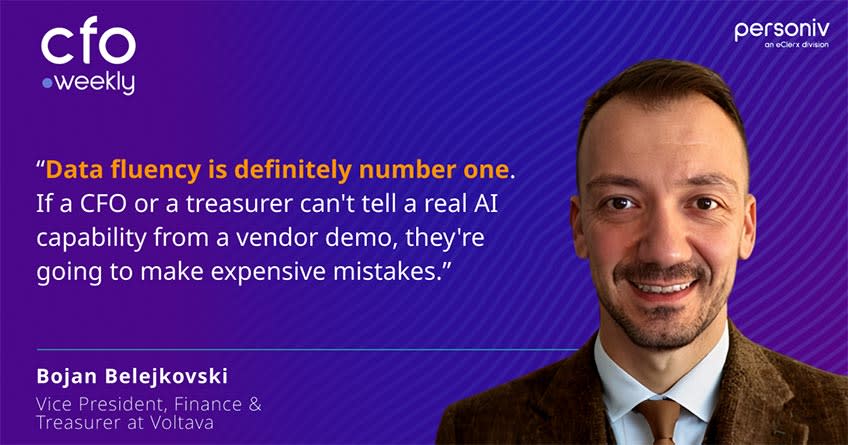
“Data fluency is definitely number one. If a CFO or a treasurer can't tell a real AI capability from a vendor demo, they're going to make expensive mistakes.” Belejkovski highlighted. - 00:23:23 – 00:25:24
Want more insights? Explore our full library of podcast blogs here.
To listen to the full conversations, check us out on Apple Podcasts, Spotify, and our RSS or your favorite podcast player!
Instructions on how to follow, rate, and review CFO-Weekly are here.
Understanding why AI failures in finance are silent requires time to establish strong data discipline and human oversight. We provide scalable, dedicated finance professionals to manage your day-to-day operations so you can focus on building a resilient, AI-native strategy. Drop us a line today to learn more.


