


In this episode of CFO Weekly, Jessica Trimmer, Senior Director of Revenue and Transformation at Intapp, joins Megan Weis to explore why the biggest constraint to scaling finance is rarely headcount and almost always the operating model itself. Jessica is a finance transformation leader with more than 20 years of experience helping organizations build scalable finance operations across revenue, lead to cash, and record to report processes. Throughout her career, she has led enterprise-wide transformation initiatives, modernized finance systems, strengthened governance, and helped high-growth organizations scale while maintaining strong controls and compliance.
Jessica shares the early warning signs that a finance organization has outgrown its current design, the right sequence for tackling people, process, technology, and governance, and why she would refuse to build an organization where people are the integration layer between systems. She also explores how finance can build compliance into the business rather than bolt it on, and what the best CFOs and Chief Accounting Officers will spend their time on as automation takes over the transactional work.
Show/Hide Transcript
Megan - 00:56
Welcome back to CFO Weekly. Today, I'm joined by Jessica Trimmer, senior director of revenue and transformation at Intapp. Jessica is a finance transformation leader with more than twenty years of experience helping organizations build scalable finance operations across revenue, lead to cash, and record to report processes. Throughout her career, she has led enterprise-wide transformation initiatives, modernized finance systems, strengthened governance, and helped high-growth organizations scale while maintaining strong controls and compliance. In this episode, we'll explore what it really takes to build a finance organization that scales, how leaders should think about people, processes, systems, and governance as companies grow, and why finance operating models must evolve alongside the business. In this episode, we'll explore what it really takes to build a finance organization that scales, how leaders should think about people, processes, systems, and governance as companies grow, and why finance operating models must evolve alongside the business. Welcome to the show, Jessica, and thank you so much for being here today.
Jessica - 02:02
Thanks for having me. I'm really happy to be here.
Megan - 02:05
So early in your career, was there a moment when you realized that the biggest constraint to scaling a finance organization wasn't actually the number of people, but the way the organization was designed to operate? Let's start
Jessica - 02:19
there. I don't know if there was a single moment. It's just something that I've learned as I've started taking on bigger and more complex organizations. I had the opportunity to really scale revenue accounting from a more traditional accounting function into a global organization and how to support a much larger, more complex business. And you start seeing pretty quickly that you cannot just keep adding people every time the business gets more complicated. So at some point you have to step back and ask, why does this take so much effort? Why are we doing this manually? Why are the handoffs? Why is the data breaking? Where are the people spending their time fixing things instead of actually adding the value. So that really changed how I think about leadership. I don't think my job is just to have capacity. My job is to create the capacity, and that's really driven a lot of the transformation work I've done since.
Megan - 03:17
So before we go any further, let's just take a step back and walk me through your career and your experience to date and how you got to where you are right now.
Jessica - 03:27
Sure thing. So outside of college, I stepped into this controller role, first journal entry, and built a business up to a couple million dollars, but it got me the ability to look at everything horizontally from accounting, HR, legal, treasury, even entering products into the business. There was really less than 10 people, so I got my hands in everything and understood the systems within a business. And from there, I started going into some software companies, into Vault, into Hillrom, and getting into the revenue accounting space. The complex puzzle, I feel like, of being able to understand and recognize the revenue, but there's more to it. There's more to being able to piece together the products, releasing the products, growing the products, growing the relationships with the clients too. And so from there, gosh. I think I'm about twenty years in now, and learning that finance is more of a transformational effort sometimes because you put out the financials, but in the end, you're trying to help show the business where to grow and providing that guidance back.
Megan - 04:42
Yeah. I started my career about thirty years ago. It's hard to believe, but it seemed back then like finance and accounting and almost everything was very siloed back then, where today it seems very important to understand operations and marketing and sales, and you cannot just be an accountant anymore.
Jessica - 05:02
No. You really cannot. You really have to understand, I think, the different pieces of the business, where everybody's going, speak their language, and make sure that you kind of lockstep, lock arms, and get to the finish line together.
Megan - 05:16
And when a company is growing quickly, finance often looks fine on the surface right up until it isn't. So what are the early warning signs that you look for that tell you that a finance organization has outgrown its current operating model and what do you typically do first?
Jessica - 05:34
I'm glad that you're asking this. So there's a few things that get my attention quickly, really. The first one is your best people really become like that workaround. There's that one person that you know that knows how to fix every weird issue. They get pulled into all the processes and every spreadsheet. No one else understands it. That's a risk. Another one is the manual work will start growing faster than the business. You might have, like, your revenue growing 20 or 30%, but your reconciliations, your spreadsheets, your manual journal entries might be growing twice that rate. Something might be wrong at that point. Or there's the data. If you're spending more time talking about the data, whose number is right but not what the number actually means, maybe the operating model isn't keeping up at that point. And then there's the exceptions. When the exceptions become the rule, when it's the actual process, I think that's when the operating model has probably outgrown itself as well. So those, I think, are some good indicators. The team might be drowning or about to drown, and you've really got to step up and address that.
Megan - 06:45
And when you inherit or build a finance organization that needs to scale, how do you decide what to tackle first, whether it be people, processes, technology, or governance?
Jessica - 06:58
I think the sequence of it really matters, I think, here. First thing, you definitely got to stabilize it, and then you can work through the optimizing and the scaling after, but you really have to understand what's happening and you have to stabilize the process, get the data right, clear up the ownership, the governance, and then you can work on standardizing and automating. But if you start automating a broken process, then you've just made the wrong process work faster, really. It might be tempting to just jump right in and start working on the people first or in the process and everything, but I think you have to understand what's happening first. Sometimes you want to plug in a different technology piece. You want to throw AI at it first, but I don't think that technology is always going to fix the problem right away too. So you have to understand why the work is hard before you're going to sit down and automate it.
Megan - 07:56
That's great advice, And, yeah, I feel like a lot of people start throwing money at a problem. And like you said, a lot of times you're just making a bad process faster. And when you're leading finance through significant growth or transformation, what tends to be harder, changing the systems and processes or changing the behavior and mindset of people using those systems and processes?
Jessica - 08:20
It's the people without question.
Megan - 08:23
Yeah. Nobody likes change.
Jessica - 08:25
Nope. And I mean, technology will do what you tell it to do, but people have the history. They have the habits, and the habits exist because they've solved a problem before, they can trust that it's worked out something in the past. If you tell somebody we're going to get rid of your spreadsheet, but you haven't given them a better way to solution that, then they're just going to go back to the spreadsheet. So I've spent a lot of time trying to understand what that current process is again before changing it. And then you have to make sure that the future state is actually going to be better for the people using it. Bring them in. Ask them. You cannot just communicate the change. You really have to design something that people are going to want to adopt. And you've led significant finance transformation initiatives. What is a transformation decision that you've seen companies get wrong,
Megan - 09:20
and what did that mistake ultimately teach you?
Jessica - 09:24
I think one of the biggest mistakes I've seen is treating transformation like a technology implementation. You can implement a new system and it can be successful technically, while the organization might be worse off. The technology is just one piece. You have to think about the process, the data, the controls, integrations, the people. I've seen that firsthand with major system changes. You go through the implementation and then the real work will start, and then there's downstream impacts. So there's always going to be iterations. So it taught me that you really cannot separate the transformation from those operations. You have to transform continuously while you're still running the business. And that means if you're intentional and then you're going to sequence the stabilization instead of assuming that go live means that you're done, you cannot just walk away from it.
Megan - 10:18
And does transformation ever actually stop? I mean, is it like a project that you come to an endpoint? And if not, does that get exhausting for your team or for you?
Jessica - 10:31
It's a puzzle for me that we continue to solve. I don't think that there's an end to it. I think that you continue to strive to be better. So there may be milestones that you're reaching and you'll continue to reevaluate and adjust where those milestones may be, but business doesn't stop. I don't believe the transformation would or should either.
Megan - 10:55
Yeah. Seems like it only needs to like, evolution is just becoming so much faster these days. You cannot sit still or you're left behind.
Jessica - 11:04
It does seem that way, especially with the speed that technology is coming along now.
Megan - 11:10
Yeah. It's crazy. It's exciting and scary, but certainly crazy. And there's often tension between finance being the guardian of the business and being an enabler of growth. So how do you build the controls and discipline that the organization needs without turning finance into the department that everyone feels they just need to work around?
Jessica - 11:31
I don't think that the controls with growth are really the conflict. I think the problem is just poorly designed controls, really. So if every transaction is going to require finance to go in and review something at the end, then that's obviously going to slow business down. So what I've tried to do is just move towards controls being built into the process where possible. And then preventative and automated is usually the best standard. For example, maybe continuous audit work so that you're able to test something periodically, move on from it. You can monitor what's happening a little bit more continuously as well. It's probably a bigger mindset shift that I've really seen. We're not looking to create friction, really. We want to create more confidence. And if the business has that confidence in the process and the data, then you'll be able to move faster and just work through the exceptions.
Megan - 12:32
And you've operated at the intersection of finance, sales, and customer success through revenue operations. So what did sitting outside the traditional finance silo teach you about how finance can actually influence revenue?
Jessica - 12:47
So this one's probably one of the bigger shifts in how I think about finance. When you're sitting at the end of the revenue process, it's really easy to think about revenue as an accounting problem. But when you look at the entire lead to cash process, you see that a lot of what eventually comes into a finance problem or revenue problem actually started much earlier. How was the deal structured? What did we sell? What did the contracts say for their concessions? How was it provisioned? What happened with the client, right? And so I've become much more interested in the upstream processes, because that's where you can actually prevent a lot of the downstream, quote unquote, finance problems. And so I think that's how I think about the role of finance now. That's how it's kind of changed my career. We shouldn't just report what's happened, really. We need to better understand the process well enough to help influence and provide the guidance back to the business and help what happens next.
Megan - 13:52
And AI and automation are making it possible to fundamentally rethink how finance work gets done. So if you were building a finance organization from scratch, what would you refuse to build the old way, and where do you still insist that human judgment remains at the center?
Jessica - 14:10
I would refuse to build an organization where people are the integration between systems. I think we've all seen that. I don't want, say, my CRM doing one thing and then ERP doing another, maybe another billing system doing something else, and then finance still maintaining an Excel sheet that keeps everything together. So it needs to make sure that it scales with the business. I would definitely start with the data architecture and the process architecture. There has to be clear ownership, standardized processes, clean data, automation where it makes sense, and then AI can come in on top of that. I'm a huge believer of data first. AI is not going to fix bad data or broken process. It's just going to give you a faster answer to a bad question. So I definitely want to keep humans involved with judgment, understanding the context, challenging the output, assessing risk, and then making decisions from there.
Megan - 15:10
And as finance organizations automate more of the transactional and analytical work, do you think the definition of a great finance person is changing? And if so, what capabilities are becoming more valuable?
Jessica - 15:25
The skill set is definitely changing. I will always believe that you still need strong financial fundamentals. That's not going away. You need to be able to understand what is going in, what is coming out, but increasingly valuable is going to be those that can operate across finance, technology, and data. So I'm much more interested in someone who can look at a process, understand the accounting and the data, but figure out how technology can improve it, and then actually influence the people to change it back to people being the number one idea there. So AI can accelerate that, absolutely, but I don't think the differentiator is going to be whether you know how to use AI. I think eventually everybody will. When PCs and Excel first came in and they moved from paper to computers. I think the differentiator is going to be whether you know what to ask it, if you can validate what it's telling you, and then what you do with it. And judgment just is going to become more valuable after that.
Megan - 16:31
And I'm just curious, so young people today, obviously, they're native when it comes to a lot of these technologies, but do you find that they have the other, the softer skills that are so important these days?
Jessica - 16:47
I have found over the years that we do make sure to communicate with them more, to make sure that, you know, you bring them in person if it's a remote environment to different interns as well, making sure that you give them time and you talk them through that. But even if I think back to when I was young in my career, I always appreciated having those mentors that took the time to explain and give you, hey, does that email look good? Second set of eyes. So I don't know if it's different now than it was before, so it's still going to be there.
Megan - 17:23
I feel like young people today often get a bad name, but not sure it is any different than when any of us started our careers. And you've worked in highly regulated environments where GAAP, SEC reporting, and SOX aren't negotiable. So how do you create a culture where compliance isn't viewed as a constraint, but as part of how the organization operates at scale?
Jessica - 17:45
I've definitely spent a lot of my career there. It's not optional. I don't think that I should be, and I have a lot of respect for those disciplines because of it, but I don't want compliance to be something that happens to the business. I want it to be built into how the business operates. I've been such a believer. I think I mentioned earlier about, like, the continuous audit as an example. If you can identify something closer to when it happens instead of discovering it later, then you can be in a much better position as a business financially and just operationally too. So I think explaining the why matters instead of just if someone hears this is a SOX control, it feels like bureaucracy. So if they understand, this is the risk, we're trying to prevent it and why it matters to the company, maybe not just to your team because you're owning a control, but it's there for a reason. The conversation makes things so different. So controls should really be part of the operating model. It shouldn't be an extra layer. And if you need that conversation and the communication to happen, then I think that it should happen.
Megan - 18:57
And what's one piece of advice that you wish someone had given you before you became a senior finance leader and something that you understand now that you couldn't have fully appreciated early in your career?
Jessica - 19:08
I've read it in a few books. It didn't really make sense. It's making more sense. So not needing to be the smartest person in the room to be the most valuable person in the room. So earlier in my career, I would dig in and I'd want to solve everything myself. I would want to know how everything worked. If I didn't understand it, I would work the late hours, work the weekends to dig in, replicate a worksheet just to make sure that I understood something through and through. And that's great for a while, but as your scope gets bigger, you cannot always be the person that solves every problem. Instead, your impact starts coming from and through your team and the processes that you build and those people that you help develop, again, in your team or even outside of your team. And so I think that's probably one of the biggest transitions I've made as a leader and wish that I would have had someone tell me maybe again and again was moving maybe from like how I solve this to how do you build an organization that can solve it without me. Still working on it, but getting better, I think. Yeah. Well, it seems like value comes from experience. So any advice to young people who maybe don't have that experience? How can they make themselves more valuable? Always ask questions. Ask questions to people around you, maybe not even within your team, to your leaders, to someone that sits next to you and their leaders. The more that you understand how you're impacting, how your work impacts the organization or someone else's team, the more valuable you will be because you will be making different and better decisions because of it.
Megan - 20:56
Yeah, that's great advice. I feel like a lot of times people are afraid to ask questions because it seems like they don't know the answers, but, yeah, nobody has all the answers. Looking ahead three to five years, what do you think will fundamentally change about the CFO or maybe the CAO roles? And as technology takes more of the traditional finance work off their plates, what do you think the very best finance leaders will spend their time doing?
Jessica - 21:25
I think traditional work of finance is going to be more and more automated. The reporting, reconciliations, the monitoring that we spend a lot of effort today, it's going to be handled much differently. I don't think that makes finance less important. I think it changes where we're going to be bringing the value from. So the best CFOs and CAOs, I think, are going to spend more time about the architecture of the business, how the company is going to scale, how the data is moving through the organization, where the risk is sitting, how technology is changing the operating model, and then how you build an organization that can keep up with the growth too. So I think they're going to have to be much more connected with the business outside of finance. So the evolution is going to probably be more about changing from reporting what has happened, which is more of the traditional sense, to helping the business understand maybe what should happen next and helping that along the way, too. It's exciting, I think, being able to provide that guidance back to the business.
Megan - 22:30
Absolutely. I often hear the word storyteller associated with the CFO role. I think the CFO role is heading in an exciting direction.
Jessica - 22:41
It definitely is.
Megan - 22:42
Jessica, this has been such an insightful conversation, and thank you so much for taking the time to be here today to share your experience and knowledge.
Jessica - 22:50
Thank you so much for having me. This has been great.
Megan - 22:53
And to all of our listeners, please tune in next week. And until then, take care.
What You'll Learn:
-
Why the biggest constraint to scaling finance is the operating model, not headcount
-
The early warning signs that a finance organization has outgrown its current design
-
The right sequence for tackling people, process, technology, and governance
-
Why automating a broken process just makes the wrong process faster
-
How to build compliance into the business instead of bolting it on
-
What the best CFOs and Chief Accounting Officers will spend their time on next
Key Takeaways:
Creating Capacity, Not Just Having It
Early in her career, Jessica learned that scaling revenue accounting from a traditional accounting function into a global organization meant she could not simply keep adding people every time the business got more complicated. At some point, she had to step back and ask why the work took so much effort, why handoffs were breaking, and where people were spending their time fixing things instead of adding value. That shift changed how she thinks about leadership: her job is not to have capacity, it is to create it.
"I don't think my job is just to have capacity. My job is to create the capacity, and that's really driven a lot of the transformation work I've done since." Trimmer pointed out. - 00:02:19 – 00:03:17
Why the Biggest Constraint to Scaling Finance Is the Operating Model
Jessica watches for a few specific signals that a finance organization has outgrown its operating model. The first is when the best people become a workaround, the one person everyone relies on to fix every strange issue. The second is when manual work grows faster than the business itself, with reconciliations and manual journal entries expanding at twice the rate of revenue. The third is when teams spend more time arguing about whose number is right than about what the number means. The fourth, and clearest, sign is when exceptions become the rule.
"When the exceptions become the rule, when it's the actual process, I think that's when the operating model has probably outgrown itself as well." Trimmer revealed. - 00:05:34 – 00:06:45
Stabilize Before You Automate
When Jessica inherits or builds a finance organization that needs to scale, she resists the temptation to jump straight into new technology or restructure people first. The sequence matters: stabilize the process, get the data right, and clear up ownership and governance before standardizing and automating. Throwing a new technology or an AI tool at a broken process, she warns, only makes that process fail faster.
As Trimmer put it, "If you start automating a broken process, then you've just made the wrong process work faster, really." - 00:06:58 – 00:07:56
Refusing to Let People Be the Integration Layer
Asked what she would refuse to build if starting a finance organization from scratch, Jessica is direct: she would never let people be the manual glue holding disconnected systems together, patching a CRM, an ERP, and a billing system with an Excel sheet. Instead, she would start with data architecture and process architecture, with clear ownership, standardized processes, and clean data, and only then layer AI on top. Human judgment, she insists, stays firmly at the center.
"AI is not going to fix bad data or broken processes. It's just going to give you a faster answer to a bad question." Trimmer remarked. - 00:13:52 – 00:15:10
Building Compliance Into How the Business Operates
Having spent much of her career in highly regulated environments where GAAP, SEC reporting, and SOX are not optional, Jessica believes compliance should never feel like something that happens to the business. She points to continuous auditing as an example: identifying issues closer to when they happen, rather than discovering them later, puts the business in a stronger financial and operational position. Explaining the why behind a control, she says, turns it from bureaucracy into something the organization actually understands and owns.
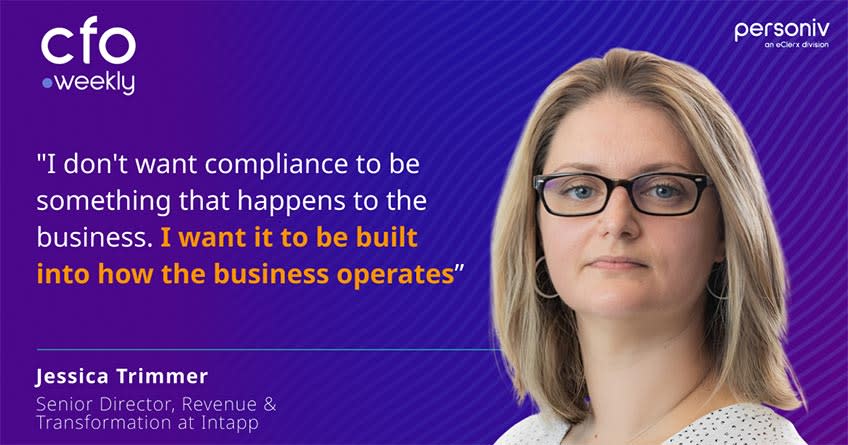
"I don't want compliance to be something that happens to the business. I want it to be built into how the business operates." Trimmer emphasized. - 00:17:23 – 00:18:57
Want more insights? Explore our full library of podcast blogs here.
To listen to the full conversations, check us out on Apple Podcasts, Spotify, and our RSS or your favorite podcast player!
Instructions on how to follow, rate, and review CFO-Weekly are here.
Recognizing why the biggest constraint to scaling finance is the operating model allows you to redesign for growth. We provide scalable, dedicated finance professionals to manage daily operations so you can focus on building an efficient structure. Drop us a line today to learn more.


