

In this episode of CFO Weekly, Alex Curran, Chief Executive Officer at Aptitude Software, joins Megan Weis to explore the evolving landscape of finance ERP vs operational ERP and why AI adoption in finance is being held back not by the AI models themselves, but by the outdated architecture and fragmented data infrastructure underneath them. Alex brings a unique perspective shaped by over two decades working with organizations of all sizes and sectors to implement and modernize their finance and accounting systems.
With deep experience supporting some of the world's largest and most complex organizations including those reporting to public markets. Alex shares how Aptitude Software has identified a critical gap in the market for a modern, AI-native finance ERP. Currently serving as CEO at Aptitude Software, a global provider of finance technology solutions, Alex discusses why real-time data, auditability, and open AI architecture are becoming the defining competitive advantages for CFOs navigating the era of autonomous finance.
Show/Hide Transcript
Megan - 0:55 Welcome back to CFO Weekly. I'm joined by Alex Curran, chief executive officer at Aptitude Software, a global provider of finance technology solutions helping organizations move toward autonomous finance through AI, automation, and intelligent data management. Alex has built her career at Aptitude for over a decade, rising through leadership roles across sales, North America operations, and executive management before stepping into the CEO role. In this episode, we'll explore the future of finance through the lens of AI readiness and data, what finance leaders need to put in place now to benefit from emerging technologies, and why clean, connected data is becoming one of the most strategic assets in the office of the CFO. Welcome to the show, Alex, and thank you so much for being here this morning.
Alex - 1:45 Thank you, Megan. Thank you very much for having me and looking forward to the discussion today.
Megan - 1:51 Yes. AI is such an exciting thing, and I'm very excited about this conversation.
Alex - 1:56 Totally agree, especially with the SaaS apocalypse that we've seen recently. I think it's super topical.
Megan - 2:03 So your view is that AI in finance isn't being held back by the models. It's being held back by the architecture underneath. Describe to us what you mean by that.
Alex - 2:14 I think, as CEO of Aptitude, it's really important to be out on the front lines, spending time with customers and partners to properly understand the pressures that they're facing. Based on all of those discussions, what has become super clear is that finance has been in this perpetual modernization cycle, but not at the core — more around the edges. Looking at new reporting tools, consolidation systems, cloud migrations of GLs. But underneath, the core finance architecture — traditional ERPs — has largely stayed the same, and there hasn't been a huge amount of new entrants or competition in that area. The moment it really became clear to me that it wasn't just a model challenge but an architecture challenge was when AI started entering the conversation. Finance teams wanted real-time insight, automation, and intelligence on top of that. But the underlying systems that CFOs and their wider teams rely on are traditional ERPs built around batch processing. They create a proliferation of fragmented data, and organizations are still heavily reliant on month-end cycles. The AI models themselves are incredibly powerful, but what's holding organizations back is the architecture underneath them. If your finance data is delayed, aggregated, or fragmented across systems, AI can only go so far. I don't think it's a finance problem. I don't even think it's an AI problem. I think it's fundamentally an issue with the architecture that underpins every single finance team across the world, no matter the sector or geography.
Megan - 4:24 It's always surprising to me that with all the technology available, there's still a huge reliance on Excel, and a lot of processes are still very manual.
Alex - 4:35 Absolutely. Spending time talking to organizations about their finance infrastructure, all of them are still reliant on manual intervention — from source systems all the way to the GL, that bit in the middle is still heavily manual. Teams of individuals manually reconciling charts of accounts, pushing results through access databases, sub-ledgers, and then posting to the GL — and then posting results to the presentation layer that sits off the back of the GL. The challenge is that process doesn't take thirty seconds. It typically takes weeks and tens, if not hundreds, of people to support. So by the time the CFO and CEO have those results, they're looking at backward-looking, out-of-date information. All types of organizations are still heavily reliant on manual processes built up around traditional systems.
Megan - 5:51 Can you walk us through your journey at Aptitude Software and how that progression has shaped your perspective on where finance is headed next?
Alex - 5:59 I've spent the last twenty years at Aptitude working with many different types of organizations — all different shapes, sizes, and sectors. As part of that, I've also worked closely with the Big Four. A lot of that time has been spent helping some of the world's largest, most complex organizations implement their finance and accounting systems, ultimately underpinning the numbers they report to the Street — a large proportion of them being major public organizations. That experience has given us a very broad view of how finance technology has evolved over the last two decades. What's really interesting is how consistent the challenges are across different industries and geographies — same, but slightly different. Organizations have been investing billions into finance transformation, but even after making that investment, many are still struggling with fragmented processes, not having the right information at the right time, and still being hugely reliant on manual effort. Over time, that's created paralysis, inertia, and fatigue around traditional ERP transformation — associated with being extremely expensive and taking a long time to implement. In parallel, the expectations on the CFO office have grown enormously, but the underlying architecture hasn't moved at the same pace. That's what has really shaped my perspective. Finance is moving toward a far more real-time, intelligent model — and "intelligent" is an important word — that requires a very different type of finance architecture than the industry has historically relied on.
Megan - 8:48 Tell us a little about Aptitude Software, what it does, and how it's differentiated.
Alex - 8:53 Aptitude Software has been around for a long time, but over the last five to ten years we've focused on finance, accounting, and regulatory solutions. That's enabled us to gain access to a high-value client base and the CFO office, where we've been tracking trends. Through that, we've identified that the CFO is essentially under pressure to be the strategic co-pilot for their business — but the systems they've relied on aren't able to support those pressures simultaneously: driving revenue faster, managing risk, supporting compliance, and being AI-enabled. We saw a gap in the market for a modern, AI-native finance ERP — one with the heritage and intellectual property we've built over many years, but with a modern AI-native tech stack. It also enables organizations to go live in weeks or months rather than multiyear rollouts and supports a real-time P&L. We're doing that not just for small, fast-growing organizations, but for large global multi-entity, multi-currency blue-chip organizations — in one instance, processing 400 million journal lines over a two-hour period and providing a live P&L. That's what we do, and we feel well positioned to support CFOs under pressure in the current market.
Megan - 10:48 Most finance leaders and vendors think they're closer to being AI ready than they actually are. Where's the gap between what they believe and what's true?
Alex - 10:59 The conversation has changed dramatically over the last few years. Historically, finance transformation was mostly about automation — making existing processes faster, cheaper, or more efficient. Today, the conversation is more about intelligence. CFOs want real-time insight, predictive decision-making, and AI embedded directly into their finance operations. But that's where the gap starts to appear. Many organizations think they're AI ready because they've implemented a dashboard, a co-pilot, or a general ledger with an AI agent concept. But AI readiness isn't about the tools — it's about the condition of the underlying data and architecture. The question is simple: is your finance data real-time, structured, and fully traceable and auditable? Or is it still fragmented, batch-based, and reconstructed at month-end? For most organizations, it's still the latter. The problem becomes obvious the moment you try to operationalize AI in finance. In finance, AI doesn't just need to produce an answer — that answer needs to be provable and auditable. You need trust, lineage, governance, and the ability to explain every output. That's why there's still such a big gap between AI ambition and measurable enterprise impact. The models are moving incredibly fast, but the real constraint is the finance architecture and data foundation underneath them.
Megan - 13:02 Many companies are obviously excited about AI, but as we've discussed, their data foundations are still fragmented. How big is that gap, and how can companies begin to close it?
Alex - 13:22 The gap is significant. Positively, there is a growing willingness across many organizations now, and boards and audit committees are placing real pressure to become AI ready. My guidance is to step back and examine the architecture supporting your AI strategy. You need a system of record that holds your financial information — even vast quantities at very granular level — in a cost-effective way, at books-and-records quality. You also need AI-native technology that underpins that system of record to connect with leading AI technologies of the organization's choice — not wedded to one particular AI stack. We've seen how quickly the AI landscape changes and how fast organizations need to move. You want a technology that's open, integrates with many different models and agent types, and allows organizations to bring their own agents to the software solution. That will change how people evaluate software. Many products are batch-based and essentially layering AI on top — which means when that organization goes live, they're locked into that particular AI stack. That's not something forward-thinking organizations are comfortable with in this modern finance era.
Megan - 15:32 If you're a CFO sitting on Oracle or SAP today and you want to be AI ready in eighteen months without a multiyear transformation, what should you do? Where do you start?
Alex - 15:45 The first thing CFOs need to understand is that becoming AI ready doesn't necessarily mean replacing the operational component of an ERP. Traditional vendors like Oracle and SAP still play an important role in large enterprises, particularly around operational workflows like procurement, HR, and supply chain. But what's becoming increasingly clear is that they were not designed to be AI-native finance platforms. That's why we're seeing the emergence of a new category: Finance ERP — platforms designed specifically for real-time finance, continuous accounting, and being AI-first. The market is starting to split: operational ERP continues to exist, but finance is increasingly being modernized separately through next-generation platforms built for the AI era. That also changes the implementation model. If someone tells you it takes eighteen months or two years just to modernize finance, that raises a bigger question about whether the architecture they're promoting is truly modern. A defining characteristic of the new generation of Finance ERP platforms should be speed — fast deployment, fast configuration, and faster time to value. The organizations moving fastest today are proving value in weeks or months, then expanding incrementally rather than committing upfront to another massive transformation program. We're already seeing this. HSBC significantly reduced their M&A finance integration timelines by modernizing the finance layer alongside existing systems — implemented in a handful of months. We also went live with Pay by Phone, where we implemented a full accounting engine and subledger processing 150 million journal lines across the day to support their AI strategy and provide a real-time P&L — and we did that in six weeks. That is where the market is heading.
Megan - 18:19 Do you feel smaller, mid-sized companies have an advantage right now with AI because they're more nimble and have less legacy investment?
Alex - 18:33 A good question. I'd position it as: it doesn't matter on the size of the organization. What matters is the ambition and openness to truly adopt an AI-native finance platform — but with a vendor that has a proven heritage of having done this before. Organizations that take that leap, whether big or small, can very quickly get ahead of the competition. Only a small percentage of organizations have enabled a real-time infrastructure and architecture. Those that get ahead of that and can effectively utilize AI on top of that AI-native infrastructure can get ahead of the market very quickly.
Megan - 19:35 Where are you seeing the most immediate and valuable use cases for AI inside the finance function? Is it AP, FP&A, reporting?
Alex - 19:45 The first area we're seeing are AI use cases that move finance from reactive to proactive. One of the biggest is continuous close and reconciliation. Instead of finance teams spending days at month-end identifying mismatches and exceptions, we're seeing customers use AI to monitor transactions continuously, detect anomalies in real time, and automatically resolve routine reconciliations before finance teams ever see them — enabling concepts like a zero-day close. The second biggest area is FP&A — real-time profitability and operational decision-making. In banking, AI should be able to analyze profitability, liquidity, and risk at a customer or transaction level as events happen, helping organizations make much faster decisions around pricing and risk. In telecoms and insurance — key sectors for Aptitude — we're seeing similar things around billing, usage patterns, churn prediction, margin optimization — all happening while the accounting period is still open, rather than after the fact. The third area, which organizations are still exploring, is AI agents embedded directly into finance operations — for variance analysis, journal recommendations, and policy checks. The key point is that the value comes when AI is embedded directly into the architecture of finance, not simply layered on top of legacy systems.
Megan - 22:04 As finance becomes more autonomous, how do leaders balance efficiency gains with governance, control, and trust in the numbers?
Alex - 22:16 That is a very good question, and something organizations are spending a lot more time on. More governance is going to come into play. AI is very effective at moving the business forward, but you still need trust, lineage, governance, and explainability behind every output. Making sure you're using AI safely within a robust system of record — with sector-specific frameworks that enable AI agents to work within — is incredibly important. In finance specifically, AI has to produce an answer that is fully auditable for the finance team to trust it. You have to balance that ambition with utilizing AI in a safe way.
Megan - 23:51 How do you see the skill set of finance teams evolving as AI and intelligent data platforms become more embedded in day-to-day work?
Alex - 24:01 Over the next five to ten years, the role of the CFO evolves quite significantly. Historically, the role has centered around stewardship, control, and explaining performance — but after the fact. As finance becomes more real-time and AI more embedded in operations, the CFO and the wider team become much more involved in actively shaping the direction of the business. The biggest shift is mindset. The role becomes less retrospective and more forward-looking — less focused on what happened last quarter and much more focused on what we should do next. That changes the skills required. CFOs don't necessarily need to be technologists, but they do need a much stronger understanding of how data, AI, and a modern finance architecture drive business decisions. Those that use AI-native architecture and fully embrace AI in a safe way — that's where the competitive advantage will come from. CFOs will also need to become much more comfortable operating in shorter decision cycles. As insight becomes continuous, a much bigger responsibility comes with it around governance and trust. As AI becomes more embedded in finance operations, the CFO has to become the executive owner of explainability, governance, and confidence in AI-driven decisions. The question again won't simply be what does AI recommend — it's going to be can we trust it, can we explain it, and are we confident when acting on it. The CFO becomes much more strategic and also operational than it's ever been before.
Megan - 26:37 Such an exciting time to be in finance as it evolves into so much more of a strategic function and role within the organization.
Alex - 26:46 Absolutely. Being in a finance role right now enables you to be at the forefront of your business — responsible for ensuring the data can service the wider functions and being the strategic steward. I'm very much looking forward to seeing how the market evolves.
Megan - 27:11 Alex, thank you so much for being on the show today and sharing your insights with us.
Alex - 27:15 Thank you very much, Megan. Great to meet you, and thank you for having me.
Megan - 27:19 And to all of our listeners, please tune in next week. Until then, take care.
What You'll Learn:
-
Why AI in finance is an architecture problem, not a model problem
-
How traditional ERPs were built for batch processing not real-time intelligence
-
What it truly means to be AI-ready in the office of the CFO
-
Why finance data must be real-time, structured, and fully auditable for AI to work
-
How a new category of finance ERP is emerging alongside operational ERP
-
The most immediate and valuable AI use cases in the finance function today
-
How CFOs must evolve from retrospective stewards to forward-looking strategic operators
Key Takeaways:
The Architecture Problem Underneath AI: Finance vs Operational ERP
Finance has been stuck in a perpetual modernization cycle that touches only the edges, new reporting tools, cloud GL migrations, and consolidation systems while the core architecture built on traditional ERPs has remained largely unchanged. When AI entered the conversation, the gap became impossible to ignore. Finance teams wanted real-time insight and intelligent automation, but the systems they relied on were designed for batch processing and month-end cycles. The AI models themselves are powerful; it is the fragmented, delayed data underneath them that is holding organizations back.
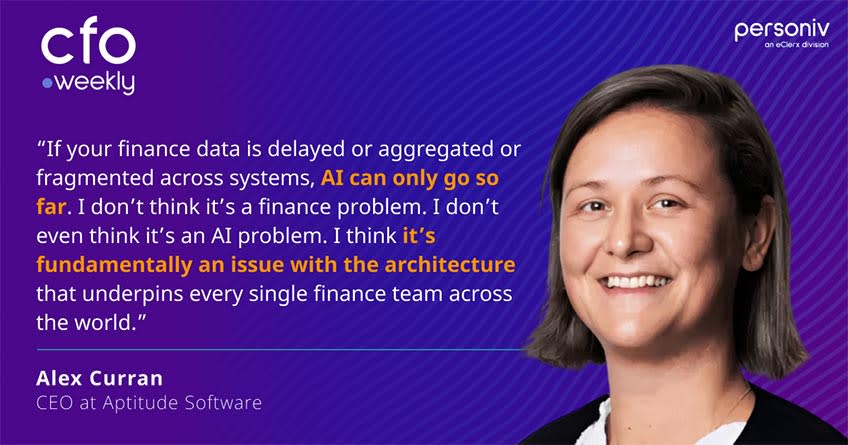
“If your finance data is delayed or aggregated or fragmented across systems, AI can only go so far. I don’t think it’s a finance problem. I don’t even think it’s an AI problem. I think it’s fundamentally an issue with the architecture that underpins every single finance team across the world.” Curran pointed out. - 00:02:03 – 00:04:24
The Real Meaning of AI Readiness
Many organizations believe they are AI-ready because they have implemented a dashboard, a copilot, or a general ledger with an AI agent concept. But true AI readiness is not about the tools — it is about the condition of the underlying data and architecture. The defining question is whether finance data is real-time, structured, and fully traceable and auditable, or still fragmented, batch-based, and reconstructed at month-end. In finance specifically, AI does not just need to produce an answer; it needs to produce an answer that is provable, auditable, and explainable. That is where most organizations still fall short.
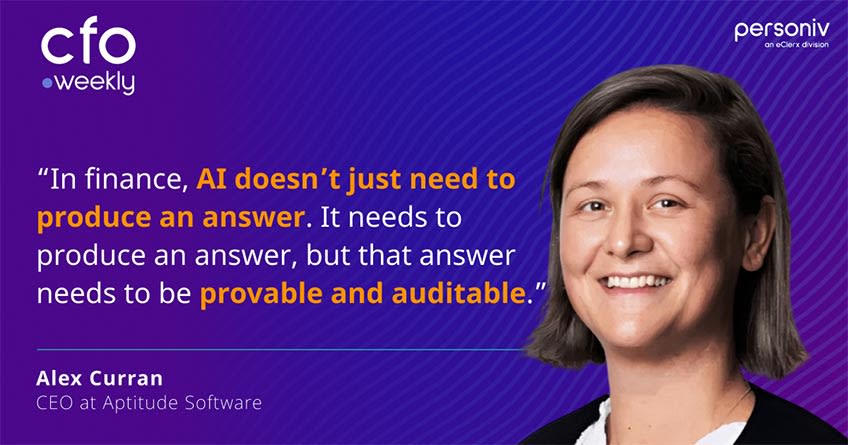
“In finance, AI doesn’t just need to produce an answer. It needs to produce an answer, but that answer needs to be provable and auditable.” Curran commented. - 00:10:59 – 00:13:02
The Emergence of Finance ERP vs Operational ERP
For CFOs sitting on Oracle or SAP who want to become AI-ready without enduring a multi-year transformation, the path forward is not replacing the operational ERP entirely. Traditional vendors still play a role in managing procurement, HR, and supply chain workflows. What is becoming clear, however, is that a new category is emerging: finance ERP. These are platforms designed specifically for real-time finance, continuous accounting, and AI-first operations. The market is splitting, and the defining characteristic of next-generation finance ERP platforms is speed, deployment in weeks or months, not years with organizations proving value incrementally rather than committing upfront to massive transformation programs.
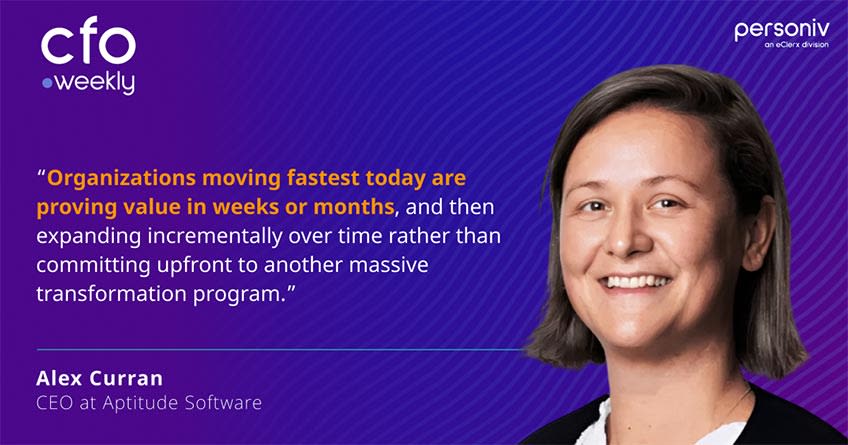
In Curran's words, “Organizations moving fastest today are proving value in weeks or months, and then expanding incrementally over time rather than committing upfront to another massive transformation program.” - 00:15:45 – 00:18:19
The Most Valuable AI Use Cases in Finance Today
The most immediate AI use cases in finance are those that move teams from reactive to proactive. The largest area is continuous close and reconciliation: rather than finance teams spending days at month-end identifying mismatches, AI can monitor transactions continuously, detect anomalies in real time, and automatically resolve routine reconciliations before finance teams ever see them — enabling a zero-day close. The second major area is real-time profitability and FP&A decision-making, where AI can analyze profitability, liquidity, and risk at a transaction level as events happen. The third, still emerging, area is AI agents embedded directly into finance operations for tasks like variance analysis, journal recommendations, and policy checks.
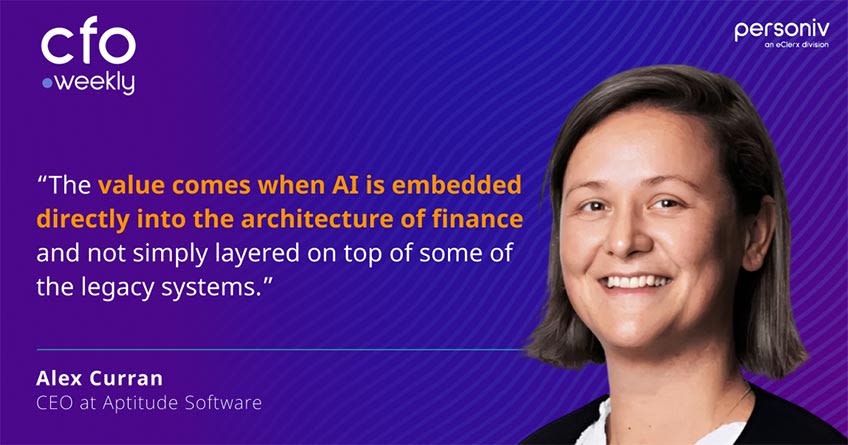
“The value comes when AI is embedded directly into the architecture of finance and not simply layered on top of some of the legacy systems.” According to Curran. - 00:19:36 – 00:22:04
Governance, Trust, and the Explainability Imperative
As finance becomes more autonomous, the CFO’s role in governance and trust becomes more critical, not less. AI is effective at generating answers, but in finance, every output must be fully auditable and explainable for the team to act on it with confidence. Organizations must use AI safely within a robust system of record that has sector-specific frameworks enabling AI agents to operate within defined boundaries. Looking further ahead, the CFO will shift from explaining the past to actively shaping the direction of the business in real time — requiring stronger fluency in data, AI, and modern finance architecture, greater comfort operating in shorter decision cycles, and ultimate ownership of explainability and governance for AI-driven decisions.
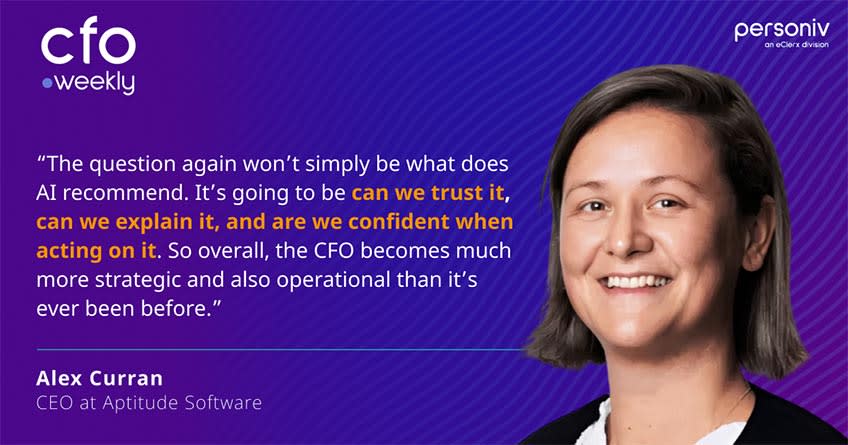
“The question again won’t simply be what does AI recommend. It’s going to be can we trust it, can we explain it, and are we confident when acting on it. So overall, the CFO becomes much more strategic and also operational than it’s ever been before.” Curran explained. - 00:22:16 – 00:26:37
Want more insights? Explore our full library of podcast blogs here.
To listen to the full conversations, check us out on Apple Podcasts, Spotify, and our RSS or your favorite podcast player!
Instructions on how to follow, rate, and review CFO-Weekly are here.
As the lines blur between finance ERP and operational ERP, your finance team needs the bandwidth to focus on strategy, not just on manual processes. We provide scalable, dedicated accounting professionals equipped to help you modernize your infrastructure and become truly AI-ready. Drop us a line today to see how we can support your transformation.


