


In this episode of CFO Weekly, Ignacio “Nacho” Redondo, Senior Vice President of Finance at Nextpower, formerly Nextracker, joins Megan Weis to explore exactly how CFOs prepare for an IPO—from building rigorous financial processes and internal controls to developing the operational discipline required to operate as a public company. Nacho brings more than twenty-five years of finance leadership experience spanning accounting, financial planning, investor relations, and compliance, and previously served as CFO of Nextracker during a critical phase of growth and public market readiness.
With an unconventional path that began in engineering and wound through private equity, utility companies, and global manufacturing, Nacho shares how a process-first mindset, implemented years before any IPO was on the horizon, ultimately positioned Nextracker for a successful public market debut. Currently serving as Senior Vice President of Finance at Nextpower, Nacho offers a grounded, practitioner’s perspective on the discipline, systems, and storytelling capabilities finance leaders need to scale companies from startup to public stage.
Show/Hide Transcript
Megan - 00:15
Welcome back to CFO Weekly, where we're talking with financial leaders about how to build efficiency in their teams, create time for strategy, and ultimately get results. This podcast is brought to you by Personiv, the trusted leader in finance and accounting outsourcing for over thirty years. See how Personiv's customized solutions can help you streamline your operations with teams that start as small as one. Visit the website at personiv.com to learn more. I'm your host, Megan Weis. Let's jump right in. Welcome back to CFO Weekly. I'm joined by Ignacio "Nacho" Redondo, Senior Vice President of Finance at Nextpower, formerly Nextracker, a global leader in solar energy technology and intelligent power generation systems. Nacho brings more than twenty-five years of finance leadership experience across accounting, financial planning, investor relations, and compliance, and previously served as CFO of NexTracker during a critical phase of growth and public market readiness. In this episode, we'll explore what it really takes to prepare an organization for an IPO, from building the right financial processes and internal controls to developing the operational discipline required to operate as a public company. We'll also discuss how finance leaders create transparency, governance, and investor confidence while scaling rapidly. Welcome to this episode, Nacho.
Ignacio - 01:43
Thanks for having me, Megan.
Megan - 01:45
To start, you've spent more than twenty-five years across different finance roles and industries. Can you walk us through your career journey and how it ultimately led you to the CFO role at NexTracker during such a pivotal state of that company's growth?
Ignacio - 02:02
Let me start with the fact that I didn't have a respect to the unorthodox career path to get there. I'm an engineer by education. I started working for Arthur Andersen in Spain. It was part of a big phase at that point. Why they did that and why they hire engineers is something I totally understood; they did hire a couple of engineers in that promotion, and I was one of them. I started working there, then I jumped onto a utility company doing more of an accounting role. At that point, I really thought I liked it, so I remained within the finance space. I did anything from FP&A, treasury, controls, and accounting—pretty much everything finance in different companies like industry companies, utility companies, and even private equity companies. I worked for a GP, a General Partner, for quite some time. The good thing about all this experience is it actually gives me a unique perspective and vision of not just all the finance areas, but also the way different stakeholders look at companies, either from an investor perspective or an industry company perspective. I can totally relate to how they're all looking at it. All in all, as I said, not really an orthodox way to get there. It's been a pretty amazing time and always within the finance area, even though it was very unlikely when I started as an engineer.
Megan - 03:25
Definitely unorthodox, but you would actually be amazed at how many CFOs I talk to that are from an engineering background. Definitely sounds like an interesting career you've had so far. Thinking back on that journey, was there an early moment in your career that shaped how you think about financial discipline, processes, and controls in scaling companies?
Ignacio - 03:46
I would say this is something that builds up over time. Processes have always been a bit of a common denominator of my career when setting up companies for scale. But if I have to think about a pivotal moment when it dawned on me that this was really something relevant, it was back in my early days in 2007. I started working for a private equity company as a General Partner. I was a very young CFO at that point; actually, my first CFO role. We started buying a lot of different companies and assets with the idea to do direct management. Meaning, there wouldn't be any executive team on the assets; we managed everything from the General Partner. That was really good from a cost perspective and it was pretty efficient, but we just didn't envision all the complexity that would take in terms of managing all of those companies. We were buying anywhere from two to three companies every month. At the end of the day, we ended up having a portfolio of over 30 companies. I sat down one day and thought to myself, "We can't manage this unless we really scale and make a systematic and methodical way to manage all those companies." That's where my journey started with processes specifically; it was more from an operations and practical perspective. I ended up designing all different processes and implementing SAP in that company and all different assets we had. That was probably my first contact with what I thought was the only way to operationally manage all the assets we were buying. From that day on, it's been a bit of a common theme everywhere I've gone. There's always been a big component of setting up processes, implementing ERPs, and getting companies ready not just for IPOs or exits, but also to make them operationally effective.
Megan - 05:41
And during your time as CFO at NexTracker, what were some of the earliest signals that the company needed to start preparing seriously for life as a public company?
Ignacio - 05:50
I wouldn't say NexTracker was a weird product experience in that sense. When I joined the company back in 2018, the company had been acquired a few years before by Flex, which was a very large public company. My mandate when I got there was to get NexTracker working in a way that they'd be able to behave as part of a public company. There was no intention at that point to take NexTracker as a standalone public company or to get out as a standalone public company at any given point in time. There was no intent to do anything different than just remain within the Flex scope and Flex umbrella. I joined and started working on processes. Our controls were deemed to be ineffective time after time whenever internal audit came. I said, "Hey, we gotta fix this. We gotta fix the way we're working. We gotta make this company more efficient in a way that we can scale and come with control," knowing that we're getting part of that big public company. I started working on all the processes and the implementation of the ERP, NetSuite. I did a lot of work on the team, growing it and setting up all the different functions. That was the first year and a half or two years. Funny enough, what happened is we looked back at some point and started seeing the market really stepping up in a big way for many reasons that had nothing to do with the company. Everything we did to set up the processes and set the company up for growth actually helped a lot to be able to tackle that growing demand out there in the market. We suddenly went from right about $300 million or $400 million revenue to right about 1.5 billion in eighteen to twenty-four months. Again, nothing we envisioned. The mandate wasn't "grow the company," it was "let's make this company behave as part of a big public company." We did that. A couple years later, around 2021, there was a complete shift on the Flex management team and the CEO joined. They decided to go back to basics, and NexTracker wasn't really part of the basic business of Flex; they're mostly a contract manufacturing company. They decided they wanted to look for ways to monetize the company. They hired JPMorgan to help on the process. Suddenly, when JPM looked under the hood, their conclusion was, "Why sell this on a private sale when the company is almost ready to go public?" All in all, without having a perspective at any given point of time to go public, we did the right things to get the company ready to be publicly traded. Not just that, but also to grow and get the scale we needed to go to the public markets. It all happened constantly, but it happened in a way that actually allowed us to be ready. They often say luck is going to catch you working, and that's exactly what happened to us. At that point, everything aligned. Suddenly, we found ourselves in a place where we're actually ready to go public and start the process. I would say I didn't really see any of that coming until it really happened and until I really got working on the S-1 and started pushing forward to that IPO.
Megan - 09:24
I'm just curious, what were some of the signs that you were ready at that point?
Ignacio - 09:29
First, the scale. The scale was a consequence of not just the market, but also the fact that we're ready to tackle that market and we could scale and deal with a much bigger number of projects at the same time. The second one, in terms of signs, is when you see a company acting in a mature way. What I mean by that is we're taking data-driven decisions for the first time since NexTracker's inception. We have the KPIs we needed to take those decisions available to us constantly. When you're working for startups, sometimes just gathering the right data is a lot. Suddenly, you see things like data available at any given point of time. You can push a button and there's going to be a lot of reports that get produced. You're going to see all the data you need to make sense of where the company is. There wasn't that much of an effort to get ready for board meetings. At the end of the day, it all comes down to realizing one day that you're behaving as a pretty mature company. There are many different signs related to how available the data is, how accurate it is, how easy the forecasting process is, how much of an accurate forecast you get, and how you're actually able to beat that forecast time after time. Those are all signs that point out you'd be ready to go there. It doesn't mean every company that gets to that point is going to go IPO, but those are signs that if you wanted to, you're ready as a company.
Megan - 11:09
Looking back, how far in advance should companies realistically begin preparing their financial processes and internal controls if they feel like an IPO might be on the horizon?
Ignacio - 11:20
That's a very good question. Most startup companies tend to overlook the financial action. At that stage, what's really important is to work on the product and the go-to-market strategy to get the company running. Some years later, after they have experienced significant growth, it's time for their investors to look for next steps, and companies suddenly find themselves in an almost impossible situation. Going backwards and fixing processes and historical financials to make them ready for a PCAOB audit, or even to just be able to report to the market, is not an easy task. A lot of companies end up failing to do it. In my mind, with my experience, in order to be successful, companies should actually start working on their processes, systems, and controls about three to four years before IPO. I know it's not easy and most companies are not going to have the luxury to do that, but three to four years gets you in a really good place. If you try to go IPO and haven't worked on any of it, and you try to go public in twelve to eighteen months, that usually becomes a challenge. I don't know if you've seen this video where you're trying to fly the plane as they're building it—that's how you feel. You go public, you're going to file your first Q, your first K, and you figure you're not ready. It also becomes a disruption to all the processes. When you're paying attention to that, you're not paying attention to real business. You're just trying to get things done quickly without everything you need to execute. Again, three to four years is what I would recommend. At least two years is really needed.
Megan - 13:13
From your experience, which finance processes tend to need the biggest transformation before a company is truly ready for the scrutiny of public markets?
Ignacio - 13:22
I would say pretty much all of them. But the two most important ones to me are the forecasting and budgeting process, and the reporting process. What I would call forecasting/budgeting on one side and record-to-report on the other. On the first one, budgeting and forecasting is really key to have visibility on the company's future performance and a solid process to have a good strategy for the first few quarters. What I mean by that strategy is you go out there and you can figure out: the first quarter, we're going to beat and raise revenue or EBITDA; the second quarter, we're just going to keep the guidance flat; third quarter, fourth quarter, getting ready for that messaging. Having a budget and forecasting process allows you to go there with confidence knowing exactly—or 95% of the way—how the company is going to be performing for the next rolling four quarters. That's going to enable an almost perfect messaging out to the market. That credibility you need, especially the first few quarters, is very relevant. The other one is the reporting process. I've lived the experience where you go out there, you think you're ready, and suddenly you have the first 10-Q or 10-K and it becomes a huge challenge just to produce it, have all the data available, and report earnings to the market. To me, that is the second biggest thing you need to do—have the process ready. What I've learned through my experience is it's good to have a mock process run two or three quarters prior to going IPO. Whether it's your Q or your K, you do it as if you were reporting out to the market and see what the challenges are and where you're getting stuck from a timing perspective. You run that process several times before you get there. Obviously, to be able to do that, you need all the underlying accounting processes—procure-to-pay, order-to-cash—to be really tightened and working smoothly. Otherwise, it's really hard to close your books on time and have the data you need to report out to the street. It all comes down to forecast, visibility, and accuracy to actuals.
Megan - 15:57
Internal controls and governance become much more visible after an IPO. How did you approach building the control environment needed to support that transition?
Ignacio - 16:08
I think it's two different sides of the same coin. You have controls on one side and you have governance on the other. When I think about governance, a CFO is part of that process, but the CEO needs to be really involved. That would be anything from setting up the right board, the right committees, and the right charters for those committees. All that is work, and having the right people take care of a board—the CEO needs to be actively building that with the CFO and other executives. That transpires all the way down with the company and how you set up all the controls. Controls are more of a CFO role. That means setting up all the operational processes first and designing the right controls. The approach when you're working on controls is trying to get ahead of the curve. The sooner the better, because the moment you start implementing controls, you're going to find some of that design is probably not effective. There's going to be gaps every single quarter when you test them, and you're going to need time to fix and retroactively go back, fix those controls, and align with the audit firm on whether there are new controls that need to be designed or old controls that need to be redesigned. It's a long process. It takes sometimes four, five, six, or seven quarters of testing to get there. The approach is to start early, even when you don't have an internal audit team. There are a lot of consulting companies that can help you design, implement, and test controls and act as an internal audit part of the company until you get that team ready. Starting early enough—two or three years earlier—goes a long way. When it comes to governance and setting up the right committees and the board, that tends to be quicker. You can start later and have a board ready the minute you push the button and price on the IPO. But when it comes to controls, look for as much help as you need. There's going to be some investment that needs to be done. The earlier you start, the better you're going to get there.
Megan - 18:29
Obviously, things like technology and financial systems play a huge role in IPO readiness. What capabilities do you believe that companies need in place to ensure that they have reporting accuracy, speed, and auditability?
Ignacio - 18:46
It all starts with designing the right operational processes and then choosing the right ERP. Most companies are going to end up with an architecture where they have an ERP and there’s a lot of different satellite systems around it. They're probably going to be managing procure-to-pay in a different system. There's going to be either APIs linked to the ERP or some communication between them, but they're going to have different satellite systems. In my experience, as long as you can keep within the ERP and not so many satellite systems, you're going to be better off. Implementing a real, strong ERP where it's not just a finance thing is key. The ERP is not a bookkeeping system; what it really is is a business system where all the company works together—operations, logistics, and supply chain are all leveraging the same system. Having that functionality goes a long way because everyone's working with the same data. They are all aligned and they have an auditable track trace of everything they're doing. Whether that system is NetSuite, SAP, Oracle, or any other solid ERP, as long as you implement it in a way that goes across the whole organization, you can be at a pretty good place. I've seen companies that say they've implemented this or that ERP, but the reality is they haven't really implemented an ERP; they're using it as a bookkeeping system and no one else outside of finance is working on it. Companies need to understand it's not just a finance thing, it's a company-wide thing. That's the only way you can talk about the same KPIs and data without arguments about whether it's the right data or not.
Megan - 20:55
Beyond the internal preparation, the finance team also has to help tell the company's story to outside investors. How does the role of finance evolve when you begin preparing for that level of external scrutiny and communication?
Ignacio - 21:12
When I think about the finance function, not just the CFO but everyone involved, I think regardless of the state of the company, finance professionals need to be able to not just tell the story, but support building the story. No matter what phase you're in, you're a big part of that. The reason being is I think finance has got a unique perspective of how to connect the dots. Well-understood finance professionals are going to be knowledgeable of all the operations, how the company works commercially, what the market trends are, and how they do things from an operational perspective. They're going to know the product and they're going to be the ones who really understand how investors are thinking. Investors, suppliers, customers—you need to really understand how they're thinking about your company and your product. As you grow that organization, you have to look for professionals that have the ability to do that, regardless of whether you're a startup or a public company. A big difference between a public company and a private company when it comes to managing investors is that when you're a private company, you have a number of investors—let's say six to ten of them. You know exactly their investment thesis and what they were looking for. You can always accommodate your messaging to fulfill their needs. It's almost like a custom-made messaging where you're trying to attract the capital you want, and once they invest, you keep the same messaging consistently. When it comes to public markets, now you're dealing with a resilient number of investors, both institutional and individuals. You've got to start thinking about the company and investors in a different way. You've got to adapt your messaging in a way that attracts the right investors in a big broad pool. It gets way more complicated because now you're trying to customize your investor base with your messaging. You want to have the right investors to make the company grow and support it as a business. It gets more complicated because you're dealing with much more complexity. But in my mind, it all starts from the beginning where, as a finance professional, you need to be able to build the story and make it work towards getting the best investors for the company.
Megan - 23:51
For finance leaders listening today who may be several years away from a potential IPO, what early steps would you recommend they start taking to build the processes, teams, and discipline that will make that transition a smoother process?
Ignacio - 24:09
When you were talking to my team, they would probably tell you I sound like a broken record. I'll go back there to the same place. It's all about designing the right processes and starting with that. When you're a finance professional, one of your first mandates is to be down with everyone, understand how the company operates, understand the product, and understand where the gaps are. Help operations, sales, and everyone in the company redesign their processes and make them work more effectively. Once you do that and you align those processes with them, you know exactly how the company operates. You know the gaps in depth and everything that's going on the operations side. That gives you a head start to be able to design processes and controls around it. That's the first step—having the mindset of, "I'm not a finance professional that sits in a silo with their numbers and comes up with the closing and the forecast." It's way more than that. Let's go and understand everything that's going behind the scenes and try to help everyone else in the company work more effectively. By doing that, you're able to influence how the company is operating and make it more effective. Second, which is really important, is you're getting a lot of trust with all the organization because everyone sees that you're actually in the trenches with them. You're trying to help them enable the business, operations, and sales, and you're trying to make everything in such a way that you can still keep certain monetary controls. To me, that's the most important part. The second thing is, once you have all those processes designed and you understand how the company needs to operate, implement a solid ERP, educate everyone else in the company to work with the ERP, and get everyone working around the same processes.
Megan - 26:09
Finally, as someone who's guided organizations through major growth phases and public market readiness, what is keeping you up at night as you think about the evolving expectations placed on modern finance leaders?
Ignacio - 26:22
My response is going to have little to do with market readiness. It has more to do with how much finance roles and CFO roles have evolved over the last ten years. This trend started way before AI was a thing. The CFO role fifteen or twenty years ago used to be that the person was an expert on finance. They'd be able to provide the numbers and help the CEO understand where the company was. They'd be able to help the CEO make investment decisions, but they were never really part of the strategy of a company and didn't have to deep dive on that. A few years ago—and I noticed this right about ten years ago—that all changed completely. The expectation for a CFO is that they drive strategy. To drive strategy, they need to understand the company and the market better than anyone else. They need to be able to foresee risks, identify opportunities, and find ways to enable the business. For all of these reasons, I think the CFO role and finance roles have become one of the most complicated ones in the company. If you add to this the growing complexity with AI and how to leverage AI to make companies more effective, we're witnessing the deepest transformation the finance functions has ever experienced. What keeps me up at night is being able to keep up with that and drive it, and being able to keep up with all those changes and expectations which are increasingly more complicated. I've been able to build a finance team and support finance professionals that can actually get to that point where they become a trusted adviser to the CEO and the rest of the executive team. I'm late in my career; I think I'm not going to have to deal with that all my life. But it's really important, and it's our responsibility as finance leaders of today to lead all those junior profiles that are starting to work in finance to get to that place and understand the finance role as a more holistic role—and understand how important it is for them to go a lot deeper than just knowing their numbers.
Megan - 28:37
And with that, we'll wrap up today's episode. Nacho, thank you for sharing your perspective and your experience on preparing organizations for the public stage.
Ignacio - 28:46
Thanks a lot. It was my pleasure.
Megan - 28:48
And thank you to our listeners for joining us on CFO Weekly. Until next week, take care.
What You’ll Learn:
-
Why building financial processes three to four years before an IPO is critical for success
-
How Nextracker accidentally became IPO-ready by focusing on operational excellence
-
The two most important finance processes to transform before going public
-
How to build a control environment that satisfies PCAOB audit requirements
-
Why an ERP is a company-wide business system, not just a bookkeeping tool
-
How the CFO role has evolved from numbers provider to strategic business partner
- The behind-the-scenes reality of how CFOs prepare for an IPO while still driving day-to-day operational excellence
Key Takeaways:
How CFOs Prepare for an IPO: Start Three to Four Years Before
Most startups deprioritize financial infrastructure in their early years, focusing instead on product and growth. But when investors look for an exit, companies that haven’t built solid processes find themselves in an almost impossible position - trying to fix historical financials and pass a PCAOB audit simultaneously. Nacho recommends beginning process, systems, and controls work three to four years before a planned IPO, with two years as an absolute minimum.
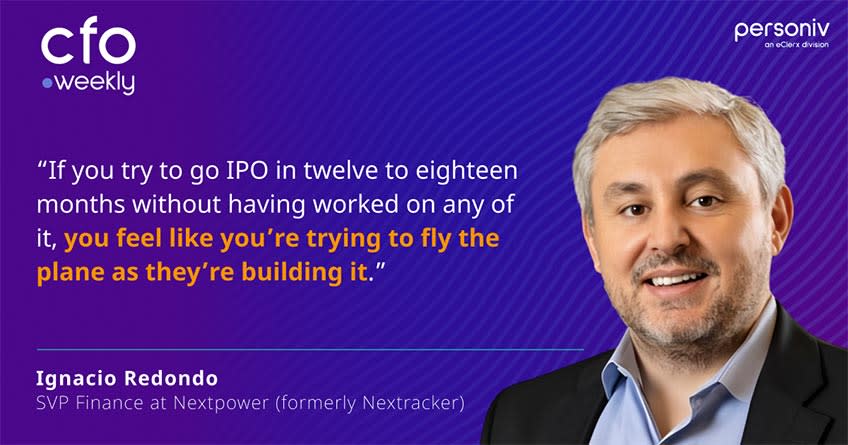
“If you try to go IPO in twelve to eighteen months without having worked on any of it, you feel like you’re trying to fly the plane as they’re building it.” Redondo said. - 00:11:09 – 00:13:13
The ERP as a Company-Wide Business System
Technology choices made early have lasting consequences. A well-implemented ERP - whether NetSuite, SAP, Oracle, or another platform - should not function as a bookkeeping tool used only by finance. When the entire organization, including operations, logistics, and supply chain, works from the same system, data alignment happens naturally, audit trails become automatic, and reporting becomes straightforward. Companies that treat their ERP as a finance-only tool create unnecessary complexity that becomes very costly to untangle before an IPO.
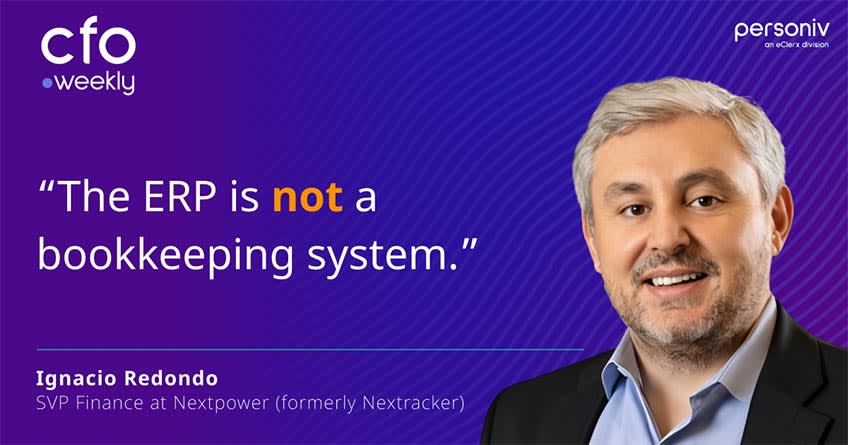
As Redondo noted, “The ERP is not a bookkeeping system.” - 00:18:29 – 00:20:55
Telling the Investor Story for CFOs Preparing for an IPO
The shift from private to public markets changes how investor communication works entirely. In a private company, finance leaders can tailor messaging to a small, known group of investors with specific investment theses. In the public market, the audience is enormous, varied, and constantly evolving. The finance function must help build and support a story that attracts the right mix of institutional and individual investors while maintaining credibility through consistent, data-backed messaging.

“Well-rounded finance professionals are going to be knowledgeable of all the operations, how the company works commercially, and how investors are thinking about your company.” Redondo commented. - 00:20:55 – 00:23:51
The Evolving Finance Role in the AI Era
The finance function has transformed profoundly over the past decade, and the pace of change is accelerating. Where CFOs once focused on providing accurate numbers to help CEOs understand company performance, today’s finance leaders are expected to drive strategy, foresee risks, identify opportunities, and enable the business across all functions. With AI adding another layer of complexity and possibility, Nacho sees finance as currently experiencing its deepest transformation ever and holds that today’s senior finance leaders have a responsibility to develop the next generation of finance professionals with a more holistic mindset.
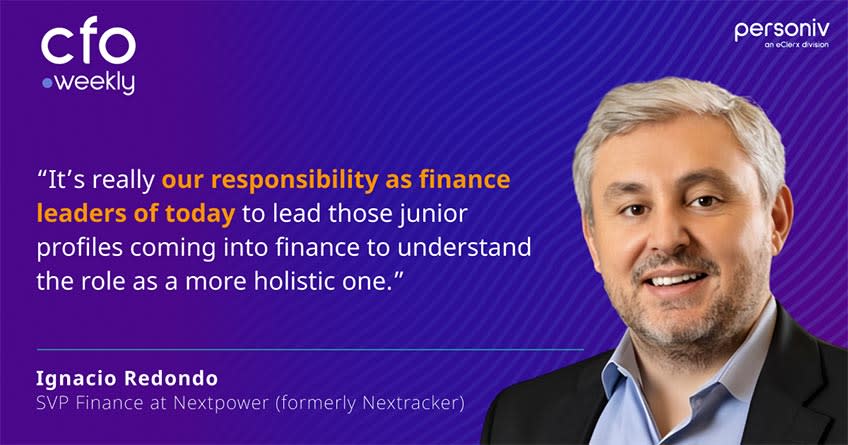
“It’s really our responsibility as finance leaders of today to lead those junior profiles coming into finance to understand the role as a more holistic one.” Redondo remarked. - 00:26:22 – 00:28:37
Want more insights? Explore our full library of podcast blogs here.
To listen to the full conversations, check us out on Apple Podcasts, Spotify, and our RSS or your favorite podcast player!
Instructions on how to follow, rate, and review CFO-Weekly are here.
Getting ready to go public? We deliver premier finance and accounting solutions tailored to support CFOs in preparing for an IPO, helping you build a scalable, audit-ready foundation for growth. Drop us a line today to learn more.


