


In this episode of CFO Weekly, Mike DePrisco, President and CEO of IMA (Institute of Management Accountants), joins Megan Weis to explore why AI cost and ROI are increasingly becoming CFO problems, how finance leaders can tie adoption to measurable business value, and exactly why AI governance belongs in a dedicated center of excellence. Mike brings more than thirty years of executive leadership experience across professional associations, certification, and higher education, including a decade of leadership roles at the Project Management Institute (PMI), before joining IMA in 2023.
Drawing on IMA's own research into AI adoption among finance professionals, Mike shares why so many CFOs still don't trust their own data, how AI amplifies a broken process instead of fixing it, and why starting small and proving value beats waiting for a perfect deployment. He also unpacks the governance structures forward-thinking finance teams are building around AI and explains how the CFO role is expanding well beyond the traditional scorekeeper function.
Show/Hide Transcript
Megan - 00:25: Welcome back to CFO Weekly, where we're talking with financial leaders about how to build efficiency in their teams, create time for strategy, and ultimately get results. This podcast is brought to you by a leader in finance and accounting outsourcing for over 30 years. See how Personiv's customized solutions can help you streamline your operations with teams that start as small as one. Visit the website at personiv.com to learn more. I'm your host, Megan Weis. Let's jump right in. Welcome back to CFO Weekly. Today, I'm joined by Mike DePrisco, President and CEO of IMA, one of the world's leading organizations dedicated to advancing the management accounting profession. Mike brings more than 30 years of executive leadership experience across professional associations, certification, higher education, and global operations, including leadership roles at the Project Management Institute before joining IMA in 2023. At IMA, Mike is helping shape the future of the accounting and finance profession at a time when AI is rapidly transforming how organizations operate and make decisions. In this episode, we'll explore why AI cost and ROI are increasingly becoming CFO problems, not just technology problems, and how finance leaders can evaluate AI investments, manage pricing uncertainty, and tie adoption to measurable business value. Welcome to this episode, Mike, and thank you so much for taking the time today to be my guest.
Mike - 01:59: It's great to be here, Megan. Thanks for having me.
Megan - 02:02: Yeah. I'm excited about this conversation. So to start, can you just walk us through your career journey and maybe how it led you to focus so closely on the evolving role of finance leaders in technology and innovation decisions?
Mike - 02:18: Sure. Absolutely. The way I would characterize my 30-plus years of professional experience is one that's been very much focused on professional development-oriented work, education, degree, certification, mentorship, community. I started my career working in higher education. I was a higher education administrator for many, many years, including a college president for seven years, and had the opportunity throughout those experiences to really help support individuals, both people in their early career and those later on in their career, find their passion and work toward a goal of earning a degree and a new career. Back in 2013, I transitioned from higher education and entered the world of nonprofit professional associations. What really attracted me to the space was that it's very much focused on skill building and ensuring that individuals have just-in-time knowledge, education, certifications to support them in their career growth and development. I started my career in professional associations as a Vice President at Project Management Institute, PMI, a global association that supports project managers, and worked there for about 10 years in a variety of different capacities. My last role was as Chief Operating Officer after doing a brief stint as an interim CEO. I then found my way to IMA in 2023 as its CEO and President. I think one of the things that really just attracted me to IMA, again, was its mission, its purpose around helping individuals obtain the knowledge, the education, the connections needed to build the type of career that they wanted to build. We do that, and we enable that through many of our programs, our certifications, our local chapters. Finance and accounting, I'm not a finance professional by trade. I'm more of an executive leader, but I certainly have worked with many, many, many CFOs and finance individuals throughout my career and have supported helping them grow and achieve the career aspirations that they have. So here we are today.
Megan - 04:52: And, I mean, as far as technology goes, I feel like technology and finance and accounting have not always gone hand in hand. Like for years, they were very slow to grip new technology, and now here we are, and I feel like they're at the forefront of technology quite often.
Mike - 05:12: That's an interesting perspective. I think accounting and finance professionals by nature tend to be a little more conservative, and I think they tend to be a little more of a laggard when it comes to adopting new technology, especially cutting-edge technology. And you understand where that comes from. They are the stewards of performance. They're accountable for the results of their organization, and they're focused on protecting and preserving the public trust. So I think naturally, there's a tendency to want to make sure that there's a high level of confidence in the new technology that they're going to bring into their organization. I will tell you, IMA did some interesting research a couple years ago on AI adoption by finance professionals. At that point of time, think about how fast AI adoption has moved just in the past two, three years. I mean, it's lightning speed. So two, three years ago when we did this survey, finance leaders, CFOs, a very small number or percentage of leaders told us that they plan to adopt AI. I think it was somewhere in the neighborhood of like 25 to 30% of the individuals that we surveyed at that point said they had plans to adopt AI. At the time, they were looking at it. They were studying it, but they were certainly not early adopters. Fast forward to today, and we just completed a more recent study, a broader study on AI and finance, and we found that 63% of CFOs and finance leaders tell us that they have deployed AI. So they have gotten on board, I think, over the last few years as AI has become more mainstream. It's embedded in a lot of the things that we do day in and day out. So, yeah, I think the adoption curve, if you will, of finance and accounting leaders as it relates to AI is probably not surprising, but it's certainly picking up now.
Megan - 07:19: It feels like it was like debits and credits for thousands of years and then Excel for decades. And, yeah, it's kind of like a hockey stick when you look at AI.
Mike - 07:28: For sure. And they love their Excel. Accounting professionals still love their Excel.
Megan - 07:34: Yeah. I don't know if we'll ever be able to give that up. So many organizations are rushing to adopt AI without fully understanding the long-term cost structure. So what is it about AI pricing and ROI evaluation that is uniquely challenging compared to other technology investments?
Mike - 07:53: I think there's a lot of things you need to consider when you're evaluating, assessing any new technology that you want to bring into the organization. I think first and foremost, you have to start with what's the problem you're actually trying to solve. I think that there are a number of organizations that have chased the shiny object when it comes to AI. Hey, we need to do it because everyone's doing it, and that's probably likely not the best way to step into it nor the way to make investment decisions. But I think that the organizations that are doing it right are starting with a clear what is the problem that they're actually trying to solve. They're using that to build the case for investment, and many organizations are starting small. They're starting with pilot programs, running experiments in sandboxes to build the compelling case for scaling. I think, like a lot of new innovation, technology is innovation, AI is new innovation. Stepping into it in that iterative way allows you to really measure results as you go, build the case for more investment before you go all in with scaling. Then the second part of that, of course, is do you buy it or do you build it? I think there's plenty of organizations that have the capacity and the capability to build, and they're doing that. They should do that because there's probably some cost benefits for them. But many organizations just don't have the capability in-house to build the types of algorithms and the coding required for AI. Again, I think the more it becomes mainstream and this technology becomes embedded in many of the products that we use, whether it's ERP or forecasting products and regular accounting products, I think that more organizations are going to be comfortable with buying.
Megan - 09:50: And how should CFOs think about measuring real business value of AI beyond just productivity and whatever promises the vendors are dishing out?
Mike - 10:02: I attend a number of conferences and walk around the exhibit halls, and the exhibit halls these days are loaded with new tech companies selling AI tools and platforms and all kinds of things. So there's a lot coming at CFOs and finance leaders and a lot for them to kind of distill and sort through what's good and maybe what's not so good. But when I think about measures to determine where you're placing your AI investment, I think it starts with business outcomes. What new value are you aiming to achieve with the investment? So that certainly should be something you're measuring: new value for your customer, new value for your internal staff. So maybe it's improved forecasting capability within your organization. That's an internal improvement in capability and allows you to make better decisions and rely on those decisions perhaps differently than if you were leveraging tools that weren't as reliable. So that's something that you can look at. In terms of customer value, it could be in less customer inconvenience because you're doing a better job of detecting and identifying where there could be cases of fraud and being more accurate and being able to pinpoint transactions that are indeed more fraud-like than not. Instead of locking down someone's account because a machine misread a transaction or misinterpreted a transaction, the customer is not inconvenienced. I've had my account locked, and I've been inconvenienced when I made what is considered simple transactions, but some machine somewhere is not reading it properly. So those types of improvements, I think, can help with your customer experiences as well. The other thing I would say is, of course, productivity and efficiency. A lot of people point to that as measures of success. Are you freeing up your people to do more value-add strategic topics or work? Are you able to take manual processes and automate them in a way that, again, saves you time, money, effort, those kinds of things? So, certainly, those are some of the measurements that I think organizations and senior leaders and CFOs can look at.
Megan - 12:29: And it definitely seems like the race is on as far as adopting AI. So how can an organization, how do they know when they're ready for AI? And I've heard so many people warn against applying AI to a broken process, and then all you're doing is speeding something up. So how do you know when something's ready to have AI applied to it?
Mike - 12:52: AI certainly doesn't repair a broken process. It amplifies it, I think. We've just published a study that talks a lot about that. So, yes, that is a real concern. I think if you ask CFOs, and we've talked to a lot of them about this, data quality rises to the top of the concern about readiness. Along those lines, if the data is not good, am I going to get the return on the investment that I'm making? That's the concern. We found an interesting finding in this research report that we just did: 37% of CFOs don't trust their data. That's a pretty scary statistic when you think about that. They're in large part responsible for the data coming out of the organization and that they are accountable for, but they don't trust it. So you think about a typical organization, they have so much data now, probably more than they know what to do with. It's structured data, it's unstructured data, it lives in silos, it lives throughout the organization. How do you bring that data together in a way that allows you to make decisions that are strategic in nature or that come with high investment ramifications? So that data quality piece is huge. So I think that for organizations that are assessing readiness, I don't think they have to have everything figured out to get started. I think the message I would say is do something. Don't wait for perfection. Progress over perfection here is, I think, the way this works. Again, I go back to what I said earlier where start small, play in a sandbox, focus on maybe a cohort of customers and a specific problem you want to solve, or focus on maybe you want to improve your contract review process and you want to be able to run all your contracts through AI and get a really good shortcut to understanding all the terms and conditions of those contracts so you can better manage all that. Start with a piece of work like that, a project where you could test, learn in an environment that's a little safer and that allows you to really tweak and refine as you go so that when it comes time to scale, you've got a lot of lessons learned that you can apply, and you have a higher degree of confidence. And I think that's the way to do it.
Megan - 15:23: And along those same lines, how can they decide what to invest in when things are evolving so quickly? How do they know they're not going to implement something that's going to be obsolete in 12, 18 months?
Mike - 15:38: I think that like most technology advances, it's always building, it's always evolving. You think about the one piece of technology probably everyone has in their pocket, the iPhone. I have version what? I think I have version 17 or something like that. I remember when version two came out, those kinds of things. I think that the way that technology is evolving, AI, agentic AI, quantum computing, all this new technology is coming. But I do think that if you look at a macro level at the amount of investment that's going into AI and emerging technology, I think organizations can take some comfort. The technology is going to be around for a while. The backbone of it is going to be around for a while. It's going to continue to evolve, change, probably get better, provide a higher degree of fidelity as we go. So I think in that regard, I think you can step into these investments with some degree of assurance. But again, I mean, the rate at which change is happening in technology is unlike anything we've seen before. So it usually comes down to looking at your business need, assessing some of those risks, making some decisions around trade-offs, and then going with it, right? Yeah, and if it supports your business and supports your customers, at the end of the day, that's why you're in business.
Megan - 17:01: I think that goes back to something else you said, you just have to get started. You can't let fear control you.
Mike - 17:08: I think so.
Megan - 17:10: So obviously, finance and accounting plays a huge role in governance and accountability. So what role do they play when it comes to AI spending and deployment?
Mike - 17:20: Well, I think it starts with the board of directors of your organization. I think today, there needs to be a lot of conversations happening inside the boardroom with the executive team around AI, how we're using it, how we're governing it, how we're protecting our customer data, our IP. They're important conversations that need to be had in the boardroom. I know a lot of boards are receiving a lot of training on the topic of AI to better understand it so that they can ask the right questions of the executive team and ensure that their organization is protected, the customers of that organization are protected. So I think it starts in the boardroom. Operationally, I think what we're seeing is governance being built into the process from the beginning. I remember when data became really a great source of competitive advantage for many organizations, and many organizations set up data centers of excellence. I think we're in the same situation with AI because so much of it is built around data. So we're seeing a lot of AI centers of excellence be stood up in an organization, and it doesn't have to be this real big, bulky overhead type of governance structure. I mean, it could be small and nimble as well. We have one at IMA, and it's made up of six or eight people. It really just ensures that the right people are sitting around the table and having conversations around what are the appropriate guardrails that you need to have in place as it relates to how you use AI. What is the oversight necessary to ensure that we're not unintentionally putting our IP out to the world in an unprotected way where it could be exposed, or doing something that runs afoul of privacy regulations in some part of the world in which we operate? How do we know that when we are designing solutions or putting AI solutions in place that we're doing it in a way that considers the totality of our customers and that we're not unintentionally putting bias into the algorithm as it relates to how we're supporting customers or the products that we're making available or the geographic markets in which we play in. So I think having some type of governance structure within your organization from an operational perspective allows you to keep it top of mind and address issues as they surface. And because it's still nascent in terms of the technologies and how it's being used in organizations, I think it's definitely warranted and a good first step along with implementing any tools that you plan to implement.
Megan - 20:15: And as we see AI becoming more embedded throughout organizations, how do you see the skill set and responsibilities of, I guess, specifically finance professionals evolving, but really all professionals?
Mike - 20:29: I love this question because I think it gets at the heart of what an organization like IMA is built for. Because for me, we really exist to support accounting and finance professionals and quite frankly, business professionals who are working on helping organizations perform better, deliver on their outcomes, and ensure the financial sustainability needed for long-term success. So in that way, I think about what we do as kind of the intersection of accounting, finance, business strategy, and we talk about and think about skill building every day. It's part of our certification program. It's part of our education program. What are the skills and competencies that professionals need to meet the moment of today in business? And, sure, technical skills, technical accounting and finance skills are absolute. It's table stakes. More and more, especially with the introduction of more technology, emerging technologies like AI, finance and accounting professionals need to be more analytical, be able to use critical thinking, make decisions, partner with the business, really understand the strategy of the organization and how the work they're doing supports the strategy, partnering with other functions of the business to work through different types of scenarios that could have an impact on risk and performance. They have to understand cyber risk. They have to understand sustainability issues. They have to understand how to lead, tell good stories. It's not just about presenting numbers. It's what's the story behind the number and why is it important that I, as a functional leader of an operations unit, understand how to put a good business case together and how it's going to be used in helping make decisions. In that way, I think accounting and finance professionals are in a really, really interesting space today because they typically have a broad understanding of the business. They see and are exposed to all components of the business. And if they're using that information to help inform decisions that can be made, think about how valuable they can be to an organization and how important it'll be to have an accounting finance professional sitting at the table when big decisions get made. So for me, it's very much around data analytics, interpretation, critical thinking, communication, having strong business acumen and strategic thinking. And, of course, underpinning all of that is integrity, ethics, protecting the public trust. That's what we talk about a lot, and that's what we're trying to arm our professional members with day to day.
Megan - 23:20: So you just talked about the skill sets, but where do you see the role and responsibilities of the CFO evolving to over the next three to five years? I don't even think we can imagine the next five to 10, so we'll just keep it at three to five.
Mike - 23:38: I think the CFO job is evolving in amazing ways. I think the CFO is being asked to do more and more, particularly in the operations area. Many CFOs are also playing the role of COO more so today than I think they were before because, again, so much of what happens in operations has implications for the overall financial health and sustainability of the organization. CFOs oftentimes are that go-to person in helping connect the financial insight to the strategy, and they are the gatekeeper when it comes to helping the organization think through capital allocation, risk, data, reporting, all kinds of things. So I think that the CFO is, again, over the next three to five years, just going to become, again, more and more of an enterprise business leader across the enterprise. And as organizations look to move fast, respond to uncertainty with speed and some degree of assurance, as well as protecting the overall health and well-being of the organization, I think you're really going to see CFOs become even more value add to the business and needed to support organization objectives.
Megan - 25:02: I completely agree. I think the world is becoming a very exciting place for finance and accounting professionals as opposed 20 or 30 years ago when they earned the reputation of bean counting.
Mike - 25:14: Like the department of no, like accounting of
Megan - 25:17: The department of no.
Mike - 25:19: And typically, the CFO was hesitant to talk to the CFO because they would share the bad news, if you will. They would say no or they would talk about why we can't do something. But I think the CFOs today are really leaning into innovation. They're really leaning into what's possible. They're really leaning into experimentation, and they're doing it within a framework of risk and performance and governance that I think is needed in today's disruptive, ultra-competitive environment.
Megan - 25:57: Mike, thank you so much for being my guest today. I really appreciate you taking the time to share your knowledge and experience.
Mike - 26:04: Well, thank you, Megan. It was a pleasure talking to you.
Megan - 26:06: And to all of our listeners, please tune in next week. And until then, take care.
What You'll Learn:
-
Why evaluating AI cost and ROI is uniquely challenging compared to other technology investments
-
How finance's AI adoption has accelerated from early skepticism to mainstream deployment
-
Why 37% of CFOs say they don't trust their own data, and what that means for AI readiness
-
How to measure the real business value of AI beyond productivity and vendor promises
-
Why AI governance belongs in the boardroom and in a dedicated AI center of excellence
-
How the CFO role is evolving into a broader enterprise leadership function over the next three to five years
Key Takeaways:
Start With the Problem, Not the Technology
Too many organizations chase AI because everyone else is doing it, rather than starting with a clear problem to solve. Mike says the CFOs getting it right build their investment case around a specific business problem, then start small with pilot programs and sandboxes before scaling. The buy-versus-build decision matters too: most organizations don't have the in-house capability to build their own algorithms, and as AI becomes embedded in everyday finance tools, buying will increasingly make the most sense.
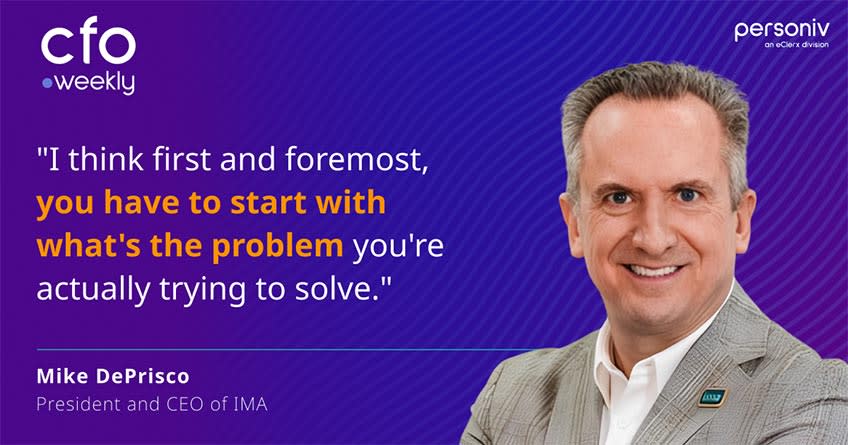
"I think first and foremost, you have to start with what's the problem you're actually trying to solve." DePrisco said. - 00:07:34 – 00:09:50
Measuring AI's Real Business Value
Beyond productivity metrics and vendor promises, Mike says CFOs should measure AI investment against real business outcomes: new value created for customers, new value created for internal teams, and improved decision-making capability. He points to fraud detection as an example, better accuracy means fewer customers wrongly inconvenienced by locked accounts, while improved forecasting gives finance teams more confidence in the decisions they make.
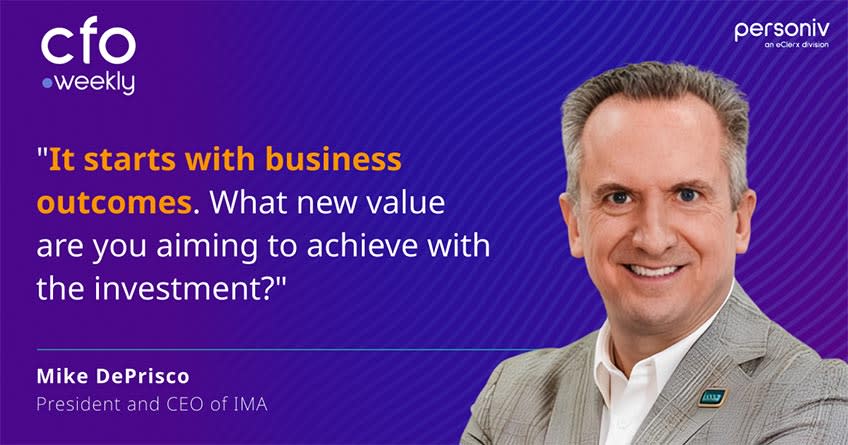
"It starts with business outcomes. What new value are you aiming to achieve with the investment?" DePrisco revealed. - 00:10:02 – 00:12:29
The 37% Data Trust Problem
AI cannot fix a broken process, Mike warns; it only makes the problem move faster. IMA's latest research found that data quality is the top readiness concern among CFOs, and the finding that stands out most is that 37% of CFOs say they don't trust their own data. Mike's advice for organizations unsure if they're ready: don't wait for perfection. Start with a narrow, well-defined project, test and learn in a safer environment, and use those lessons before scaling.
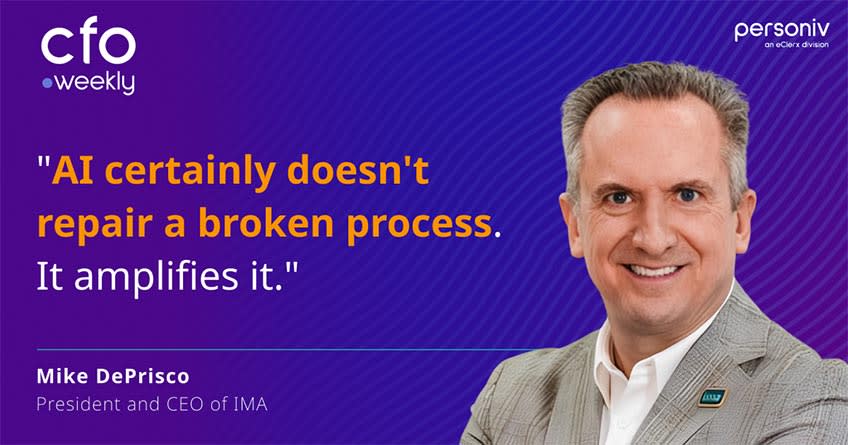
"AI certainly doesn't repair a broken process. It amplifies it." DePrisco remarked. - 00:12:52 – 00:15:23
The CFO Is Becoming an Enterprise Business Leader
Mike sees the CFO role expanding well past its traditional boundaries over the next three to five years, increasingly overlapping with the COO function as operational decisions carry bigger financial implications. As organizations need to move fast and respond to uncertainty, CFOs are shifting from the historic “department of no” reputation into the enterprise leaders who connect financial insight to strategy and safeguard the organization's overall health.
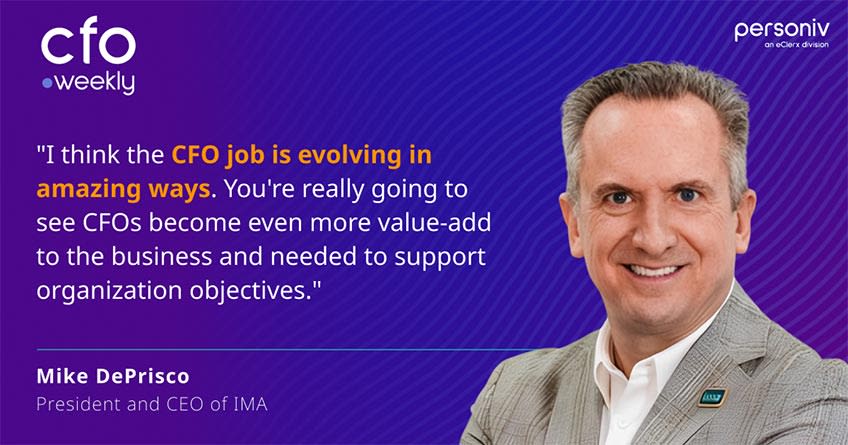
As DePrisco put it, "I think the CFO job is evolving in amazing ways. You're really going to see CFOs become even more value-add to the business and needed to support organization objectives." - 00:23:38 – 00:25:57
Want more insights? Explore our full library of podcast blogs here.
To listen to the full conversations, check us out on Apple Podcasts, Spotify, and our RSS or your favorite podcast player!
Instructions on how to follow, rate, and review CFO-Weekly are here.
Understanding why AI governance belongs in a dedicated center of excellence takes time and strategic oversight. We provide scalable, dedicated accounting professionals to manage your daily operations so you can focus on leading your enterprise's AI transformation. Drop us a line today to learn more.


