


In this episode of CFO Weekly, Rick Hasselman, Chief Financial Officer at Clari + Salesloft, joins Megan Weis to explore what it takes to lead a finance organization through a major M&A integration, exactly why finance leaders need to communicate the "why" behind a merger, why collaboration between finance and go-to-market teams has become essential for scaling modern SaaS businesses, and how an unconventional path can prepare leaders for today's CFO role. Rick brings more than thirty years of finance and operational leadership experience with a career that spans audit and transaction services at PwC, mergers and acquisitions at Google, and CFO leadership at high-growth technology companies including Sumo Logic, Podium, and Expel.
With hands-on experience guiding teams through system integrations, cross-functional alignment, and the emotional uncertainty that comes with organizational change, Rick shares how he keeps finance teams focused and engaged during a merger, why guardrails matter more than rigid rules when balancing growth and risk, and why the biggest lesson from every deal he has closed is that integration always takes longer than the plan says it will. He also unpacks how artificial intelligence is beginning to reshape the relationship between finance and revenue teams, and what it means for a CFO to become an orchestrator of AI agents rather than just a steward of the numbers.
Show/Hide Transcript
Megan - 0:52
Welcome back to CFO Weekly. Today, I'm joined by Rick Hasselman, chief financial officer at SalesLoft, where he is helping lead the finance organization following the merger of Clari and SalesLoft. Rick brings more than thirty years of finance and operational leadership experience with a career that spans audit and transaction services at PwC, mergers and acquisitions at Google, and CFO leadership at high growth technology companies, including XPEL. His journey from M&A finance to leading finance organizations at $300,000,000 plus enterprises gives him a unique perspective on growth, transformation, and strategic leadership. In this episode, we'll discuss what it takes to successfully lead finance teams through a merger, why collaboration between finance, sales, and revenue teams has become essential for scaling modern SaaS businesses, and how an unconventional path through M&A can prepare leaders for today's CFO role. Rick, thank you so much for being with me here today, and really looking forward to this conversation.
Rick - 1:56
Great. Thanks for having me. Appreciate it.
Megan - 1:58
So if you think back to the early days working in M&A at Google, was there a particular deal or maybe an experience that made you realize that you wanted to move from advising businesses to actually helping lead one as a CFO?
Rick - 2:14
I think it even goes back before then out of business school. I rejoined PwC in transaction services and did a lot of deals, M&A deals for corporate entities that were buying smaller companies or spinning one out, and then also did a lot of deals for private equity where they were acquiring companies that I'd meet. I'd meet founders, I'd meet who are now my peers, CFOs at these companies, and I'd get to learn a lot about how they drove revenue, what made the businesses tick. And I've just found it interesting to dig beyond the numbers and understand the different functions and how they came together and who their suppliers were and who their big customers were. I really liked all aspects of business as I dug into those transactions more. And then when I joined Google, I did quite a few deals there. The biggest one I did was when they acquired Motorola Mobility for $12,000,000,000, and then they subsequently spun parts of it off. But in doing that, I met a lot of folks who then went on within Google to start CapitalG, which is their growth stage venture arm. And I joined that after I did a lot of those transactions at Google and joined their arm. And I met a bunch of folks who ended up being my peers again as CFOs of these growth stage companies that Google was thinking of investing in through CapitalG. And a lot of times, I was just impressed with their knowledge of the business, things like go-to-market motions and how the pipeline was progressing, how the forecast and productivity and capacity planning, all that was coming together. From my diligence days, these folks seem to be pretty dialed in on what's running the business and where the costs are. Then I'd meet other folks, and I'd say, well, wait a minute. I think they should know some of this stuff. And in doing that multiple times and meetings to a lot of smart people, I said, I think just by all this exposure, I love it at Google, but the reality is I'm a small cog in a big machine at Google. Couldn't it be more impactful and see more of a business if I joined one of these growth stage companies and really dug into all aspects of it, not just having to build and run the finance org, which I enjoy doing and working with my peers in that, but also working with the CRO, working with the chief product on the roadmap and how you build a revenue plan off of that and building a capacity plan for sales and understanding how much pipeline we need and why and where it should come from for marketing spend, this feels like an operator, and this is interesting to me. And so I think it's a culmination of a lot of experiences, including those at Google that led me down the path of wanting to kind of do more and be not just a finance person in a really great company like Google, but perhaps an executive who had more of an operational role in another company. That led me to make some decisions that now I think this is the fourth stint I've had as a CFO in software. So it's been great, but there was probably a series of things that led me to want to go this route rather than staying at a larger company in a smaller role.
Megan - 5:25
Sounds like you've had an amazing career to date. And today, you're helping lead finance through Clari and SalesLoft's merger. So what's been the biggest lesson that you've learned about leading people through a merger as opposed to simply integrating systems and financials?
Rick - 5:42
We've made a lot of progress. There's still some work to do in terms of the integration around areas like our combined price book and things like that that we'll go to market with here shortly, but a lot of the systems work's been done. It starts with a plan. Obviously, it starts with a work plan and timelines and key responsible parties and stakeholders that need to be consulted along the way. You pick systems. You move from one to another. You integrate. You have a detailed plan that you test and sandbox before you go live. So I think most people understand the nuts and bolts of building out a detailed plan and executing, but really helping the team understand why are we picking one system over another, why this timeline, why these requirements, what does it help the business achieve longer term as we combine these two entities and really seek to cross sell all the various solutions we have for the thousands of customers we have that we would not have otherwise been able to do. And so helping them understand the why and the timeline behind it. The longer these things take, the more distracted you get and less you can focus on driving the business forward. So you really have to have some compressed timelines if you can help it on integration planning. And so I think those are key. It's painting along the lines of why in terms of small picture things. The timeline and getting to things like the ability to cross sell are great, but then you have to be able to level it up and say, from a strategic standpoint, what's the big why? Why do these companies come together? What's the synergy overall from a revenue standpoint that we can hope to achieve in combining what we have here are three best-in-class legs of the stool with forecasting, with sales engagement, and then conversational intelligence, and that's pretty unique to the market. And so not everybody in the business understands all of that from a product perspective and what it could mean for the business in the future. So articulating those things, I think, is helpful for people to understand, like, oh, okay. That does sound like a more powerful solution for our user base if we can make all this work internally. I think those are keys. And then lastly, it's probably just around timely communication. You want people to get together virtually, mostly, weekly with some sort of status update on how things are going. Celebrate some wins. Hey, we got this data migrated over. Great job, team. I know some people worked the weekend. Making it clear that you understood the effort that was involved, but then also being there to hear what blockers might come up. Because that's where sometimes people get frustrated because there are ultimately going to be blockers or things that come up that you didn't anticipate early on and you want to be there to listen and help diagnose the real problem that's causing the delay or the issue, help offer up some solutions with the team. So I think people want to feel heard through the process, which can be pretty cumbersome and lengthy and know that there are people there to support inevitable roadblocks that come up and help you push through them, and then understanding some of the bigger whys of why we did the whole thing in the first place. I think it can help as you work through all the details.
Megan - 8:56
And during a merger, uncertainty can spread quickly across finance teams and oftentimes what they're imagining in their own minds is worse than reality. So how is it that you keep people focused and engaged while so much is changing around them?
Rick - 9:12
I think some of the things said earlier about the why is important, but then also individually helping them understand why this kind of work is helpful to their career progression because if they are needle movers in the process to getting things done, if they are impactful, if they take ownership, they're going to inevitably learn a lot about how systems and businesses come together, and so those are transferable skill sets. And so as you go through your career, you have opportunities to jump into areas that are maybe large in scale or significant in complexity, and if you're one of the people who helps work through those things and those challenges, one, you learn a lot, and, two, you become more valuable both within the business and in the marketplace in general. I think appealing to people's ability, and finance, generally speaking, has a lot of folks in it who are naturally curious about both business and transactions, and so you can usually find people who will raise their hand and then you want to encourage that and give them the opportunity to go beyond their day-to-day activities and learn something new and different because as you progress in your career, obviously, a lot of people want to move from an IC role to a leadership role and having some breadth of experience across other areas like M&A, I think are important aspects to try to gain when you can. So I think that's appealing to a lot of finance folks, and we're generally pretty organized and can help project plan and help bring other teams along. I also think it's a great opportunity for some finance folks to get the opportunity to speak, maybe not publicly, but just in larger team meetings than they're used to speaking in, and so I think that's a career progression opportunity as well to present how plans are evolving and coming together. And so I just think there's a lot of good things to anchor on in terms of a transaction. You might also get exposure to the key investors, which is always something that's interesting I think for a lot of folks is to really know, okay, what do these people think about? And the more you're involved in getting a transaction done and getting it integrated, the more likely you are to have exposure to the board and to key investors. I think these are all great for your career progression and seeing how other people think about the problems. So with all the challenges that are involved in a merger and all the migration integration work, there's also a lot of opportunities for those who look at it in that lens. I try to make sure that people see that too.
Megan - 11:41
And finance often owns the integration plan, but successful mergers require much broader collaboration. So how have you seen sales and finance work together to create value rather than simply combining two operations?
Rick - 11:57
Yeah. You have to. Even outside of a transaction, the sales leadership and the finance leadership have to be working together. I think ultimately this isn't unique, but what I believe is we all own the number. So our CRO has a bookings number, has a retention target every quarter, so it's a net number. We all own it. The success of the business is driven largely based on its revenue and its obviously efficient operations, but you need to drive revenue in a business. And so just having a real partnership around, okay, what are the resources that we need that are focused in the right way to help you, sales leadership, hit your numbers? You need obviously marketing program dollars. You need enough sales capacity or reps to be in seat and to be working pipeline and building pipeline. You need support from sales engineers, from folks in the customer org. You need information on how the product roadmap's progressing. And so it really takes everyone's concerted effort and aligned effort to drive revenue effectively. And so you have to go and do it with that partner mindset. It's not, oh, finance wants this or finance wants that. It's like, okay, we understand the constraints of a business because all businesses have constraints. What are the constraints we have to work in from a spend perspective or a timeline perspective? And then within those, once everyone kind of understands them, how should we optimally deploy the resources? How many reps? How much program spend? How should we think about the overall model of driving revenue? And so I think when you really get down to it and work with good partners in revenue, you can get aligned. And once you're aligned on what those investments need to be and what the key milestones along the way need to be in terms of how pipeline progresses throughout the quarter, how deals progress throughout the quarter, the work, it doesn't feel like it's finance and sales. It feels like it's just folks trying to hit the number. And so that's what I find is just the more you can communicate about why the number's important, why they are kind of the building blocks of what we need to do in terms of resourcing the business and partner and be able to listen to a sales leader who might want to allocate resources from one bucket to another, I think you can develop a really good partnership. And then it's not just separate orgs. You break down the silos and you start working together on achieving the outcome, which is ultimately we got to hit our number. So I think those are kind of some of the concepts that we as finance folks try to bring to the table when working with our sales peers.
Megan - 14:42
And every CFO wrestles with the tension between protecting the business and accelerating growth. So how do you personally decide when finance should slow the organization down versus when it just needs to get out of the way?
Rick - 14:56
There's a lot of things you can do here. I think what I've tried to do, and it takes a little time when you're merging two companies, is you set guardrails or rules of engagement to say, okay, if a particular deal in sales, for example, is in either enterprise segment or a commercial segment, and it has certain attributes, discounts below a certain level, payment terms within a certain range, other attributes as well, if it has all these different components to it, it sales right through. It doesn't need a heavy hand from finance review in terms of gross margin analysis. It doesn't need heavy input from Deal Desk. It can get done the order form. The quote can get submitted and issued rapidly, and you can get back to consultative selling with the customer. And so that is what we look to do from an operational standpoint. We kind of set it depends where you are in your phases. If you're a public company, as a CFO, you probably have to set kind of guardrails that are more akin to, let's say, a two lane road. There's not a lot of room to move around, but there's some. But in our phase as a privately held growth stage company, we might have a four lane highway. And so I can give a little bit more in terms of what's acceptable to get a deal done because we need to move fast and we're not subject to earnings per share expectations of the stream. We have to hit certain targets around revenue and EBITDA and free cash flow and the like, but you have room to maneuver within those. So that's kind of operationally how I think about it. And then bigger picture, you look at the results. You look at as you progress through a quarter, you can start to see trends emerge. You can see how spend is trending in the quarter versus what the plan says, and that can dictate whether you need to slow or speed hiring. You could see how the forecast for both bookings and retention are progressing throughout the quarter, and that can also drive resource allocation decisions, whether you slow down or speed up. And so I think the quicker you can get in this case, an integration done and start to get one set of data to work from, you can make informed decisions throughout the months and quarter to make sure that by and large, given what you think you're going to produce, if it's on plan, good, then you spend on plan. If it looks like you're going to be ahead, well, maybe release a few more dollars for an extra sales rep or an extra event for marketing to drive more pipeline, or you slow some things down around hiring or backfills to try to just maintain the overall net approach to the plan. So for existence for example, you can still hit an EBITDA target even if you're slightly behind on revenue because you can just manage the underlying costs of the business as you go. So I think there's guardrails that set operationally so people can just go about their day and try to do their best, and then there are decisions you can make somewhat real time as data starts to come over the transom as you move through a quarter. Those are the things we try to balance out with the leadership team.
Megan - 18:02
And looking back across Google, Sumo Logic, XPEL, and now SalesLoft, what's one lesson about scaling a business that you've had to relearn at every stage?
Rick - 18:12
You really have to figure out, are you ready to scale? And what does scaling mean? It means different things for different people. So if you're talking about scaling a revenue org from 10 reps to 20, well, what is telling me that I should be doing that? And is it across all segments? Is it a specific segment? Is it a specific region? And so what you would look at is you'd obviously look at things like rep productivity. You'd look at pipeline build. You'd look at trends in the business there, and then you'd also get a sense for our ability to support that internally. To me, it's really getting pretty into the details on what scaling means and how we're going to measure whether it's working. Because, for example, just going out and hiring a bunch of people because it's time to scale is usually not a great answer unless you have more revenue and opportunities coming over into the inbound side that you know what to do with. Then clearly there's a scaling opportunity. But otherwise, it needs to be a bit measured. What's going to tell us that it's time to unlock more and to grow faster and to put more resources against an opportunity? And so you got to look at the productivity. You got to look at the number of opportunities coming in, and then you've got to take a few bets. You've got to make a few bets to say, okay, we have a roadmap for our product. We understand from talking to our leadership and also our board that if we can execute on this roadmap, we feel like we'll be introducing some unique competitive advantages in the marketplace such that we can scale revenue faster and grow more and take more market share, well, okay, we're going to have to get a little ahead in R&D hiring. And so that's a bet you make. And then how do you monitor that bet? Well, you have a product roadmap and you have milestones and release dates on that roadmap. And you see if you're holding to those, you get some sort of beta test in the market. You judge whether the average or case probably daily usage is such that it looks like it was the right bet. And then you go faster, and you scale the production of that to get it what you call GA. And then if you see the momentum behind that, well, then maybe it's time to increase marketing spend behind it. And then as that starts to produce more pipeline, maybe then it's time to hire more sales reps. So there's a lot you can do to really get to the details of the business by segment based on where you're trying to scale to see if efforts, one, the right time and, two, to the right degree.
Megan - 20:49
And having worked on both the deal side and the operating side, what's something that executives often underestimate about the work that begins after the transaction closes?
Rick - 21:00
It always takes twice as long as you think. We all create the Gantt charts and the roadmaps and the plans, but for whatever reason, they just, well, more people and things come up and issues arise that you can't always anticipate. So it takes longer, and so you have to understand that. You have to kind of know internally. I think it's always great to drive to a tight deadline, and you can't burn people out, but there are certain times when you try to meet a deadline and so, yeah, people understand the need to put in some extra work. It's not sustainable. So you have to understand, all right, is it time to release the pressure a little bit because these deadlines just there's too many new things that have happened or things we didn't anticipate that are driving an increase to the amount of time needed to do this. And so that's okay, but you just have to get your arms around it and rethink the plan. I mean, planning is indispensable, but plans are useless, I think, or is something I think that was an Eisenhower quote maybe. So you have to understand that the plan is a fluid thing and you set your best original plan and you try your best to execute against the real key milestones of it, like getting from two of our ERPs to one. But then there are other areas which just may take a bit longer, and you got to understand that's probably going to happen. So I think that is the one major learning that I've had several times now. And the other one is you got to look for some quick wins as well to help people understand why you'd put the companies together in the first place. And so for us, that would be really looking at the cross sell opportunities between the two customer bases that came together. And there are a lot of them. And so making that a priority, even if it's not pretty, but getting the data together in a way that says, okay, here is all of our customers across the two businesses, Clari, SalesLoft, here's who has what, and here, based on the attributes that we can ascribe to our customers based on their size, their industry, their size of their sales teams, in our case, etcetera, we think they'd be a really good prospect for cross sell product A or B, and then start putting together some quick marketing collateral and programs and incentives for your rep base to go do it. And so that's a whole other area of potential revenue growth that you really try to seize on sooner than later, even before systems are merged and workflows between the new Salesforce from one business and the other are merged together. You can go attack expansion opportunities, and I think that's good for momentum. It's good for morale, and it's also a way to start bringing some of the incremental revenue in the business, one of the reasons you did the merger in the first place. So quick wins and then understanding some aspects of an integration plan are likely to slip and just knowing why and being able to adapt, I think, are some key points.
Megan - 23:54
I'm just curious, speaking of morale, what are some of the or one of the hardest conversations that leadership teams often avoid having that maybe they should be prioritizing? Should Band-Aids be ripped or should people be protected? What are some of those hard conversations?
Rick - 24:10
It's always a tough one because ultimately in a merger, there are going to be duplicative roles and you don't need two of everyone in a business. So there are some tough decisions to make. I think as soon as you know what those decisions are, they should be communicated and you need to work with people to identify new opportunities for them to the best of your ability. But that's always a challenge is I think even if you can deliver some high level views early on to say, hey, this is the combination of two business entities, there are some headcount redundancies that are clear. You don't need two CFOs.
Megan - 24:51
Right.
Rick - 24:51
One. And so then I think people can understand, all right, well, I have a couple choices here. They don't know yet how all that's going to come together, but clearly there's redundancy in the business. If I believe in this merger and I think it's an exciting place to be, I'm going to do my very best to make myself stand out and be one of the drivers of this newly merged company and the work that has to go to get it done, or, boy, this sounds like a lot of work and I don't know. I've already been here four or five years. Maybe it's time for me to start looking for my next adventure. Both are fine answers to the question, but I think the sooner that leadership can at least directionally say, look, we have 3,000 employees, and we probably need, based on duplicative roles, to find a way to get down to about 2,000 over the next six months and give them a time horizon, then I think people can start to make their own decisions. Do I want to be part of this? And do I feel like I have a lot to contribute, or is it time for me to go think of my next adventure? And I think those are fair things to offer up to people early on. And then for those who really want to stay, I think it's incumbent on them to say, all right, let me talk to my manager. Let me make sure I'm plugged in to what this business really needs, and let me make sure I'm doing a good job helping the company achieve those goals and, quite honestly, being my own advocate while I do it. And so I think there's opportunities for those who want to try to excel in times of transition, and then there's also an opportunity for people to reflect on whether it's time for the next adventure. And to me, the sooner you can give people the broad strokes that there is probably a roughly whatever the timeline, six, nine month timeline, before some of those decisions seem to be made, then I think people have plenty of time to act accordingly and make the best decisions for themselves. Because that's obviously that's the biggest thing that people are concerned about when two companies come together. It's like, well, what does that mean for my role? And I think you start having detailed discussions with your manager and you lay out your career path and what you're excited to go and do. And if it aligns to what the business needs, well, then you dig in and you really show that you're a key player in doing it. And to me, like, top talent is always critical and hard to find, so people with the growth mindset, the willingness to diagnose and solve problems and to learn and to be accountable, they're always going to be in high demand. And so if that's how you position yourself within a business, I think you can succeed and obviously be part of the business going forward.
Megan - 27:23
Great answer. And as AI becomes increasingly embedded in revenue operations and forecasting, how do you see the relationship between finance and go-to-market teams evolving over the next few years?
Rick - 27:32
What we'll need to do is we're going to continue to get to the so a lot of what happens is sales will come up with its forecast, finance will come up with its forecast, and we'll triangulate between the two. But I think it's going to converge even more as we go. And one of the reasons I think that is it's how our platform is evolving. The Clari/SalesLoft platform is really being reimagined with this AI native approach in terms of we have this amazing kind of data layer from the merged companies for many years of transactions and sales engagement and conversations and forecast inputs versus target achievement, and we have all this rich data. We have more being added every day. And so on top of that, you can kind of have a context layer that informs the sales team on what the next best action is to go and take, and then our agents that we're building out can go and do the action for you, and it could provide this feedback loop that says, okay, that was successful because you got a booked meeting or you're able to progress the pipeline from stage one to stage two. And as all that data continues to get identified and enriched for us, we're going to be using our platform more and more internally to be aligned and to use Clari to look at the forecast and the pipeline progression of the deals. And so finance and sales will more and more speak from the same or sing from the same sheet of music, so to speak, because we'll be using that kind of internal data that our system produces. And, obviously, then our customers can get the same results if they work with us on where we're taking the platform. So bit of a specific question or answer based on what we're doing, but I do think it's applicable. And other businesses can do it in other ways, but I think AI and feeding it the signals and the data are going to be increasingly critical to fine tuning forecasts and that's best action that we'll be able to help you take within our platform. But to me, that's the key is really leveraging these technologies to get the best next step to go and take to close the deal. And then to use all the signals that are out there to really hone in on the accuracy of the forecast. There's just an unprecedented amount of analysis you can do now at the drop of the hat to really layer in all the various signals of what's happening in your deal flow to know how good your forecasting is. We're building a lot of that into our platform today, and we'll just keep leveraging it in finance as well. So we'll be lockstep on how the business is progressing with our sales partners.
Megan - 30:20
And last question, but looking ahead, how do you see the role of the CFO evolving over the next three to five years and what new skills or mindsets are going to be critical?
Rick - 30:31
Having a growth mindset is I think always critical for this role. We're in a unique seat where we see so much and we can frame it in numbers across different parts of the business, sales, like we've talked about quite a bit and what some of those key metrics are, what an engineering org needs to look like at scale in terms of its ratios, in terms of its things like code pulls and how it's progressing versus the roadmap. You could just really put data behind everything. And so I think CFOs are going to need to continue to be consultative to the business and help them understand the constraints within the business and how they can operate within those to achieve their targets, which then ladder up to us hitting revenue and EBITDA targets. And so I think continuing to be curious about how the business works and understanding the key levers that exist within the business to help it go and how to adjust those as the quarters progress and work with your peers across the leadership team to do it. And then I think as we go, one of the things we're doing now is since we've got these two companies coming together is we can reimagine all of our workflows, and that's going to be the biggest challenge is it's easy to say, okay, I have a workflow that does this in accounting. Well, where can I just plug in AI to help me a little bit? And that's interesting, and we're doing some of that, but I think the more interesting question is, well, what should this workflow look like if it was driven by an agent from start to finish? I think it would probably look a little different. So what you have to do is you have to kind of disaggregate all your processes and you have to break them down into, I guess, first principles and say, okay, how does this process work, whether it be how a deal goes from quote to cash? How does that work? What systems need to be talked to? What checks need to be made? What things might a human in the loop need to review? And if you can think about your workflows in that way, not just a CFO, but using CFO maybe type examples with accounting in this case, what you could start to do is you could start to become an orchestrator of agents, I guess at CFO level and then at the controller level, at the accounting manager level, at the FP&A level. And if you have the workflows reimagined based on the outcomes you're trying to achieve, because obviously agents and AI is goal seeking. And so what are my goals? What are the safety measures that have to exist within those workflows around human in the loop, checking a journal entry before it's actually booked or reviewing some sort of payment before it goes out? What are the ways I need to orient the agents so that I get the same answer every single time in a certain analysis? Because in finance, we have to be consistent. And then how do I do it at scale? How do I do it with one person directing five or six agents? Couple years ago, it would've been three or four people. And so I think there's a whole interesting new world coming online here with how you can rethink what it means to run at scale and do it with a mix of people who have obviously expertise and context and knowledge that the agents need to know, but you can do it a lot more effectively, efficiently, and spend more of your time, one, obviously, directing and fine tuning the agents, but, two, being more consultative across the business or at least in your own department around what's the next thing I can be looking around the corner on to help this business grow. And so I think it's like an unprecedented opportunity for those who are willing to be self learners and dig into all the things that you can do now to really reimagine a lot of how, at least, finance operates in the future.
Megan - 34:25
Rick, this has been such an interesting topic, and I appreciate you taking the time today to share your knowledge with us.
Rick - 34:33
Sure. I hope it was helpful. I was happy to do it. So thank you for the time, Megan.
Megan - 34:36
Yep. And to all of our listeners, please tune in next week. And until then, take care.
What You'll Learn:
-
Why finance leaders need to communicate the strategic "why" behind a merger, not just the timeline
-
How framing integration work as a career opportunity keeps finance teams engaged through uncertainty
-
Why finance and sales must operate as true partners who "all own the number"
-
How to set guardrails that let a business move fast without losing financial discipline
-
Why every integration takes longer than planned and how to protect morale along the way
-
How AI and agents are turning the CFO into an orchestrator of finance workflows
Key Takeaways:
Why Finance Leaders Need to Communicate the "Why" Behind a Merger
For Rick, successful integration starts with a detailed plan, timelines, and clear ownership, but the real work is helping people understand why a particular system, timeline, or requirement was chosen and what it helps the combined business achieve. He points to consistent, timely communication, celebrating wins, and being present for the roadblocks that inevitably surface as the difference between a team that stays engaged and one that stalls.
"The longer these things take, the more distracted you get and less you can focus on driving the business forward." Hasselman noted. - 00:05:25 – 00:08:56
Turning Uncertainty into Career Opportunity
Merger uncertainty can spread quickly, and Rick's approach is to help finance professionals see the moment for what it also is: a chance to build transferable skills, gain exposure to investors and the board, and stand out as someone who takes ownership. Finance teams tend to be naturally curious and well organized, which makes them well suited to lead integration work if leaders give them the opportunity and the visibility to do it.
"If they are needle movers in the process of getting things done, if they are impactful, if they take ownership, they're going to inevitably learn a lot." Hasselman revealed. - 00:08:56 – 00:11:41
Sales and Finance: We All Own the Number
Rick believes finance and sales cannot operate as separate silos, especially during a merger. Both functions share ownership of the revenue number, which means finance's job is to understand sales' constraints and deploy resources, whether that is program spend, sales capacity, or engineering support, in the way that best helps the business hit its target. When that partnership works, the work stops feeling like finance versus sales and starts feeling like one team trying to hit the number.
"We all own the number." Hasselman remarked. - 00:11:41 – 00:14:42
Quick Wins and Realistic Timelines
Every integration takes longer than the Gantt chart suggests, and Rick has learned to treat the plan as a living document rather than a fixed commitment. At the same time, he prioritizes early, visible wins, particularly cross-sell opportunities between the combined customer bases, to build momentum and remind the organization why the two companies came together in the first place, even before every system and workflow is fully merged.
"Planning is indispensable, but plans are useless." Hasselman commented. - 00:21:00 – 00:23:54
The CFO as Orchestrator of AI Agents
Looking ahead, Rick sees the CFO's role shifting from directing people to directing a mix of people and AI agents. Rather than layering AI onto existing workflows, he encourages finance leaders to break processes down to first principles, decide where a human needs to stay in the loop, and reimagine what a workflow would look like if an agent ran it end to end. Done well, this lets one person do the work that used to take a team, while freeing up time for the strategic, consultative work only a CFO can do.
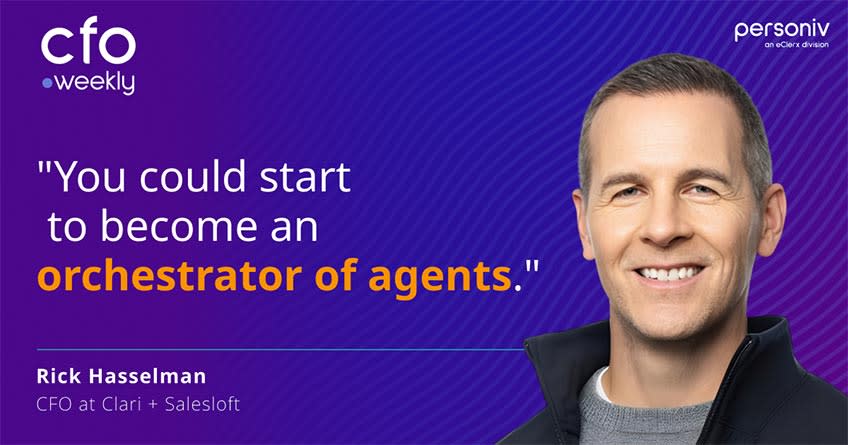
"You could start to become an orchestrator of agents." Hasselman mentioned. - 00:30:20 – 00:34:25
Want more insights? Explore our full library of podcast blogs here.
To listen to the full conversations, check us out on Apple Podcasts, Spotify, and our RSS or your favorite podcast player!
Instructions on how to follow, rate, and review CFO-Weekly are here.
Understanding why finance leaders need to communicate the "why" behind a merger is critical, but integration takes serious bandwidth. We provide scalable, dedicated finance teams to handle the day-to-day operations so you can focus on leading your people through the transition. Drop us a line today to learn more.


