


In this episode of CFO Weekly, Jill Howe, Chief Financial Officer at Lineage Cell Therapeutics, joins Megan Weis to explore how finance leaders can modernize their teams through technology, uncover the biggest automation opportunities in biotech finance, and keep people at the center of transformation. Lineage Cell Therapeutics is a biotech company developing innovative cell therapies for conditions including spinal cord injury, age-related macular degeneration, and cancer.
Jill brings more than two decades of leadership experience across biotechnology and pharmaceutical organizations, with deep expertise in building operational infrastructure, scaling finance functions, and partnering with executive teams to execute long-term strategic vision. Having helped grow Gossamer Bio from six employees to over 200 and currently serving as CFO at Lineage Cell Therapeutics for nearly four years, Jill shares how she evaluates technology investments, fosters team adoption, and ensures that automation serves people rather than replacing them.
Show/Hide Transcript
Megan - 0:57 Today, I'm joined by Jill Howe, Chief Financial Officer at Lineage Cell Therapeutics, a biotech company developing innovative cell therapies for conditions including spinal cord injury, age-related macular degeneration, and cancer. Jill brings more than two decades of leadership experience across biotechnology and pharmaceutical organizations, with deep expertise in building operational infrastructure, scaling finance organizations, and partnering with executive teams to execute long-term strategic vision. In this episode, we'll explore how finance leaders can modernize their teams through technology while also investing in talent and organizational growth. We'll discuss how automation and AI are reshaping finance operations, what skills modern finance teams need to succeed, and how leaders can balance innovation with the human side of transformation. Welcome to the show, Jill.
Jill - 1:49 Thank you so much for including me. Happy to be here.
Megan - 1:53 As you think back earlier in your career, was there a moment when you realized that building a strong finance organization was just as much about developing people and processes as it was about managing numbers?
Jill - 2:09 Absolutely. The people side of our business is really important. Without the teams that we build and cultivate, what are we doing here? Technology is very important, but I view it as a tool. Very early on in my career, as I had the opportunity to be brought into the sector and really raised by some phenomenal people, it was very evident that the investment in people is the key to driving innovation and success — whether you're in technology or biotechnology.
Megan - 2:41 When companies talk about modernizing finance, what do you think they often get right, and what do they often underestimate?
Jill - 2:51 It's about finding the right system and application for your company — one that's fit for purpose and sized correctly. What gets underestimated is when you bring in tools that overwhelm what you're trying to do. Suddenly the technology is running you rather than serving you. You get excited about a new opportunity and it becomes more of a burden because you're maintaining the system rather than using it to create bandwidth in other areas of your role.
Megan - 3:31 Before we go further, tell us a little about your background — where you've spent your career and where you are today.
Jill - 3:39 I had the great opportunity of growing my career in the San Diego biotech sector. I started out as an accountant with my sights set early on becoming a CFO. I was part of phenomenal companies and management teams, and was very vocal about wanting to learn how to run a business and be part of the decision-making process. I had the opportunity to be part of Receptos, which was acquired by Celgene in 2013 for multi-billions of dollars. That led me to become a founding employee at Gossamer Bio, where I helped build the company from six people to over 200, across 18 companies in a multiple platform setting. That led me to where I am today at Lineage Cell Therapeutics, where I've been CFO for almost four years, partnering with the management team to advance the cell therapies we're developing across our current indications.
Megan - 4:40 For listeners who are aspiring CFOs — what advice would you give them? Was it being vocal about your goals, taking chances, or a combination?
Jill - 4:52 All of that. I also think it's about understanding what the CFO role actually entails — appreciating what you're walking into when you get to that seat. There's a lot of pressure, a lot of moving parts, a lot of teams to support and manage, plus the external component of the role. I was vocal, I was observant, and I built my network and worked hard to make connections across industries. But I also felt it was critical that I understood operations — so that when I'm overseeing teams across finance and the broader organization, I have a strong handle on what they do because I've likely been in that seat at some point. For people who are operationally minded, I think it's a very valuable path. It builds real confidence across the breadth of the business.
Megan - 5:51 I feel like as the CFO role evolves, that operational component becomes more and more important. I'm not sure I would have heard that twenty years ago.
Jill - 6:05 Especially in biotech, there are two distinct phenotypes of CFOs. Because so much of this role involves raising capital, there's a theory that you bring in a former banker. Those individuals are often very talented strategically and in fundraising, but they don't always have the operational background. In a couple of instances in my career, I was paired with CFOs who were former bankers, and it became a real win-win — they'd teach me the capital markets side, I'd teach them the business operations side. It worked out really well.
Megan - 6:43 How do you evaluate which technologies or systems are truly worth investing in versus those that may create more complexity than value?
Jill - 6:52 The number one thing I do is make sure I'm not the only one making that evaluation. I'll make the final decision, but I can't be the one assessing it throughout the process, because I won't be using it as much as the rest of the team. Getting the team involved in the process also dramatically increases adoption. When people are choosing tools because those tools address their own pain points, they're far more likely to embrace them. And I always remind the team: don't over-solve. Don't solve for the edge case — solve for what the system really needs to do for you. When you bring in all the key stakeholders who would be advocating for the tool, you have a much better chance of people actually using it, rather than resenting it and doubling their workload by running parallel processes.
Megan - 8:02 That's great advice — it builds buy-in from the start. In healthcare and biotech organizations, where are you seeing the biggest opportunities for automation and AI within finance functions?
Jill - 8:18 Finance is integrated into the entire organization, so a lot of the opportunity runs through finance but starts elsewhere. One of the biggest areas is working with people in the lab who are procuring equipment and supplies, all the way to clinical teams processing purchase orders and contracts. Creating a seamless, almost Amazon-like user interface — where they go in and order what they need and it integrates back into our systems — is a huge evolution I've seen over recent years and one that still has a lot of runway. It allows team members to do what we actually want them doing: using their expertise to solve problems, be innovative, and advance the science.
Megan - 9:33 When I started this podcast six years ago, it felt like CFOs were slow to adopt new technology. Now it seems like finance is almost at the forefront of it. What's your view?
Jill - 9:58 We've been forced as a community to keep it in our line of sight. At Gossamer Bio, with 18 companies, I had one AP person — because we'd built the technology to handle most of the processing. That was a formative experience. As I think about applying that same approach at Lineage, where we have a very lean cash position and we're in a tough fundraising environment, I have to be thoughtful about every dollar. I don't want to put money into redundant processing roles. I want to invest in people who are problem-solving, who are innovative, and who are advancing the science. Technology enables that by handling the repeatable work with fewer errors, freeing up dollars for what really matters — developing medicine for patients.
Megan - 11:22 How do you balance introducing new technologies while making sure your team feels supported rather than overwhelmed or scared by the change?
Jill - 11:31 It's genuinely hard. When I introduce new technology, the team sometimes catches their breath — and understandably so. We're lean, we have a lot on our plates as a public company. It comes back to bringing the right people in early so they can see the opportunity it creates — how it will eventually take things off their plates. And critically, you can't take a "we're wiping everything out on Monday and it's done by Friday" approach. These are sometimes twelve-to-twenty-four-month initiatives. Real modernization takes time.
Megan - 12:20 What skills do finance professionals need to develop now to stay relevant in this more technology-driven environment?
Jill - 12:28 Above all, remain open-minded. Change is scary and hard, but being open to new ways of running a company or using a tool is going to be essential. That openness enables team development. Human judgment in technology is still incredibly important and desired. We have real threats — cybersecurity, data privacy — and navigating those thoughtfully is part of the job. It comes back to understanding the right fit for your organization and what problem you're actually trying to solve. That kind of clear, flexible thinking is necessary for both existing and future finance leaders.
Megan - 13:23 Beyond open-mindedness, when you're hiring for your own teams, what makes someone stand out?
Jill - 13:33 The ability to be flexible. In my organization, I want people who are entrepreneurial. We're doing exciting things — it's not always going to be comfortable, and we're not always going to know the answer. But if you can be flexible and supportive as we're working through data, understanding information, figuring out how to allocate capital, and being comfortable with a little discomfort — that to me is the real key to success on the teams I try to build.
Megan - 14:03 You've spent years building operational infrastructure inside growing organizations. What separates finance transformations that succeed from those that stall or fail?
Jill - 14:17 Politics can certainly be stifling to advancement. It comes down to tone at the top — having support throughout the organization for innovation and people management, and ensuring teams have the cohesion to move forward. In my industry, it also means keeping the focus on the right outcome for patients.
Megan - 14:41 How has technology changed the way finance partners with other parts of the business, especially in highly regulated industries like biotech?
Jill - 14:51 It's enabled stronger lines of communication. The better the technology, the faster we can get information to other parts of the organization — so they understand their budget constraints and capabilities in real time as they're advancing the science. Any budget is instantly wrong the moment it's set, so we need to be fluid, move capital around, and identify where to redeploy resources quickly. Technology allows me to get an answer to a colleague in three or four days now, instead of three or four weeks.
Megan - 15:29 As CFO, how do you build relationships with leaders in other departments and avoid being seen as the "CF-No"?
Jill - 15:52 I hope that's not how I'm perceived. My mindset is: I can always find the money. If something is important enough and necessary enough, I will find a way to fund it. I'm involved in the core team meetings, so I know what's coming — where the pain points are, where unexpected capital may need to be deployed. I always keep contingency funds in mind — my mother taught me to bury money in the checkbook. I never want to be the person who inhibits the team from solving problems. I do ask: was this necessary and required, or is this curiosity we're chasing? But fortunately, we have a strong team with high mutual respect, which makes that a productive conversation rather than a confrontational one.
Megan - 17:01 Do you ever see a point where AI and automation fully replace a finance and accounting team, or will these roles just continue to evolve?
Jill - 17:21 I don't think so — and I think about it through the lens of the industrial revolution. Machines entered a world that had never seen them before. That was new and scary. This is no different; it's just moving faster. We're still figuring out what AI is truly capable of and how to put the right policies around it to protect confidential information. But I believe technology's role is to handle the mundane and repeatable work so that our highly talented people can use their expertise to think and solve problems in ways that machines simply won't. I don't believe our jobs are going away. Things will look different — but different isn't bad, and our careers have already seen multiple tech evolutions with similar fears that ultimately resolved into something better.
Megan - 18:32 Looking ahead, how do you see the CFO role evolving over the next three to five years?
Jill - 19:13 Technology has always been important and will continue to be. But alongside embracing new tools, we also have to be clear-eyed about the risks — cybersecurity, data leakage, and the downsides of moving fast. The other critical piece is cultivating and developing the next generation of employees, all the way up through the C-suite. Biotech itself is going to advance significantly because of AI's ability to unlock discoveries we haven't been able to reach before. Having the right people in place to support that talent and those breakthroughs is going to be essential.
Megan - 20:06 Jill, thank you so much for being my guest today. I appreciate you taking the time to share your insights and experience.
Jill - 20:12 Absolutely. It was wonderful speaking with you today.
Megan - 20:16 To all of our listeners, please tune in next week. Until then, take care.
What You’ll Learn:
-
Why investing in people remains the foundation of finance innovation
-
How to evaluate and choose technology that fits your organization’s size and maturity
-
Where the biggest automation opportunities exist in biotech and healthcare finance
-
How to introduce new technologies without overwhelming a lean team
-
What skills modern finance professionals need to stay relevant
-
Why AI will not replace finance teams and what it will change instead
-
How to build a collaborative CFO relationship with the rest of the business
Key Takeaways:
People Are the Foundation, Technology Is the Tool
Jill’s conviction that people are the most important investment in any finance organization was shaped early in her career by the leaders who mentored her in the San Diego biotech sector. While technology plays a critical role, she has always viewed it as a tool in service of the team, not a replacement for it. That philosophy has guided every hiring decision, system implementation, and transformation initiative she has led across more than two decades of building finance organizations.
“The investment in people is the key to really driving innovation and success whether you’re in technology or biotechnology.” Howe explained. - 00:02:09 – 00:02:41
Right-Sizing Technology to the Organization: Automation Opportunities in Biotech Finance
One of the most common and costly mistakes Jill sees in finance modernization is selecting tools that are too large or complex for the organization they are meant to serve. When technology overwhelms the team or requires more effort to maintain than it returns in efficiency, it stops being an asset and becomes a burden. Her approach is always fit-for-purpose: choose systems that match where the company actually is, not where it hopes to be in five years.
“You get excited about this new opportunity with technology and suddenly it’s becoming more of a burden because you’re maintaining the system rather than the system. Becoming opportunity for you to have bandwidth in other areas of your role.” Howe highlighted. - 00:02:51 – 00:03:31
Technology Decisions Belong to the Team, Not Just the CFO
When evaluating new systems, Jill is deliberate about not making the final selection alone. The people who will use the technology every day are the ones best positioned to identify what is actually broken and what a solution needs to fix. Including the team in the evaluation process also accelerates adoption, because employees who helped choose a tool are far more likely to use it rather than work around it.
“If you’ve got the team that’s in there that’s choosing the ideas because they understand what pain points they have… I think then you have a better likelihood of people using the system.” According to Howe. - 00:06:52 – 00:08:02
The Biggest Automation Opportunities in Biotech Finance
In biotech and healthcare, Jill sees the greatest automation opportunity at the intersection of finance and operations: procurement, purchase orders, and contract workflows that involve scientists, clinical teams, and lab staff. When those processes are streamlined into intuitive, Amazon-like ordering systems that flow back into finance automatically, the entire organization moves faster and finance teams are freed to focus on higher-value problem-solving rather than transaction processing.
“It’s almost like Amazon. They go in and they order their supplies and that integrates back into our systems… that allows the team members to do what we really want them to do, which is use their big brains to solve problems.” Howe revealed. - 00:08:18 – 00:09:33
Balancing Innovation with a Lean Team: Automation Opportunities in Biotech Finance
Introducing new technology on a lean team is never simple. Jill acknowledges that change causes real disruption, especially in a public company environment where timelines and compliance obligations are already demanding. Her approach is to bring key stakeholders into the process early, help them see the long-term relief the technology will provide, and remind everyone that major implementations are twelve-to-twenty-four-month journeys, not overnight switches.
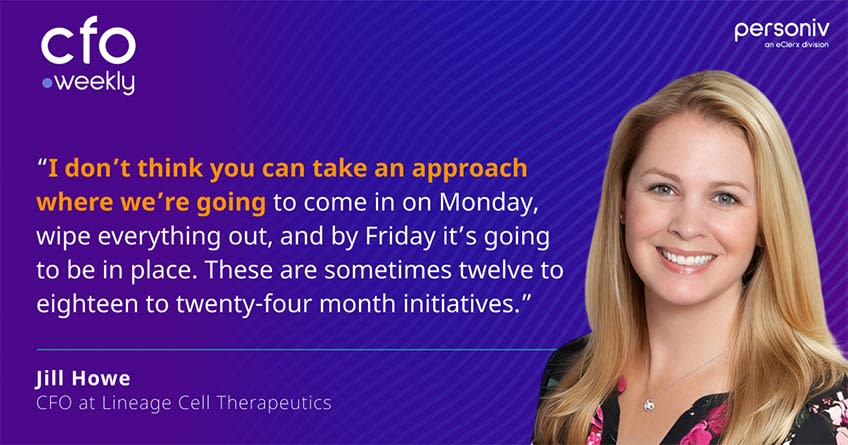
“I don’t think you can take an approach where we’re going to come in on Monday, wipe everything out, and by Friday it’s going to be in place. These are sometimes twelve to eighteen to twenty-four month initiatives.” Howe said. - 00:11:22 – 00:12:19
AI Is the Industrial Revolution, Not the End of Finance
Jill draws a deliberate parallel between today’s AI moment and the industrial revolution: disruptive, fast-moving, and initially unsettling, but ultimately a force that creates new roles rather than eliminating human value. Her goal with automation has never been to reduce headcount but to eliminate repetitive, error-prone work so that talented professionals can spend their time on the strategic, innovative work that machines cannot replicate.
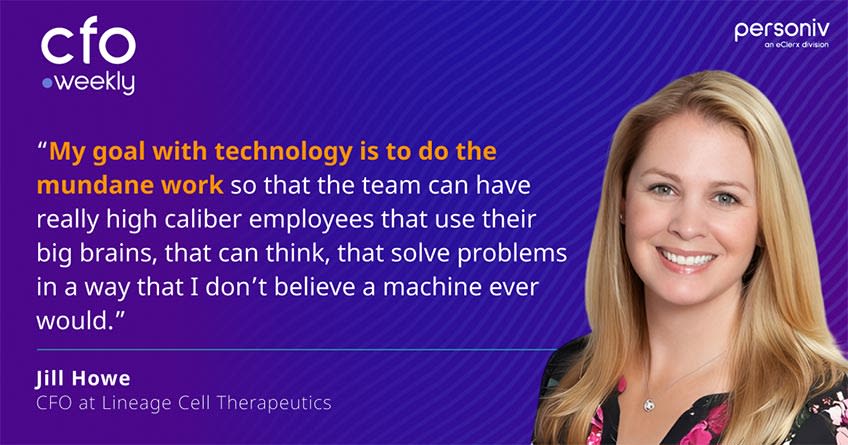
As Howe put it, “My goal with technology is to do the mundane work so that the team can have really high caliber employees that use their big brains, that can think, that solve problems in a way that I don’t believe a machine ever would.” - 00:17:21 – 00:18:32
The Skill That Matters Most: Comfort with Uncertainty
When hiring for her finance team, Jill is less focused on specific technical credentials and more focused on mindset. The quality she values most is the ability to stay flexible and entrepreneurial in an environment where the answers are not always clear. In a fast-moving biotech company, the finance team needs to be comfortable operating with incomplete information, iterating quickly, and supporting decisions as data continues to evolve.
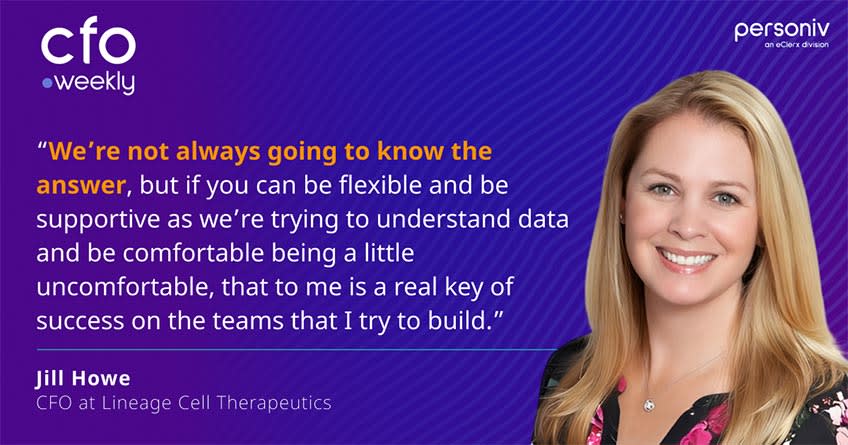
“We’re not always going to know the answer, but if you can be flexible and be supportive as we’re trying to understand data… and be comfortable being a little uncomfortable, that to me is a real key of success on the teams that I try to build.” Howe mentioned. - 00:13:23 – 00:14:03
Want more insights? Explore our full library of podcast blogs here.
To listen to the full conversations, check us out on Apple Podcasts, Spotify, and our RSS or your favorite podcast player!
Instructions on how to follow, rate, and review CFO-Weekly are here.
Unlocking the best automation opportunities in biotech finance requires a team that can handle the day-to-day operations while you focus on innovation. We provide scalable, dedicated accounting professionals to manage the workload so you can lead the strategy. Drop us a line today to learn more.


